Dive Brief:
- Nissan North America has canceled two electric SUV models for the U.S. market that were slated to be built at its Canton, Mississippi assembly plant, company spokesperson Jennifer Swanner confirmed in an email to WardsAuto.
- “The automaker said its decision would “better align with market conditions, customer demand and its updated strategic direction” announced in mid-April that includes the rollout of a new version of its e-Power hybrid technology and the development of plug-in hybrid and extended-range powertrains to serve as a bridge toward EVs.
- “Nissan remains fully committed to the U.S. as a lead market and a foundation for stable returns and sustained growth,” the company said in an emailed statement. “That approach is grounded in leadership in large vehicles, a strong U.S. manufacturing footprint supported by high localization, and a diverse range of powertrain solutions customers want.”
Dive Insight:
The automaker had designated the Canton plant as the hub for its U.S. EV production and announced a $500 million investment in the facility in early 2022 to build the two EVs. Nissan’s other U.S. assembly plant is located in Smyrna, Tennessee.
Last July, Nissan confirmed to WardsAuto that it delayed the 2028 production launch of the two electric SUVs models slated to be built in Mississippi, including one for Nissan and the other under its luxury brand Infiniti.
At the time, company spokesperson Brian Brockman told WardsAuto that the decision to delay production was an “internally driven consideration, not a specific reaction to policy changes,” such as the expiration of the federal tax credit on Sept. 30, 2025, that led to a sharp decline in EV sales in the U.S.
However, since the expiration of the tax credit last year, many other automakers, including Ford Motor Co., General Motors, Stellantis and Honda have significantly revised their mid- to long-term electrification strategies after billions of dollars of EV writedowns amid challenging market conditions, including waning demand.
In December, Ford announced a major shift in its electrification plans toward extended-range hybrid vehicles and new truck models powered by internal combustion engines. The automaker expects about $5.5 billion in non-recurring costs associated with canceling specific EV programs and preparing its plants to produce new models.
GM reported a 55% decline ($3.3 billion) in year-over-year net income in 2025, which was primarily the result of $6 billion in electric vehicle-related charges in Q4.
In February, Stellantis posted a net loss of 22.3 billion euros ($26.3 billion) in FY2025 following its multi-billion EV write-down and corresponding pivot back toward gasoline and diesel models.
In March, Honda also confirmed the cancellation of three EVs for the U.S. market: the 0 Series Saloon, 0 Series SUV and Acura RSX.
Nissan’s updated long-term strategy, dubbed “Mobility Intelligence for Everyday Life,” is focused on its three key global markets, Japan, the U.S. and China, and is centered on a reduced portfolio of AI-powered vehicles with new electrified powertrains. The automaker said it will discontinue low-performing models and reallocate investments to higher-growth areas to improve profitability and market positioning.
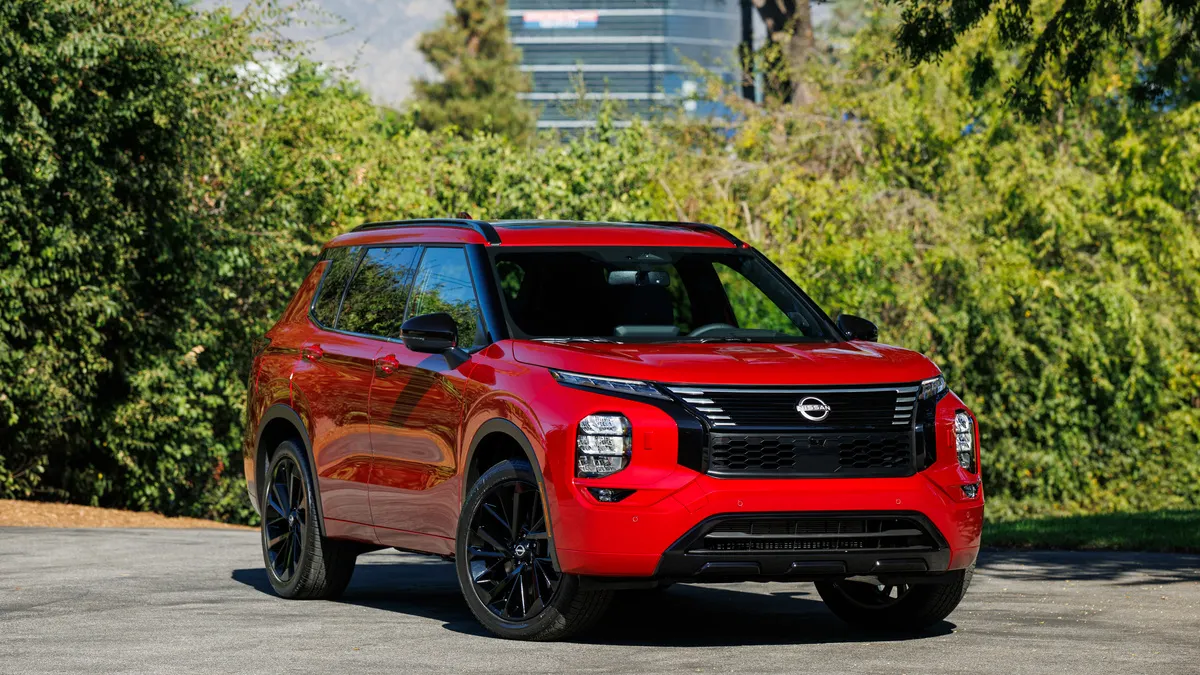
New products for the U.S. market include the new Rogue hybrid that will contend in the highly competitive midsize SUV segment. The automaker said its next-generation e‑Power hybrid technology used for the Rogue will deliver an “electric‑like driving experience.”
Nissan is targeting 1 million annual vehicle sales in the U.S. by 2030, with a focus on larger vehicles and a revised manufacturing footprint. The automaker said it will share more about its new long-term strategy when it reports its full-year financial results in May.