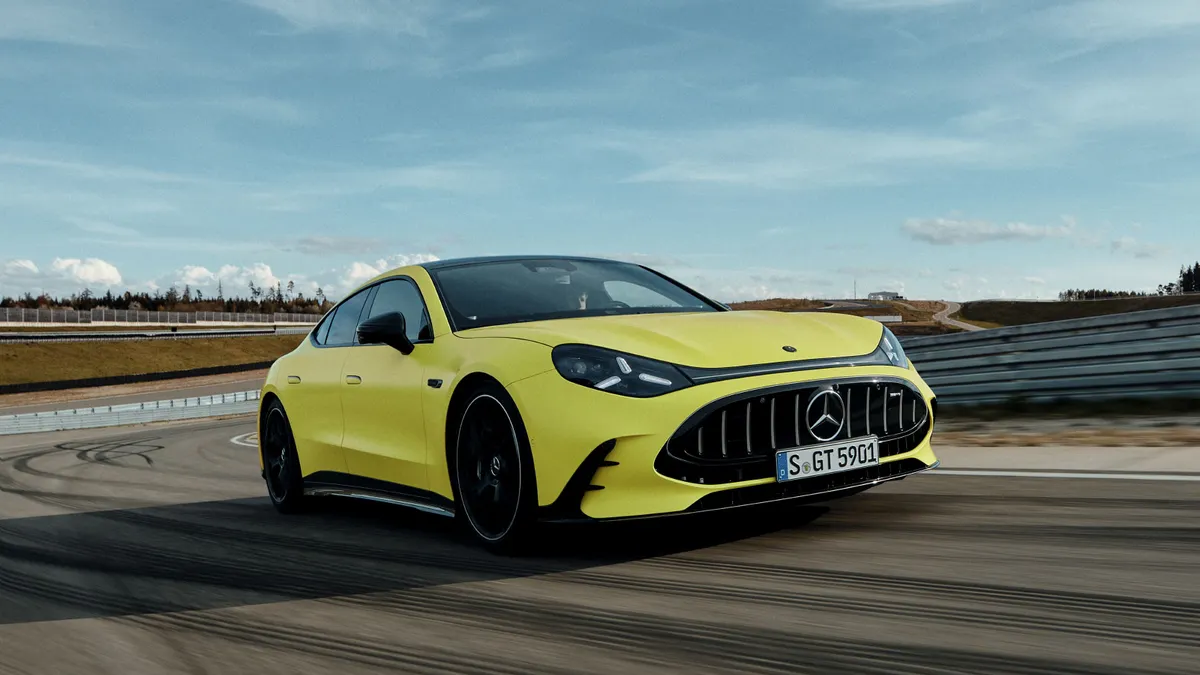
LOS ANGELES — Mercedes-AMG is moving into its own territory distinct from Mercedes-Benz with the second-generation GT 4-Door Coupe, the first series-production model developed entirely on its new, dedicated AMG.EA electric car platform.
Mercedes-AMG’s current line-up supports two electric models, the EQE 53 4Matic+ sedan and SUV. The upcoming GT 4-door Coupe not only introduces a dedicated platform but a whole new technical foundation, from brand-specific electric motors and a unique battery to control systems and operating strategy designed around high-performance characteristics.
The model follows the first-generation GT 4-door Coupe, an internal combustion engine model launched in 2018. But broadly for AMG, the significance of the new GT 4-Door Coupe goes beyond a single model. It establishes a technical baseline for future models, including a new electric SUV to rival the recently unveiled Porsche Cayenne Electric.
At launch in the U.S. later this year, the new GT 4-Door Coupe lineup will be led by the GT 63, producing 1,169 hp and 1,475 lb-ft of torque, making it the most powerful roadgoing Mercedes-AMG model yet, according to a press release. The brand claims it will reach 62 mph in 2.1 seconds and is limited to a top speed of 186 mph. A lower-output GT 55 is also planned to see sales before the end of 2026, delivering a slightly less potent 816 hp and 1,328 lb-ft.
Those figures place the initial two GT 4-Door Coupe models directly against the Porsche Taycan Turbo and Taycan Turbo GT, but Mercedes-AMG says it is positioning its latest model less around outright acceleration figures and more around how consistently its performance can be delivered. Drawing on its name, the GT 63 is claimed to deliver maximum power for up to 63 seconds without thermal derating, supported by a further continuous output of 721-hp.
The powertrain reflects a break from convention. Instead of the radial-flux motors used in current Mercedes-Benz electric models, Mercedes-AMG has adopted axial-flux units developed with Yasa, a U.K.-based electric motor specialist the German automaker purchased in 2021. The setup includes two motors mounted within the rear axle assembly, with a third at the front, forming a three-motor layout that enables fully variable four-wheel drive and rear-axle torque vectoring properties.
The disc-shaped axial-flux motors, also referred to as a “pancake motors,” are significantly more compact and are claimed to deliver higher torque density compared to radial flux units, allowing Mercedes-AMG to package them lower in the chassis than any of its existing electric models. The rear units spin up to 13,000 rpm, while the front motor extends to 15,000 rpm when engaged.
Power from the rear motors is fed through a single-speed planetary transmission, while the front motor disconnects under light loads to reduce drag. The result is a system that can shift between rear-driven and fully engaged four-wheel drive without driver intervention.
Electric energy is supplied by a 106-kWh battery using cylindrical cells with liquid cooling at the individual cell level. Mercedes-AMG says this approach, derived from its Formula 1 program and AMG One hypercar, is intended to maintain stable operating temperatures under repeated high-load conditions rather than just during short bursts.
Charging capability extends well beyond the 350-kW peak of standard Mercedes-Benz electric models. The GT 4-Door Coupe’s electricial system supports currents of more than 600 kW on a DC-fast charger, adding roughly 286 miles of range in around 10 minutes under ideal conditions, according to Mercedes-AMG’s official figures. The total range is quoted at up to 432 miles on the WLTP cycle, with an EPA figure yet to be revealed.
The drivetrain and underlying 800-volt electric architecture have already been exercised in development form. Mercedes-AMG’s GT XX prototype covered almost 25,000 miles of high-speed running at the Nardo test track in Italy in 2025.
Dimensionally, the GT 4-Door Coupe sits in the upper end of the segment. At 200.6 inches in length with a 119.7-inch wheelbase, it is slightly longer than the Taycan, and at 5,423 pounds, it is also heavier.
The EV’s chassis systems have been developed to manage both that weight and the available power output. AMG Active Ride Control replaces traditional anti-roll bars with hydraulically linked dampers, allowing roll stiffness to vary continuously. Rear-axle steering, with up to six degrees of rear steer angle, is used to balance low-speed maneuverability with high-speed stability.
Braking combines carbon-ceramic discs at the front with steel discs at the rear, integrated with regenerative braking that can be adjusted via steering wheel paddles.
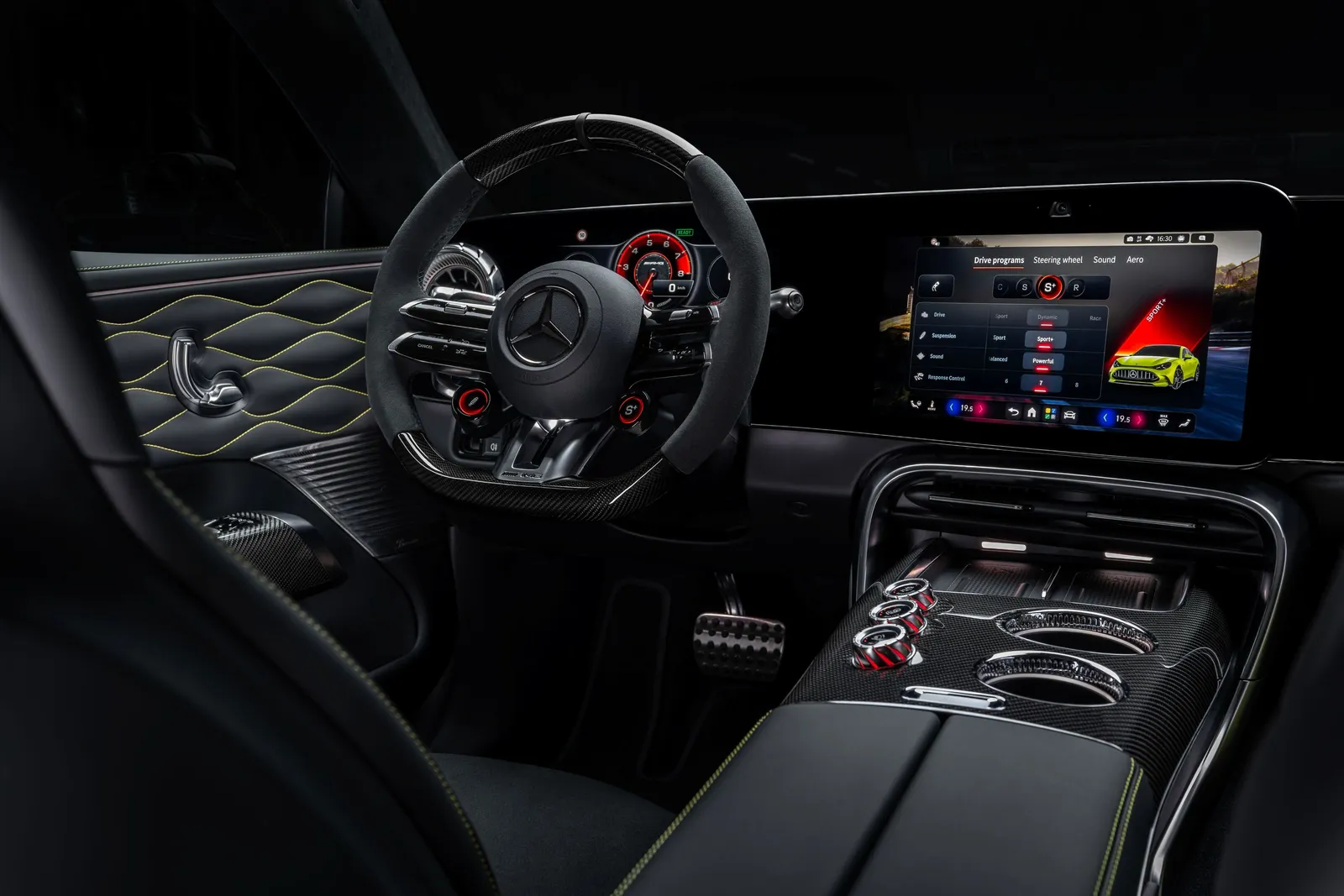
Inside the control architecture, a new AMG Race Engineer system coordinates drivetrain, chassis and braking behavior. Drivers can adjust response, traction and handling characteristics through physical controls rather than relying solely on software menus, giving the car a wider range of usable driving modes, according to the company.
Mercedes-AMG has also attempted to address criticism of the clinical feel of electric vehicles by introducing sensory feedback into the driving experience. A newly developed AMGForce system adds a synthesized V8 gas engine sound, accompanying seat-based vibration and a simulated shift function that briefly interrupts torque delivery under hard acceleration. The intent is to add structure and drama to what would otherwise be a silent and elastic surge of electric power.
Production of the new GT 4-Door Coupe is scheduled to begin in July at Mercedes-Benz’s plant in Sindelfingen, Germany, with its axial-flux motors produced separately at a factory in Berlin.