Dive Brief:
- Nissan Motor Co. unveiled its new long‑term strategic vision dubbed “Mobility Intelligence for Everyday Life,” with a focus on launching AI-defined vehicles with new electrified powertrains along with a reduced product portfolio, the company announced in a press release.
- The plan will focus heavily on AI and automated driving, with the automaker integrating its “Nissan AI Drive Technology” into vehicle control and safety systems for 90% of its model lineup. Nissan aims to launch “end-to-end” automated driving capabilities with its next-generation ProPilot Assist by the end of fiscal year 2027.
- The long-term strategy also includes the rollout of a new version of Nissan’s e-Power hybrid technology, which also includes plug-in hybrid and extended-range powertrains through industry partnerships.
Dive Insight:
Nissan said it's transforming its industrial model for greater scale and consolidation with increased manufacturing efficiency. The strategic plan is focused on three key global markets, Japan, the U.S. and China, which will help it compete globally on "speed, cost and consumer relevance,” per the release.
According to the release, Nissan will use a new shared-platform, architecture-led approach for product families that add up to more than 80% of future sales volume. The automaker aims to increase sales volume per model by 30% using this approach.
Nissan also said it will reduce its product portfolio from 56 vehicles to 45 offered with additional powertrain options. The automaker said it will discontinue low-performing models and reallocate investments to higher growth areas to improve profitability and market positioning.
Nissan said its next-generation e‑Power hybrid technology will help boost the adoption of electrification by delivering an electric‑like driving experience that will serve as a bridge toward fully electric vehicles.
“As we continue on our path to recovery, it is essential that Nissan demonstrates our relentless focus on serving the customer, seizing the opportunities provided by AI technologies, expanding electrification and driving innovation into our vehicles to deliver sustainable market growth,” Nissan President and CEO Ivan Espinosa said in a statement.
Nissan’s future product portfolio will center on four core categories it calls Heartbeat, Core, Growth and Partner.
Heartbeat models will focus on the brand’s core identity and innovation, while Core models sustain Nissan’s global business scale and stability. The company’s Growth segment will target expansion in emerging markets, while Partner models will be developed in collaboration with Nissan’s industry partners.
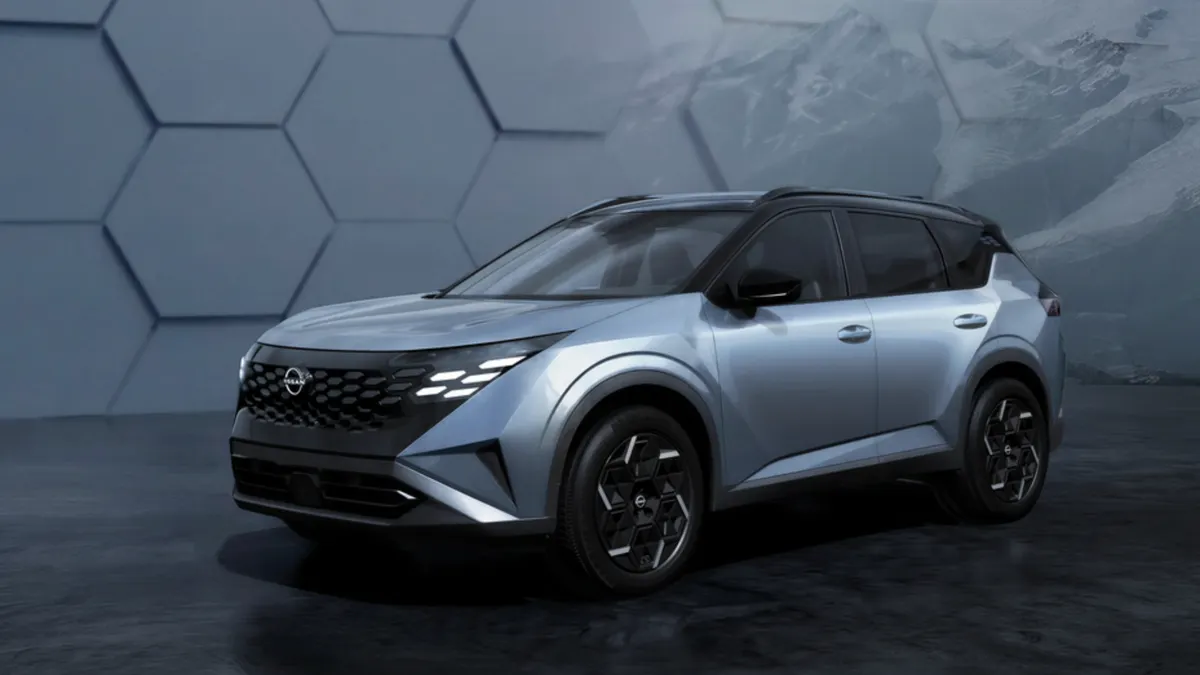
In the U.S., Nissan is targeting 1 million annual sales by 2030, with a focus on large vehicles and a manufacturing footprint using a high level of localization. New products for the U.S. market include the Rogue hybrid that will compete in the highly competitive compact SUV segment.
"Rogue has long been at the heart of Nissan's success in the U.S. and Canada, and the next generation represents a major step forward for this incredibly important model," said Ponz Pandikuthira, senior vice president, Chief Product & Planning Officer, Nissan Americas, in a separate release.
In addition to the Rogue hybrid, Nissan said it will continue to offer V6 gas engines in larger D‑segment SUVs in the U.S. as demand requires and that its future EV investments will be guided by consumer trends and policy evolution, per the release.
The automaker is exploring a family of five U.S.-built models on a new body-on-frame platform, including the return of the full-size Xterra SUV, which may include pickups and multi-row SUVs across Nissan and Infiniti brands. The Xterra will be offered with a gas-powered V6 and V6‑hybrid powertrain option. Nissan discontinued the Xterra in the U.S. after the 2015 model year due to declining sales.
In December, Nissan named Victor Taylor as division VP for U.S. manufacturing, supply chain management and production engineering as part of a restructuring aimed at bolstering its U.S. manufacturing footprint.
Nissan said it will expand on its new long-term strategy when it reports full-year financial results in May. Additional details will be shared later in the year.
The automaker has been working on its turnaround since the company ousted its former CEO in March 2025, along with other top executives following its failed merger with rival Honda Motor Co. in early 2025.
Nissan appointed Espinosa as its new CEO effective April 1, 2025, and announced its “Re:Nissan” recovery plan in May 2025, which includes initiatives to create a leaner, more resilient business that adapts more quickly to market changes.