Dive Brief:
- Subaru posted a 90% year-over-year drop in operating profit from 405.3 billion yen ($2.5 billion) to roughly $267 million in the fiscal year ending March 31, the company announced in its earnings report.
- The automaker cited $385 million in impairment losses and expenses related to EVs for the decline, as well as external factors such as U.S. tariffs, changes in exchange rates and higher raw material costs, which combined, led to roughly a $2 billion hit on its bottom line.
- Due to the EV-related losses, Subaru CEO Atsushi Osaki said in a statement that the company is postponing the launch timing of in-house-developed EVs and shifting resources toward expanding the automaker’s more profitable ICE and hybrid vehicle lineup.
Dive Insight:
Despite the EV-related losses, Subaru’s YoY revenue increased 2.1% to $31.9 billion. The automaker’s North America vehicle sales reached 708,000 units, down by 24,000 units YoY.
“Although the impact of tariffs and higher raw material costs could not be fully offset, we achieved tangible results by responding swiftly and collaboratively across development, production, and sales,” Osaki said in a statement.
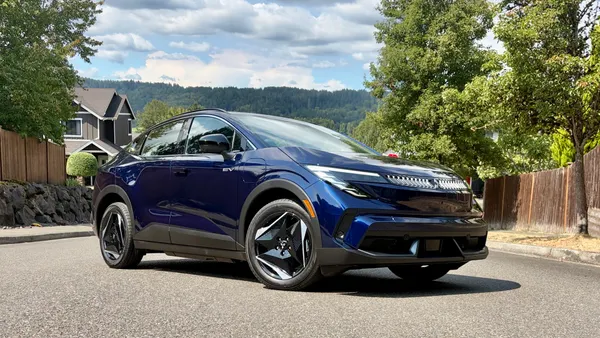
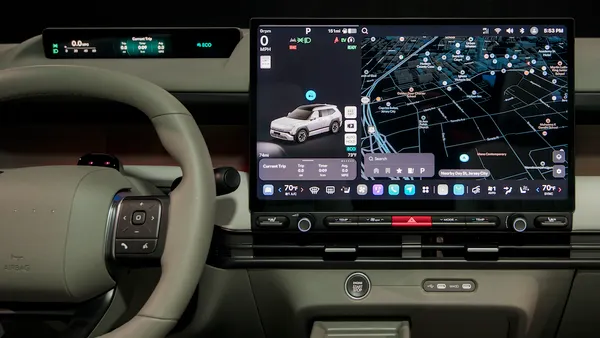
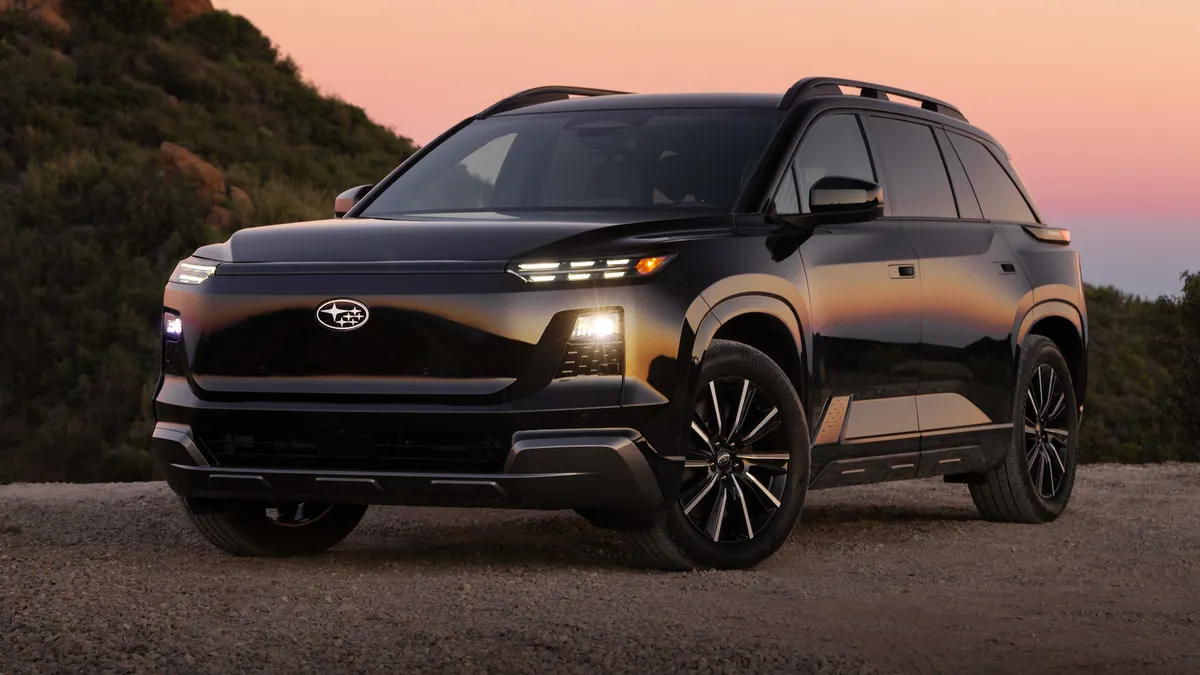
To date, Subaru has launched four electric SUV models in the U.S. — the Solterra, Uncharted, Trailseeker and most recently the Getaway. The four models were co-developed with Toyota as part of a strategic partnership between the two companies announced in 2024. The Getaway is being built at Toyota’s plant in Georgetown, Kentucky, for the U.S. market.
The partnership was intended to help Subaru mitigate the financial risks of developing an EV on its own and share research and development resources as the automaker worked on its more long-term electrification initiatives. But those plans are now on hold as the automaker eyes recovery in FY2027.
Subaru is forecasting consolidated vehicle sales of 940,000 units in the current fiscal year, an increase of 44,000 from FY2026. In North America, Subaru forecasts sales of 736,000 vehicles, roughly 28,000 more than last year. Revenue is forecast to reach $32.7 billion with an operating profit of approximately $945 million.
Subaru in October 2024 announced its next-generation hybrid system, which debuted in the Crosstrek sold in the Japan market. Osaki said in a statement that Subaru has completed the groundwork for mixed ICE, hybrid and EV production at its assembly plant in Yajima, Japan, following a six-month retooling project, which he said was “an important step towards flexible manufacturing.”
“Going forward, we will leverage the capabilities, technological assets, and expertise gained through BEV development to enable timely vehicle development and further lineup expansion,” said Osaki.
However, like Honda, Subaru is not entirely abandoning its long-term electrification plans.
“Our view that BEVs remain an important option for achieving carbon neutrality society has not changed,” Osaki said. “Development of essential future technologies, including batteries and eAxles, will therefore continue.”
He called the four electric SUVs co-developed and launched with Toyota a “significant achievement” in terms of production evaluation and an accumulation of technologies, which he said can be leveraged in the future.
Subaru’s pivot from EVs to hybrid vehicles mirrors its domestic rival Honda Motor Co., which announced last week that it’s reallocating resources to launch new hybrid vehicles after posting total EV-related losses of roughly $10 billion for the fiscal year ending March 31.
Toyota also announced this month that it's ramping up hybrid vehicle production after U.S. tariffs erased all of its North America profits in FY2026.