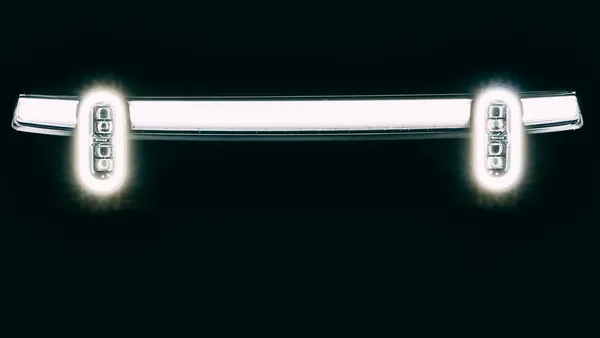


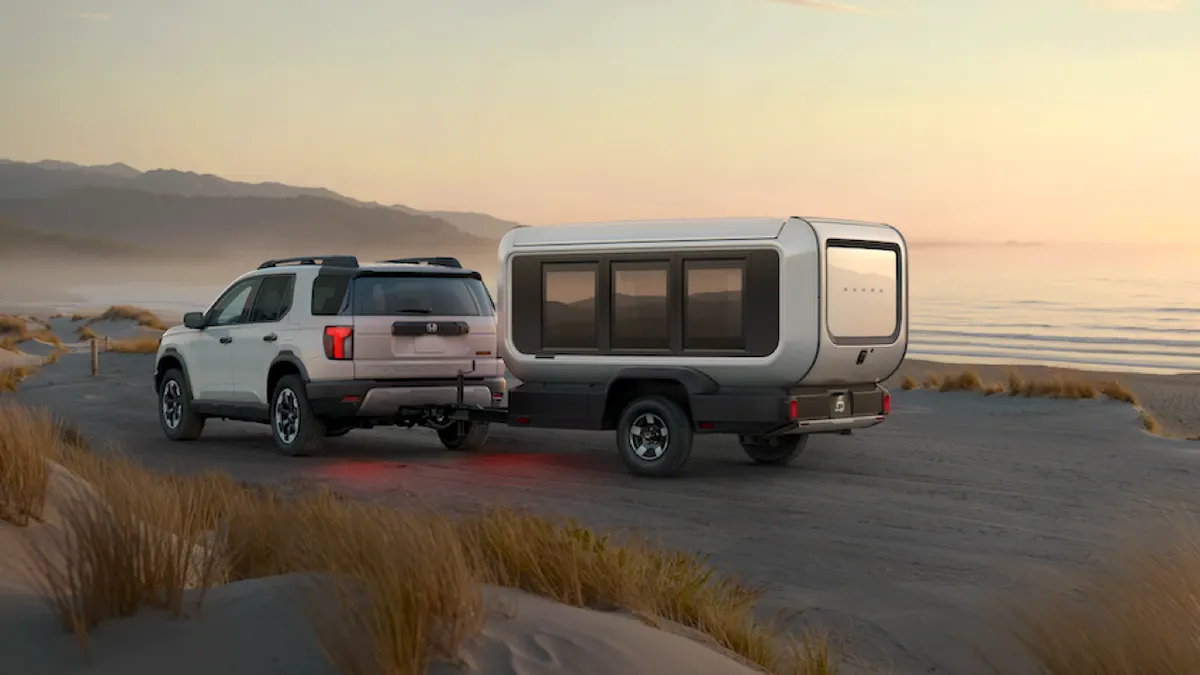
Outdoor recreation is booming in America, and camping is a big part of it. But not every family that enjoys outdoor adventures wants to tow a 33-foot Airstream with a heavy-duty pickup or gigantic SUV.
With the lightweight Base Station Prototype towable travel trailer that Honda revealed in mid-January, it’s emphasizing a CR-V or Toyota RAV4 will work just fine, as will the fully electric Honda Prologue or now-canceled Honda 0-Series SUV, which Honda showed it hitched up to.
Honda won’t say exactly how much the Base Station weighs, but it confirmed the product is under 1,500 pounds—light enough to be towed by many popular compact family SUVs. It’s also been sized to fit into a standard garage or parking space.
The Base Station “will revolutionize, redefine, and disrupt the towable RV class,” according to Jane Nakagawa, vice president of American Honda R&D, in a brief in-person preview of the Base Station in Torrance, Calif.
According to outdoor industry figures cited by Honda, there are currently more than 80 million campers in the U.S., including 15 million who were first-timers just in the past two years. Among those first-timers, Honda says the average is just 30 years old—a generation younger than newbies a decade earlier.
A project pulled ahead by the pandemic
The pandemic is what accelerated the generational shift towards camping and more downsized solutions.
“We were interested in this idea before COVID, but when that started it crossed the threshold where now this market is big enough and it made sense,” said Dillon Kane, the senior project leader at Honda who led the Base Station from idea to product.
“It was really form-follows-function for us on this one,” remarked Kane. His team, coming from the same California R&D group that developed the Motocompacto electric scooter, went deep into what he described as “research and logic mode,” targeting handling characteristics in crosswinds as one of the big concerns. To address this, Honda did a computational fluid dynamics analysis at different crosswind angles, arriving at a particular aerodynamic shape featuring curved corners.
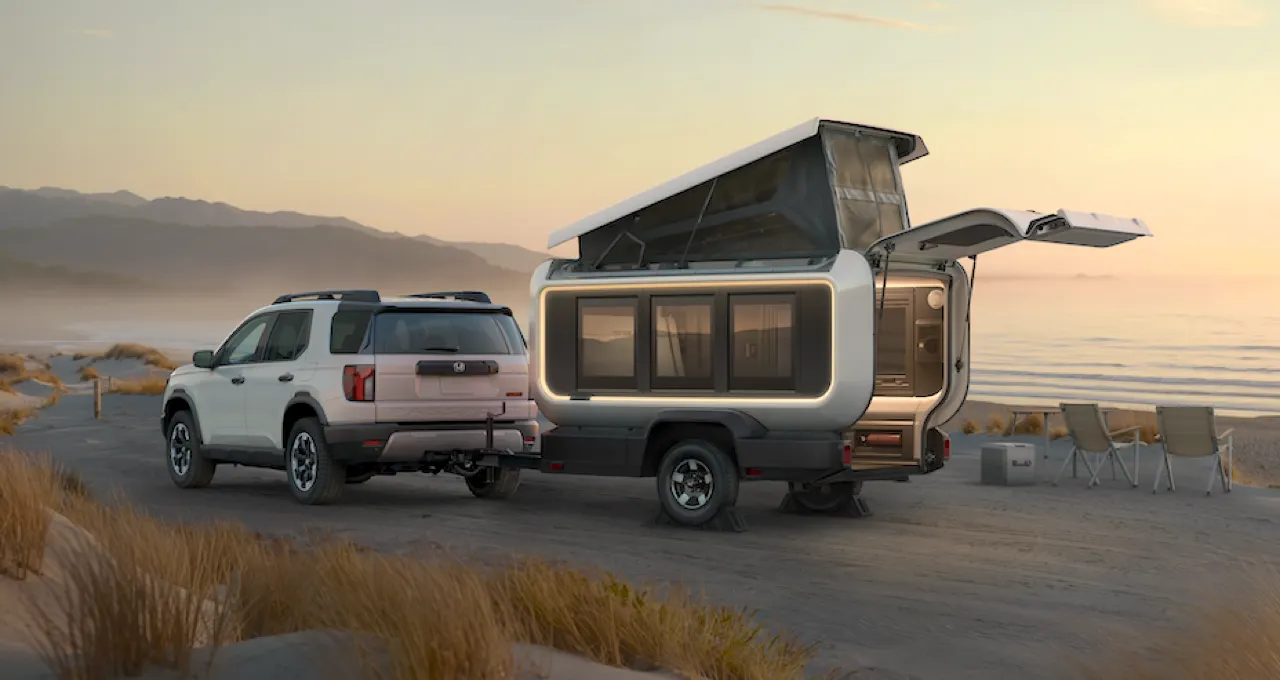
Five different modules for the Base Station include a kitchen, shower and air conditioner, plus available awnings and a full-size spare tire. Inside, the RV can sleep a family of four, with a futon-style couch pulling out into a queen-sized sleeper plus an optional top bunk bed. The Base Station can be made ready for sleep in less than five minutes after campsite arrival. Individual modules can also be removed or connected to form a different layout on a trip-by-trip basis.
Rooftop solar panels, but no electric drive of its own
Popping up the roof takes seconds, according to Honda, allowing more than seven feet of vertical standing space. Solar panels on the roof can charge a lithium-ion battery pack to power the A/C, inductive cooktop and more. Honda did not provide details of the battery size, but said it’s “very competitive with the market, on the high end.”
With an aluminum frame and composite shell, the Base Station is set to be assembled by Honda in North America using “a unique construction method.” Although the RV was designed in California and engineered in Ohio, it was conceived with the U.S. market in mind, according to Honda. The company won’t say yest whether it will sold in Europe or Japan, or if there might be different size variations available. While the prototype is white, Honda also did not confirm if the Base Station will be offered in other colors or with wrap options.
Beyond its futuristic design, there’s nothing radical about the RV’s hitch. There are no stabilizing gyros borrowed from Honda’s Asimo robot or electrification of the trailer’s wheels to help with towing. All of that might have driven up the price, company officials hinted.
At the preview, Honda elaborated that the Base Station would be sold by Honda and Acura dealerships, not by RV dealers. Although the company emphasized that the Base Station is just a prototype, Nakagawa said it’s “very indicative of what we plan to bring to market.” Honda promised more info soon.
Whether the automaker can break into the RV market may not rely on just cost and customer interest in the outdoors, but also on dealerships being able to sell the whole adventure package.