Dive Brief:
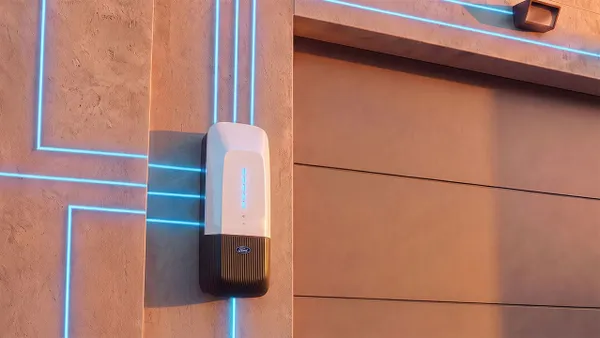
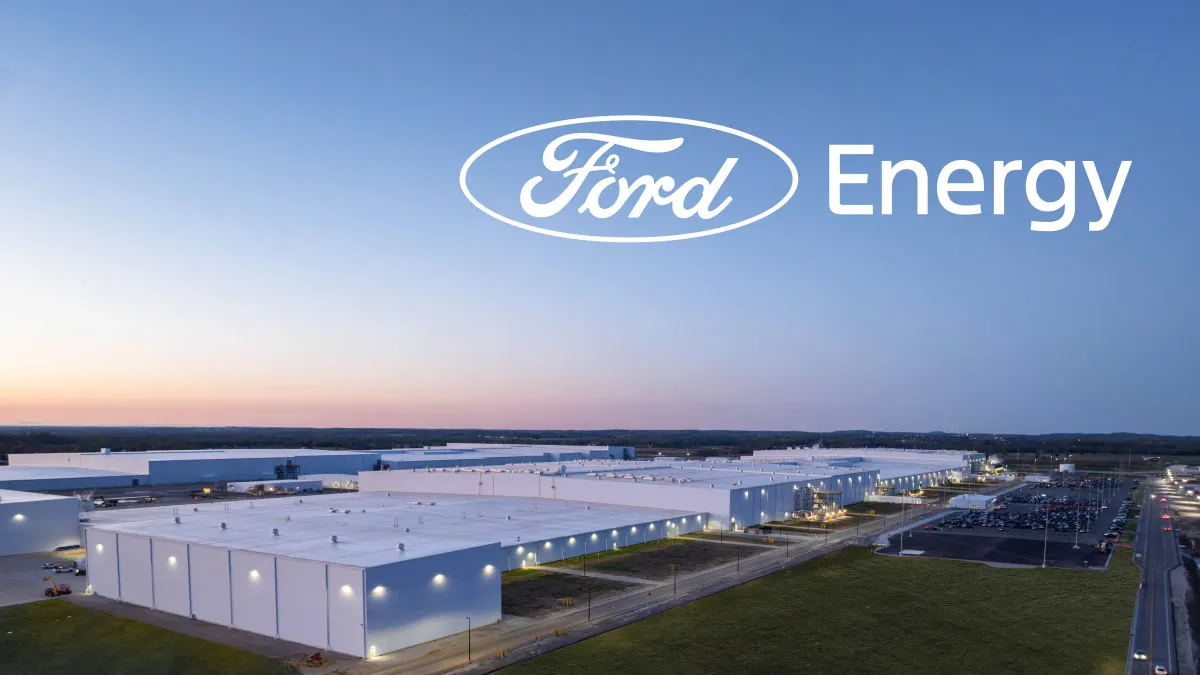
- Ford Motor Co. has officially launched its wholly owned subsidiary “Ford Energy” that will manufacture battery energy storage systems for data centers, utilities and large industrial and commercial customers in the U.S., the automaker announced in a May 11 blog post.
- Ford Energy aims to deploy a minimum of 20 GWh of battery energy storage systems annually, with first customer deliveries slated for late 2027.
- After the automaker scaled back its EV plans, the new subsidiary was established to meet the growing demand for stationary battery storage systems and generate new revenue streams for the company, by utilizing unused production capacity at its former joint venture electric vehicle battery plant in Glendale, Kentucky.
Dive Insight:
In December, Ford and its former joint venture battery partner SK On reached a mutual agreement to dissolve their BlueOval SK battery joint venture due to lower-than-expected EV demand.
The joint venture was established in September 2021 as part of a planned $11.4 billion investment by the two companies to build three large-scale manufacturing plants in the U.S., one in Tennessee and two in Kentucky, to produce batteries for Ford’s future EVs. But amid declining EV sales and the expiration of the federal tax credit last year, the automaker does not require the additional battery production capacity it originally anticipated.
However, following the agreement to dissolve the joint venture, Ford said it was repurposing the Kentucky battery plant to manufacture 5-megawatt-hour, advanced battery energy storage systems to meet large-scale energy loads. These systems are also in demand due to the rapid growth of AI data centers.
Ford Energy’s operations in Kentucky will include full battery cell manufacturing, including production of electrode coils, assembly of modules and containers, as well as sales and service support, per the blog authored by Ford Energy president Lisa Drake. Her appointment as the unit’s president was announced in January, where she reports directly to Ford Vice Chair and former CFO John Lawler.
Ford previously announced plans to invest roughly $2 billion over the next two years to set up Ford Energy and begin manufacturing operations. The company plans to hire roughly 2,100 workers at the former joint venture battery plant in Kentucky.
“U.S. demand for dispatchable, bankable energy storage is accelerating,” Drake said in the blog post. “The convergence of data center growth, renewable energy integration, and grid resilience requirements has created a gap in the market.”
The flagship product will be the “Ford Energy DC block,” a standardized 20-foot battery, industrial-grade energy storage system designed around 512 amp-hour lithium iron phosphate prismatic cells. The unit will be offered in two configurations: the two-hour FE-250 and four-hour the FE-450. Both battery storage units will utilize liquid-cooled thermal management and battery management systems. Each is designed to deliver a 20-year service life.
Ford is touting its longevity as a company and its more than a century of manufacturing expertise as a way to better serve the needs of its energy storage systems customers, including if a problem arises after purchase.
“Utilities and developers need storage systems they can finance, insure and depend on for decades,” Drake wrote in the blog post. “They need suppliers who will be there in year 10 to honor a warranty claim.”
Along with Ford, Tesla also aims to grow its battery energy storage business. In March, the Department of the Interior announced that Tesla and battery maker LG Energy Solution were expanding their partnership with a $4.3 billion supply agreement for LFP prismatic battery cells. The cells will be manufactured at LG’s plant in Lansing, Michigan, and will power Tesla’s Megapack 3 energy storage systems that the company produces at a facility in Houston. Production is targeted to start in 2027.
Last month, EV maker Rivian and battery recycling firm Redwood Materials announced a partnership to deploy an energy storage system at the company’s assembly plant in Normal, Illinois. As part of the agreement, Rivian will provide more than 100 second-life EV battery packs to Redwood to be repurposed in an energy storage system that will initially provide 10 megawatt-hours of energy to the factory.