Dive Brief:
- Honda Motor Co. is reallocating its development and production resources to launch new hybrid-electric vehicles in key global markets after posting massive EV losses of roughly $10 billion in the fiscal year ending March 31, the automaker announced in a business briefing.
- Over the next three years, Honda said it will invest 4.4 trillion yen ($27.8 billion) in new gasoline and hybrid vehicles and another 1 trillion yen in software technologies as it pivots from EVs towards more profitable vehicles.
- The automaker plans to launch 15 new hybrid models featuring an all-new hybrid system and platform through March 31, 2030, primarily in North America. The new hybrid models also include D-segment vehicles for the first time, such as fullsize SUVs.
Dive Insight:
Honda’s planned shift to hybrids has been evaluated since last year. In May 2025, global CEO Toshihiro Mibe said the company was reducing its investments in EVs by $20.7 billion through 2030 to focus on launching new hybrid models. At the time, Mibe said hybrid vehicles would play a key role in the company’s long-term transition towards full electrification, particularly in North America, its biggest global market.
As part of the company’s updated business strategy, Honda said it will reallocate all of the excess capacity at its assembly plants in Ohio to produce both ICE and hybrid vehicles and will make all of its North America plants capable of producing hybrid vehicles.
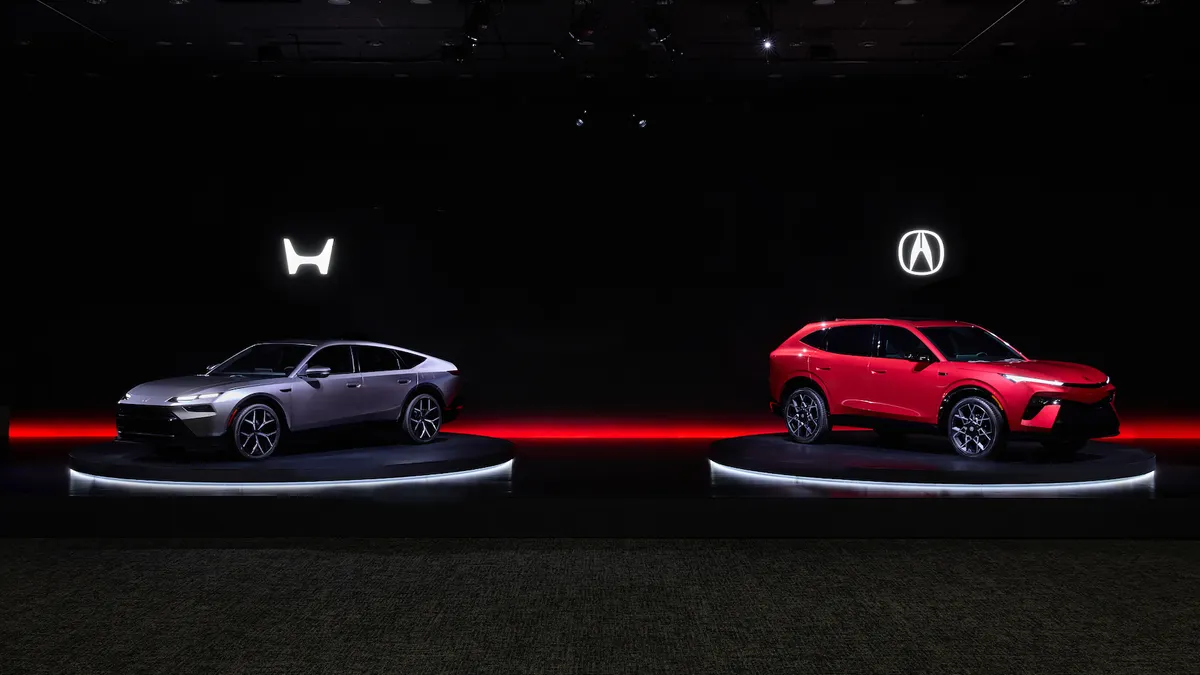
Honda also unveiled two prototypes of its next-generation hybrid models as part of its business update, the Honda Hybrid Sedan and Acura Hybrid SUV, both of which are slated to go on sale within the next two years.
To further prepare for the launch of new hybrid models, Honda and its battery partner LG Energy Solution will convert some of the production lines at a joint venture battery plant in Ohio for production of hybrid vehicle batteries, which Honda said are in high demand. The automaker also plans to produce batteries for other applications and said it will pursue a battery procurement strategy with a focus on “competitiveness in North America.”
To mitigate the impact of U.S. tariffs on its profitability, Honda said it will increase the local content of hybrid vehicle components, such as motors and inverters, by more than four times the current level, which it also says will help reduce the risk of supply chain shortages.
The automaker also aims for cost savings and efficiency gains for its next-generation hybrid vehicles. Honda said it intends to reduce the cost of its next-generation hybrid system by more than 30% compared to its current version.
Honda’s future vehicle platform will combine its next-generation hybrid system with a new electric all-wheel-drive unit with the goal of improving the fuel economy by more than 10%.
The company also aims to improve production efficiency by 20% over the next five years.
Honda also confirmed in its business update that a planned investment of $11 billion announced in April 2024 to establish a comprehensive EV value chain in Canada has been indefinitely put on hold. Last May, Honda announced it was postponing the investment in Canada by two years.
“Based on our revised strategic objectives, we have determined that an indefinite suspension of the value chain project is appropriate at this stage,” the automaker said in a statement on its Canada EV investment. “We will continue reviewing our future procurement and business strategies, while carefully monitoring market conditions.”
In March, Honda confirmed the cancellation of three EVs it planned to launch in the U.S. — the 0 Series Saloon, 0 Series SUV and Acura RSX. The company also canceled the Afeela 1 sedan and a second electric model it planned to launch under its Sony Honda Mobility EV joint venture with Sony.
Honda originally planned for EVs and fuel cell vehicles to account for 100% of its sales by 2040.
However, in a business briefing speech, its CEO said the automaker's revised plans are “by no means an indication that Honda is withdrawing from EV business.” Mibe said Honda will continue to work on a “highly-competitive” EV platform and solid-state battery technology to be ready when EV demand increases again.
“We will continue to carefully monitor market conditions and the trend of consumer demand and lay the groundwork so that we can deliver compelling products when the timing is right,” he said.