Dive Brief:
- Hyundai Motor Group revealed on April 29 that it will deliver its next-generation Pleos Connect infotainment system in May as the first deliverable in its transition to software-defined vehicles, according to a press release.
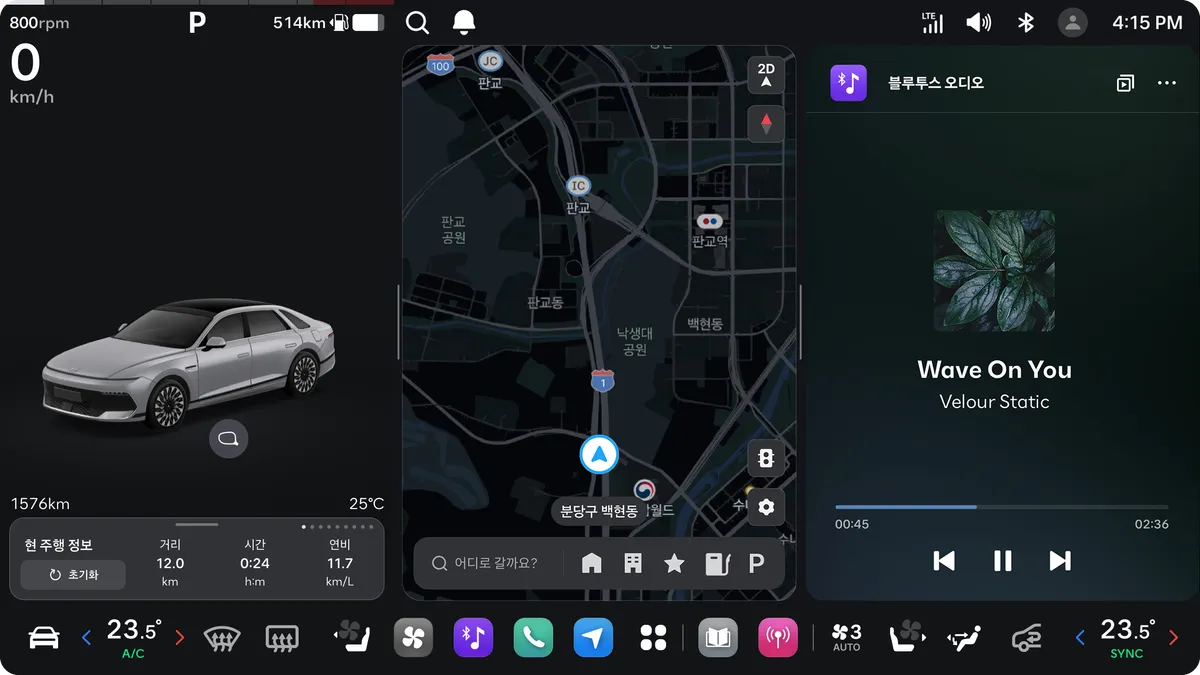
- The new UX combines a central infotainment display, driver display and physical buttons for commonly used vehicle settings. It integrates with Hyundai’s “Gleo AI” assistant powered by a large language model for voice control of vehicle functions, including navigation, adjusting climate settings, web searches and access to the vehicle owner’s manual.
- Pleos Connect will debut in Hyundai’s flagship Grandeur sedan in the South Korea market followed by a phased global rollout, including for the upcoming Ioniq 3 EV set to be sold in Europe later this year. By 2030, Hyundai aims to deploy the system in approximately 20 million vehicles.
Dive Insight:
Hyundai announced the Pleos end-to-end vehicle software platform at its Pleos 25 developer conference in Seoul in March of last year. It includes Pleos Connect and is based on a scalable, zonal electrical/electronic architecture designed to boost the performance of the company’s future software-defined vehicles, according to Hyundai.
The Pleos OS integrates high-performance vehicle chips, controllers, cloud infrastructure, and mobility and logistics optimization for connected fleets.
The Pleos Connect infotainment system is based on the open Android Automotive OS platform. According to Hyundai, the smartphone-like interface with split-view and multi-view layouts is focused on intuitiveness and simplicity in order to minimize driver distractions.
“Pleos Connect is a next-generation infotainment system that offers customers an elevated mobility experience by combining a mobile-friendly platform with advanced AI technology,” said Jongwon Lee, SVP and head of the features and CCS sub-division at Hyundai in a statement. “With the new Gleo AI and an open app market, users will experience the limitless potential of future mobility.”
It has a combination of touch and physical controls, developed through extensive research into driver behavior at Hyundai’s global UX Studios in Irvine, California, Seoul, Frankfurt and Shanghai. Buttons on both the steering wheel and below the center display allow quick access to key functions without using the touchscreen, per the release. And with the built-in Gleo AI assistant integrated into Pleos Connect, drivers will be able to execute multiple voice commands within a single request.
The AI-powered system is built on a large language model and will be continuously updated over-the-air. At launch, Gleo AI will be centered on vehicle controls and convenience features, but will be linked with other application services in the future, according to Hyundai.
“Gleo AI is an intelligent AI agent that engages in natural conversation like a companion in the passenger seat, understanding user intent and making holistic, context-aware judgments,” said Jongho Lee, team lead of the Gleo AI Group at 42dot, the automaker’s software subsidiary, in a statement. “Going forward, Gleo AI will continue to evolve with more advanced personalized services, helping deliver a more enjoyable and convenient mobility experience for customers.”
Hyundai said it paid significant attention to the design of the Pleos Connect navigation system to be more convenient and less complex to use. The screen layout and menus have been reorganized around more frequently used functions and the automaker adopted simpler screen icons rather than complex graphics to enhance visibility. The navigation system is based on real-time traffic data collected from other vehicles, using live maps with up-to-date road information to provide the best route.
“Navigation delivers a better mobility experience when complexity is reduced,” said Hanna Yun, research engineer at Hyundai, in a statement.
Pleos Connect also includes a third-party app marketplace where drivers can download their favorite apps. More popular apps, such as YouTube and Spotify, will be available directly from the vehicle’s infotainment screen without needing a smartphone connection. Hyundai said last year that customers will be able to create and store a unique user profile and access their personalized settings from any Pleos Connect-based vehicle.
Hyundai plans to expand the infotainment offerings to include gaming, entertainment, and vehicle management services through external partnerships, per the release. The company also launched its “Pleos Playground” for developers to create in-vehicle apps for Hyundai's future SDVs running Pleos Connect that drivers can download.
“Pleos Connect is a platform born from our deep commitment to understanding customers’ mobility experiences,” said Changsub Kim, Senior Research Engineer, UX Strategy Team at Hyundai, in a statement. “Even after launch, we will continue to listen closely to diverse customer voices and strive to design in-vehicle experiences that further enrich the value of mobility.”
The automaker did not say when Pleos Connect will be available for vehicles sold in the U.S.