The QX65 midsize SUV from Nissan Motor Co.’s luxury brand Infiniti will arrive at U.S. dealerships in early summer. Ahead of its launch, the automaker invited WardsAuto to Nashville, Tennessee, to experience the new SUV in person, learn about its new technology and get behind the wheel to evaluate its road manners and in-cabin experience.
The QX65 is built on Nissan’s midsize D platform, which is also used for the Murano, Pathfinder and three-row Infiniti QX60. With the new QX65, the automaker says it’s targeting "successful high earners” who prefer a two-row layout in an SUV, as well as a bit more refinement and luxury for everyday driving.
"This segment is no secret. It's a huge segment in the premium [SUV] industry that represents around 40% of the market share, and it's a segment that still has opportunity to grow,” said Francisco Negron, Product Planning Manager at Infiniti, in a media briefing. “We're trying to capitalize on a unique delivery of a unique product.”
“Infiniti is absolutely a key pillar to Nissan's future, and it's great to have support and direction from the very top of the house so that we can start to go execute,” said Eric Ledieu, VP of Infiniti Americas, in a media briefing.
Infiniti says the design of the QX65 was inspired by the FX, an SUV that it claims helped define the coupe-crossover segment when it first debuted in 2003. At the time, the company’s designers aimed to marry the styling of a sports car with the body of an SUV in an era where most other vehicles in the segment featured more boxy looks.
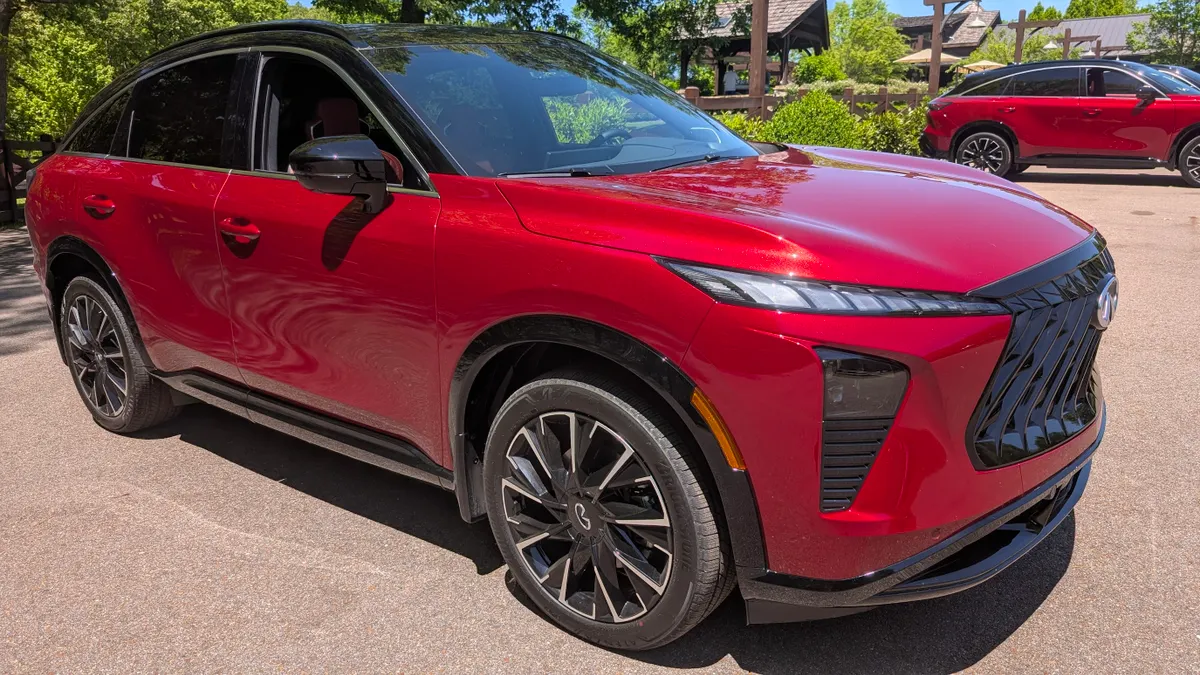
The QX65’s arched roofline and aggressive nose hints at those FX models of the past, but with a more modern presence, according to Infiniti. An aggressively designed front grill is framed by narrow LED headlights.
Cargo space
The absence of a third row allows for a much larger second row and cargo area. The second seats also slide, recline and fold as needed for more cargo space. There’s 67.7 cubic feet of cargo space behind the first row and 35.8 cubic feet behind the second row with the seat in the upright position. Representatives told us that’s enough room to fit four large suitcases or two golf bags. But with the QX65’s bow-shaped roofline, rear seat headroom felt a bit compromised at 36.9 inches. Infiniti added a compartment under the rear floor for extra storage needs.
Interior and infotainment features
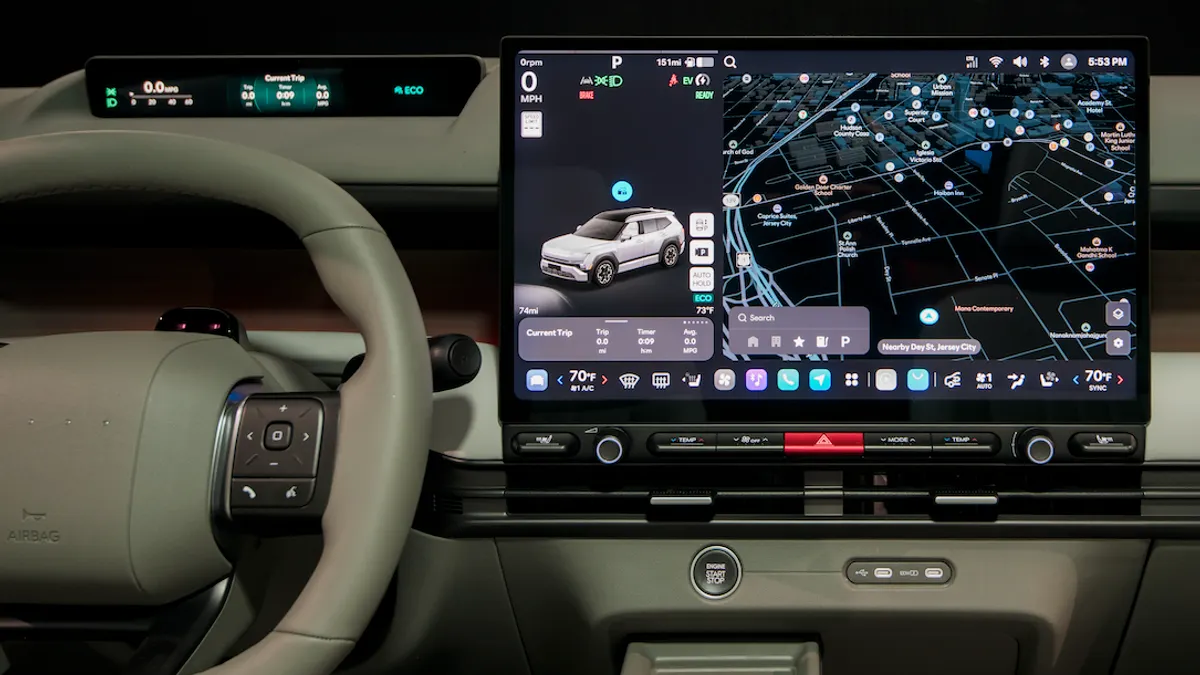
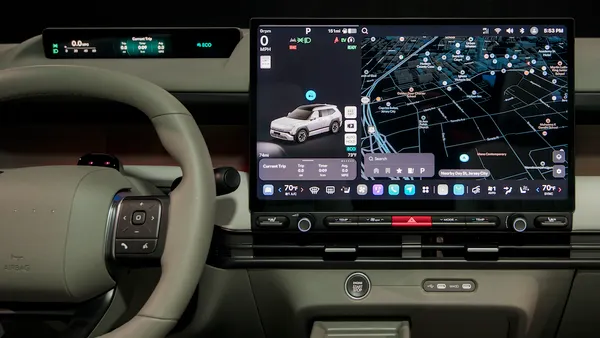
All QX65 models come with dual 12.3-inch displays — one for the instrument cluster and the other for the infotainment system, which features Google built-in and the ability to download apps from the Google Play Store. The QX65 also features Google Assistant, which allows drivers to control features with their voice, such as the climate controls or navigation. The infotainment system supports standard wireless Apple CarPlay and wireless Android Auto.
Infiniti added four USB-C ports to the QX65’s cabin, two in the center console and two in the second-row center console. The standard wireless charging pad adopts the Qi2 universal wireless charging standard, allowing for faster, more consistent charging at up to 15 watts, according to Infiniti. The wireless charger has magnets to help keep smartphones in the optimum position, as well as a cooling fan to reduce device heat when charging.
We drove the top-trim Autograph, which featured red accents and semi-aniline red leather seats with an asymmetrical quilting pattern that matches well with the luxury look of the QX65’s interior. The quilting pattern extends to the dashboard, which features open-pore wood trim that adds to the interior’s luxury feel, and there are various soft leather touchpoints throughout.
The QX65 we drove was painted Sunfire Red with genuine gold-coated glass flecks embedded into the paint, which looked sharp. The paint process requires three layers of coating to achieve the appearance, according to Infiniti.
The Luxe, Sport and Autograph trim levels of the QX65 each come with distinct audio systems. The Autograph trim features a 20-speaker Klipsch Reference Premiere system delivering 1,200 watts of power, which sounded great to our ears.
Customers can also download Nissan’s personalized sound app to dial in a more personalized sound. It first runs through a simple hearing test by playing tones of varying loudness and pitch and directs a listener to press a button on the infotainment screen when audible. Using the responses, the program creates a custom equalizer setting based on an individual's unique hearing profile. We previously tested the personalized sound feature in the 2026 Nissan Leaf last December, and it worked well.
Infiniti places speakers to the front seat headrests, which are also used to provide the driver with dedicated turn-by-turn directions or phone conversations without disturbing other passengers. They weren’t configured for music in our test vehicle, as Infiniti reps said some features were not available in our preproduction model.
The cabin of the QX65 also features Active Noise Cancellation and what Infiniti named “Active Sound Enhancement” that is attached to each selectable drive mode. The Active Noise Cancellation feature is similar to noise-cancelling headphones; the technology eliminates undesirable tones like tire noise while amplifying and exaggerating sportier exhaust harmonics. When selecting the sport drive mode, the Active Sound Enhancement feature delivers simulated engine noise up to five decibels through the vehicle’s speakers to mimic the sound signature of a V6 engine, Infiniti reps told us.
“With the technology, we’re using the front and rear speakers for a more immersive acceleration experience. You’re going to instantly recognize higher levels of volume pumped into the cabin during that acceleration experience,” said Scott Fritz, Senior Manager, Powertrain Performance Test at Nissan Motor. “We're utilizing sound enhancement which are in response to the client's input.”
Although the Active Sound Enhancement worked to simulate a more engaging engine note, it was subtle and sounded artificial at times.
Powertrain takeaways and first drive impressions
Unlike the Nissan Pathfinder, which shares the same platform as the QX65, there is no V6 engine option. The automaker replaced it with its 2.0L, variable compression turbocharged 4-cylinder engine (VC-Turbo) paired with a nine-speed automatic transmission.
The 4-cylinder was the world's first production engine utilizing a variable compression ratio when it debuted in the 2019 Infiniti QX50 and was named to the Wards 10 Best Engines and Propulsion Systems list that year.
The transverse-mounted engine produces 268 horsepower and 286 lb.-ft. of torque. All QX65 models feature all-wheel drive, and Nissan is estimating EPA fuel economy ratings of 20 mpg city, 26 mpg highway, with a combined 22 mpg. The QX65 requires premium fuel.
Although the QX65 has adequate power delivery on par with other vehicles in the segment, the curb weight of the top trim Autograph is over 4,700 pounds and the high-revving 4-cylinder engine felt labored at times during our test drive. Infiniti said its engineers specifically dialed in more aggressive shift points to increase power. The tuning scheme works to deliver quick off-the-line performance and under hard acceleration for passing at highway speeds. The QX65 also features steering wheel paddle shifters for manual shifting, which provided near-instant gear changes during our road test.
“Number one was to prioritize stronger and immediate acceleration,” said Fritz in a media presentation. “We have a sportier shift schedule, with intuitive downshifts after brake application.”
The suspension setup in the QX65 includes MacPherson struts up front and a multilink independent rear design. The wheelbase of the QX65 is 114.1 inches, with an overall vehicle length of 198.5 inches without a license plate attached. Ground clearance is 5.87 inches.
But as a luxury SUV, Infiniti prioritized refinement and comfort with the QX65. It trades ruggedness for a smooth ride on paved roads, and the automaker’s target customer will not likely be taking it on off-road adventures. The Nissan Pathfinder SUV is a more suitable vehicle for trails with its available Terrain Modes, which includes snow, sand, dirt and gravel.
Pricing and Trims
The 2027 QX65 Luxe trim starts at $53,990. Standard features include a panoramic sunroof, 20-inch wheels, 11-speaker audio system, 8-way power, heated front seats, leather-wrapped steering wheel, automatic climate control, Intelligent Cruise Control and ProPilot driver assist system, and wireless phone charging.
Infiniti expects the middle Sport trim to be the top-selling of the three. It starts at $55,690 and includes 20-inch black alloy wheels and exterior black chrome window surrounds. Sport models come with climate-controlled front seats and an upgraded Klipsch 16-speaker premium audio system.
An optional premium package adds a smart rearview mirror, head-up display, a motion-activated rear liftgate and a tow hitch receiver. Autograph models also have an available tow package with trailer sway control and a rated towing capacity of 6,000 pounds.
The top-trim Autograph we drove came with larger 21-inch wheels, semi-aniline leather-appointed seats with perforation and quilting, front seat massaging, heated rear seats, an auto-dimming outside mirror and that top Klipsch audio system.
The Autograph trim is available with Nissan’s ProPilot Assist 2.1, allowing for hands-free driving on certain highways. When traveling on compatible roads, the system takes over acceleration, steering and braking. However, it’s categorized as a Level 2 system, so drivers need to pay attention to the road at all times and be ready to take over control if prompted.
Series production of the all-new QX65 began on April 16 at Nissan’s assembly plant in Smyrna, Tennessee.