Editor’s note: This is a reported column, in which Steve Finlay periodically explores the relationship between automakers and dealers for WardsAuto.
Automakers and dealers alike are fixated on fixed ops — and there’s a clear reason why.
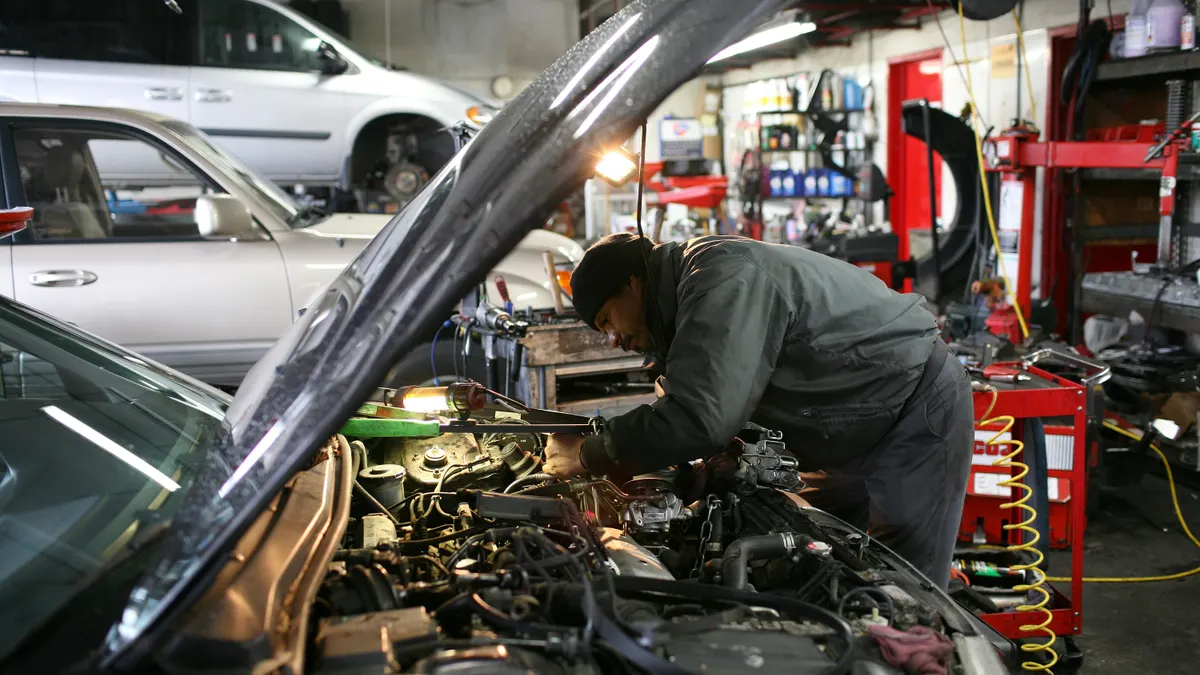
With the average cost of a new car closing in on $50,000, many budget-minded consumers figure they can get off cheaper by spending more to keep their current vehicle in good running order. The trend was evident in 2025, when the average dealer’s service and parts revenue reached $9.2 million, up 33% from eight years ago, according to Cox Automotive.
That increase has spurred dealers to up their service game and make the customer experience better, even as service work has become more expensive than before.
“It’s clear that as ownership stretches longer and service and costs compound, fixed operations are tremendous growth levers for dealers,” said Skyler Chadwick, director of product consulting at Cox Automotive.
Meanwhile, automakers are getting in on the game of making dealership service visits more user-friendly.
But wait. Manufacturers build and sell cars, mostly through dealers. So why are automakers so interested in the service side of the automotive industry?
It’s simple, Mazda’s Tim Manning told me.
“A person who has a positive service experience at a dealership is 70% more likely to purchase their next car there,” said Manning, senior vice president of retail operations for Mazda North American Operations. “Service is the No.1 factor in purchase loyalty. That’s why we’re putting so much effort into it.”
He adds: “Any OEM will tell you that a good service operation is the pillar of the brand. Especially if it provides stability during unstable times.”
Unstable times like the present, maybe.
His company has implemented the Mazda Service Promise, billed as a commitment to customer-centric experiences at the brand’s dealerships.
That includes more transparent interactions, empowering customers to decide which repairs they want and — this one is really important — having plenty of service loaner vehicles on hand. Mazda subsidizes that.
Another part of the initiative is offering customers payment plans for costly repair work. It shows how expensive fixing a car has become in some cases.
“Any successful, forward-thinking OEM and dealer knows how important the service space is, although it’s not as sexy as talking about sales and new-product launches,” said Manning.
In other words, most consumers are geeked when going to a dealership to buy a new car. It’s less exhilarating to head to a dealership for repairs and maintenance. But if the thrill isn’t there, the experience should at least be tolerable. Crank up the waiting room’s espresso machine.
How Mazda is improving the customer experience
Like many brands, Mazda is big on service technicians using their cell phones to do video vehicle inspections. Those are then digitally sent to customers, showing them what’s right with their vehicle and what needs fixing.
“Customers find those videos extremely helpful and appreciate that you took the time to educate them,” Manning said.
How hard is it to get technicians to do the videos?
“If you asked me that four or five years ago, the answer would be, ‘Tremendously difficult,’” Manning said.
The initial complaint from many auto technicians — who just wanted to do their job of working on cars — was that shooting videos slowed them down. Plus, many technicians weren’t particularly comfortable narrating the footage.
That reluctance has changed dramatically.
“Today, it would be hard to stop technicians from doing the videos, because they are so effective,” Manning said. They lead to more billable hours, and technicians like that part.
At Lee Johnson Mazda of Seattle and Lee Johnson Mazda of Kirkland in Washington state, the video inspections are standard operating procedure.
“Not only does the customer see what needs to be done to their vehicle, but we have a record of it,” Chris Reeves, a partner in both dealerships, told me.
At first, technicians considered it one more thing to do, he said. But once technicians get comfortable with it and see results in increased repair orders, they’re all-in.
Reeves said most of the early skeptics were older technicians. “But one of my best performers in Seattle is a tech in his 60s who does dynamite videos. He talks naturally. He has a good tone of voice and plays on it.”
Starting as a lot boy, Reeves has spent 37 years working at Mazda dealerships. He’s learned a lot in those years.
For instance: “The fixed-ops foundation supports you when sales slow.”
The auto industry is known for its cyclical up-and-down sales years.
“As Warren Buffett said, ‘When the tide goes out, you see who’s exposed,’” said Reeves. “If you have a good fixed-ops department, that tide can go out and you’ll be OK.”
Reeves also notes that in selling a car, a dealer will interact with a customer essentially once, but more than that when it comes to service and maintenance.
His stores promote prepaid maintenance programs. They’re not big money makers. “We barely break even with oil changes,” he says. But the maintenance plans increase customer visits.
Sure, familiarity can breed contempt. But done right at a dealership, it creates customer loyalty.