How far can efficiency be pushed with the technology underpinning Volkswagen’s next-generation EVs?
Seeking to answer that question with its Mission Efficiency, the automaker has returned to some of the engineering strategies behind its earlier, wind-cheating XL1.
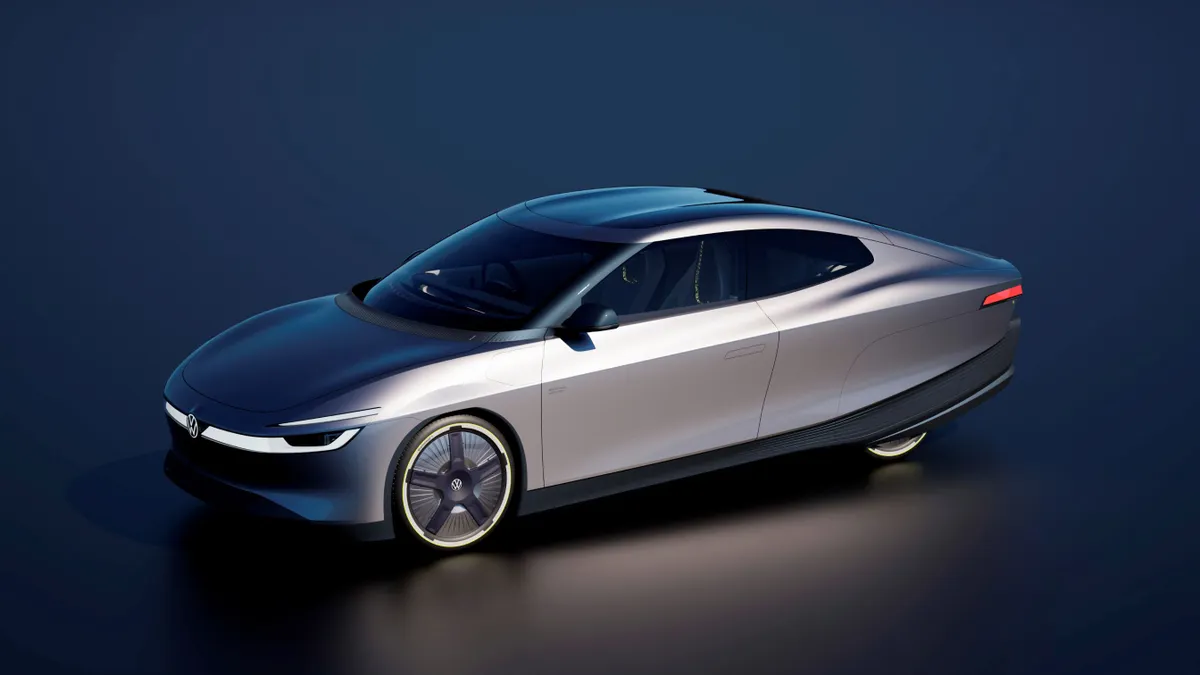
The low-slung, two-plus-two Mission Efficiency is not a preview of a new production model. Instead, it serves as an engineering showcase built around elements of the German carmaker’s MEB+ platform and electric drivetrain technology developed for the new ID. Polo hatchback.
Volkswagen describes it as a “near-production” vehicle and says its primary purpose is to demonstrate the effect of aerodynamics, weight reduction and drivetrain efficiency on energy consumption and range.
Volkswagen Chief Designer Andreas Mindt says the Mission Efficiency’s long roofline and aerodynamically dictated shape allows “a state-of-the-art, efficient sports car in which the DNA of the legendary Volkswagen XL1 chines through,” as stated in a release. The Mission Efficiency development team also used both the XL1 and Volkswagen's ID.R electric sportscar as aerodynamic reference points.
At the heart of the Mission Efficiency is the same front-mounted synchronous electric motor used by the ID. Polo, developing 133 hp and 195 lb-ft of torque. It drives the front wheels through a single-speed transmission.
The battery pack corresponds to the production unit used by the ID. Polo, and it uses the same unified-cell and cell-to-pack technology, although Volkswagen increased its usable capacity from 52.0 kWh to 54.9 kWh through software changes. Maximum DC charging power is 105 kW.
Where Mission Efficiency departs radically from the ID. Polo is in the body wrapped around that hardware.
At about 188 inches long, 69 inches wide, and just 55 inches high, the two-door concept is exceptionally long and low. Its 106.3-inch wheelbase is 3.9 ins. longer than that of the ID. Polo, while a lengthy rear overhang allows the body to taper into a narrow teardrop-shaped rear.
That’s a whole size up from the XL1, which was just 153 inches long, 66 inches wide, and 45 inches high, on an 87.6-inch wheelbase. Yet the same fundamental aerodynamic philosophy is evident in its heavy front end taper, long roofline, enclosed rear wheels and teardrop shape.
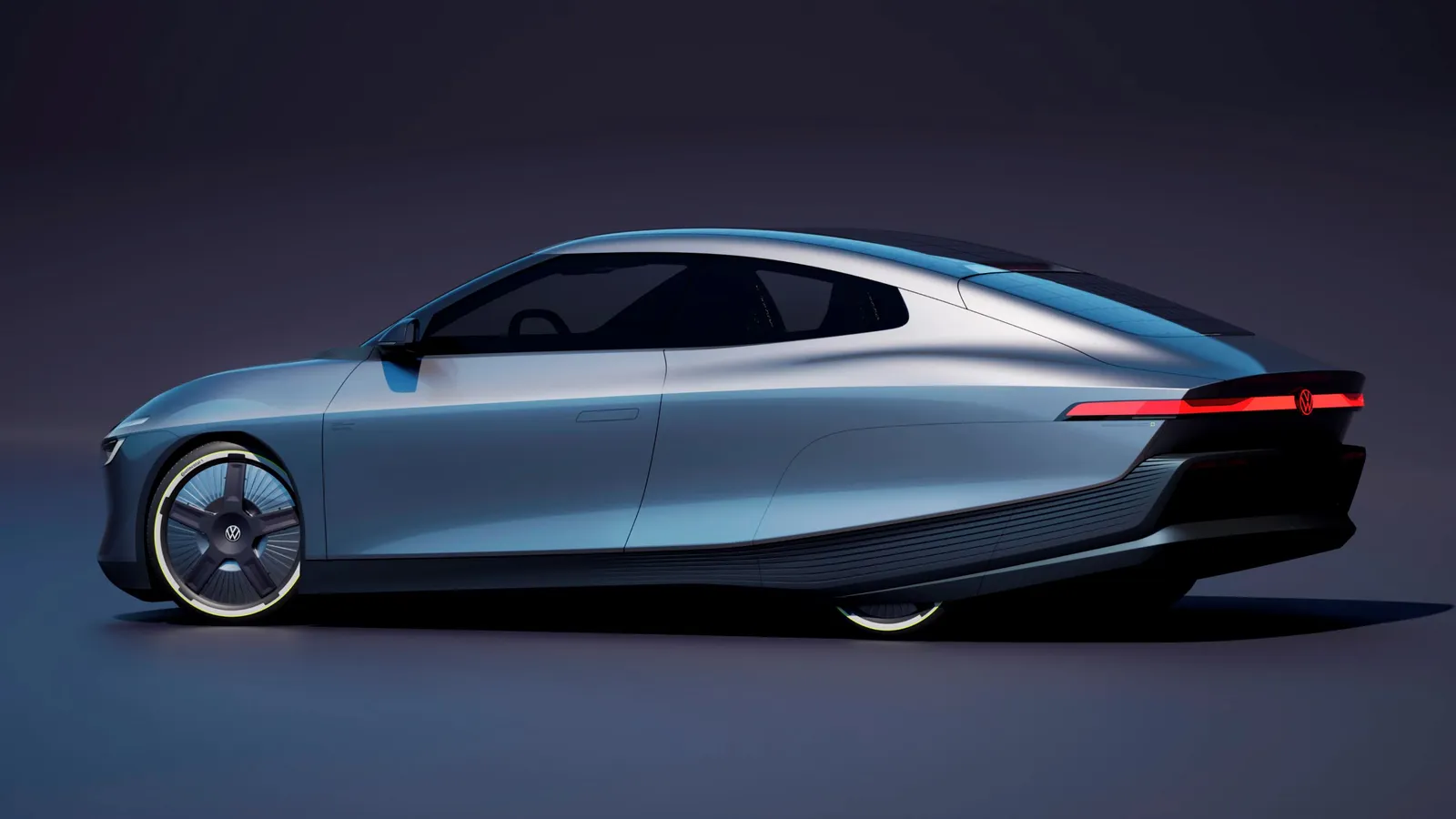
The approach produces a claimed drag coefficient of just 0.158 — lower than the original plug-in hybrid XL1’s 0.189 — which Volkswagen says makes it more aerodynamically efficient than any other vehicle yet approved for road use. That and a small frontal area mean exceptionally low drag. New ideas included in the Mission Efficiency include a trio of cooling flaps that sit flush within the front end and open only as far as cooling requirements demand. Volkswagen has also developed patented deflectors inside the wheels to prevent air entering the rims and creating turbulence.
The concept retains conventional exterior mirrors. Volkswagen says calculations and wind-tunnel testing indicated cameras would provide only a negligible overall efficiency improvement while adding significant cost in a potential production application.
Affordable EV bones, plus composites and a solar roof
Under the extreme appearance, it’s not just the propulsion system that’s borrowed from the ID.Polo. It shares its front axle and steering with the ID. Polo, as well as the basic architecture of its rear suspension — although a 6.7-inch narrowing of the rear axle helps achieve the tapered body profile.
The Mission Efficiency’s doors, hood, rear hatch, fenders and other add-on components use a high-strength carbon-fiber reinforced plastic composite material. Volkswagen says it has European road approval and meets the relevant crash, strength and protection requirements.
Another experimental feature is a semi-dry braking system. The front retains the ID. Polo's hydraulic brakes, while the rear uses a new electromechanical system developed with supplier Aumovio that eliminates conventional brake lines and fluid.
A 370-watt photovoltaic system integrated into the glass roof and rear hatch supplies low-voltage electricity to various components rather than the propulsion system. Still, VW claims the lighter demand on the high-voltage battery pack means as much as 18.6 miles extra range per day depending on variables like the season and weather conditions.
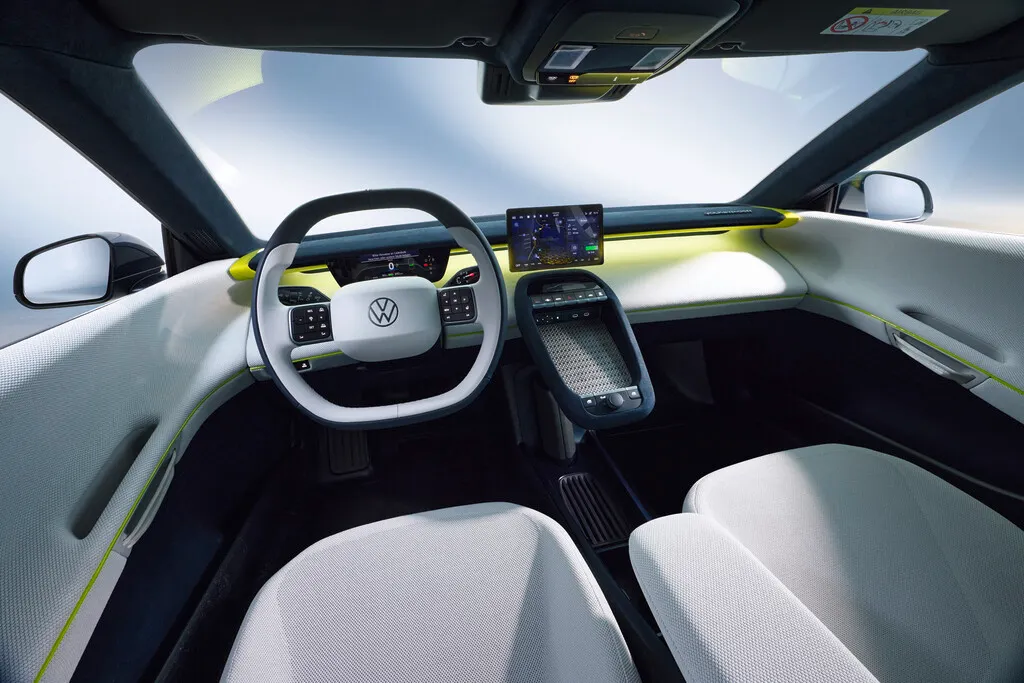
Unlike the two-seat XL1, the Mission Efficiency makes at least a nod toward practicality. It has four seats — although Volkswagen says the rear pair are intended for occupants no taller than about 5-foot-3 — and a 17.0-cubic-foot luggage compartment. Folding the rear seatbacks creates a load floor 71 inches long, it reveals.
There is no permanently installed central infotainment display and no audio system. Instead, a smartphone or tablet serves as the infotainment screen, while a portable Bluetooth speaker replaces built-in speakers. Vehicle functions are activated through physical controls and a small e-paper display.
From the original XL1 to lessons for an EV future
The original XL1 emerged in 2013 from Volkswagen's long-running project aiming to develop a so-called “one-liter car”. Its plug-in-hybrid drivetrain combined a 0.8-liter two-cylinder turbocharged diesel engine producing 47 hp with a 27-hp electric motor, a 5.5 kWh lithium-ion battery, and seven-speed dual-clutch transmission. The 1,753-lb two-seater featured a carbon-fiber body structure, rear-wheel drive and an electric range of approximately 31 miles — with a combined fuel efficiency claimed at an equivalent 261 mpg under the older NEDC European test cycle used at the time.
Although the XL1 was never officially offered for sale in the U.S., it did reach some global customers in tiny numbers. Volkswagen claims 200 examples were built for customers at its Osnabrück factory in Germany, but this most efficient Volkswagen road car cost 111,000 euros, the equivalent of roughly $145,000 then.
Official WLTP consumption is 8.4 kWh/100 km, or about 7.4 miles per kWh. The concept accelerates from 0-62 mph in 9.0 seconds. and has a top speed of 99 mph. On a recent 794-mile road journey from its Wolfsburg research and development center in Germany, through Poland and the Czech Republic to Vienna in Austria, VW reports nearly 6.9 kWh/100 km excluding charging losses and about 7.5 kWh/km with them — with an average 42 mph for the journey and a top speed of 86 mph.
As a result of its low drag, Volkswagen says Mission Efficiency uses more than 30% less energy than the production ID. Polo above 50 mph. At 87 mph, it claims the concept consumes approximately the same energy as the ID. Polo does at 62 mph.
Where the original XL1 asked how little fuel an internal combustion engine could use, the new concept poses much the same question for an electric car. The difference is that its drivetrain is no exotic laboratory exercise but one already set to be delivered in mass production.