Dive Brief:
- The Supervisory Board of automaker Volkswagen Group has approved a sweeping restructuring plan dubbed “Future Plan 2030” that targets reducing its workforce by 50,000, consolidating its global model lineup and implementing cost controls to improve its margins, the company announced in a Sept 3 press release.
- The Future Plan 2030 strategic plan has 12 initiatives, including investments in new products and technologies for future growth areas, more efficient structures across its operations and efforts to make the automaker more competitive in order to sustain long-term profitability.
- “This is a strong sign for the future of the Volkswagen Group, said CEO Oliver Blume, in a statement. “We are taking responsibility for our entire team, for our partners and for industrial jobs worldwide. Over the coming years, we will invest a three-figure billion sum to make our iconic brands even more attractive, stronger and more competitive.”
Dive Insight:
The goal of Future Plan 2030 to have a leaner corporate structure and more effective use of capital. The automaker is targeting global sales of nine million vehicles a year and targets an operating margin of 9% by 2030.
Volkswagen expects operating costs of 31 billion euros ($36 billion), with 37 billion euro in overhead costs and a target of 135 billion euro for capital expenditures and research and development costs between 2027 and 2031.
The automaker is also implementing an “Operational Excellence” program to bring together research and development, procurement, production, quality and sales teams to boost efficiency, reduce vehicle development timelines and increase the automaker’s global competitiveness.
By 2035, Volkswagen says it will reduce its model portfolio by around 50% from its current number, while also reducing vehicle complexity by around 75%. With a reduced model lineup, automaker is targeting higher volumes per nameplate, as well as lower production costs through economies of scale.
Volkswagen plans to tailor its vehicle platforms for global regions, launching new electronic architectures, driver assistance systems and software to meet the expectations of customers in both the Western and Eastern hemispheres.
In North America, the automaker says it will shift towards high-margin vehicles, while its vehicle production in China will be adjusted downward on lower demand, but the vehicles built in its local factories will be exported to other regions it calls the “Global South.”
Volkswagen is also exploring a significant reduction in production capacity in Europe. Its Supervisory Board determined that the automaker’s European capacity currently exceeds demand by more than 500,000 units per year, per the release.
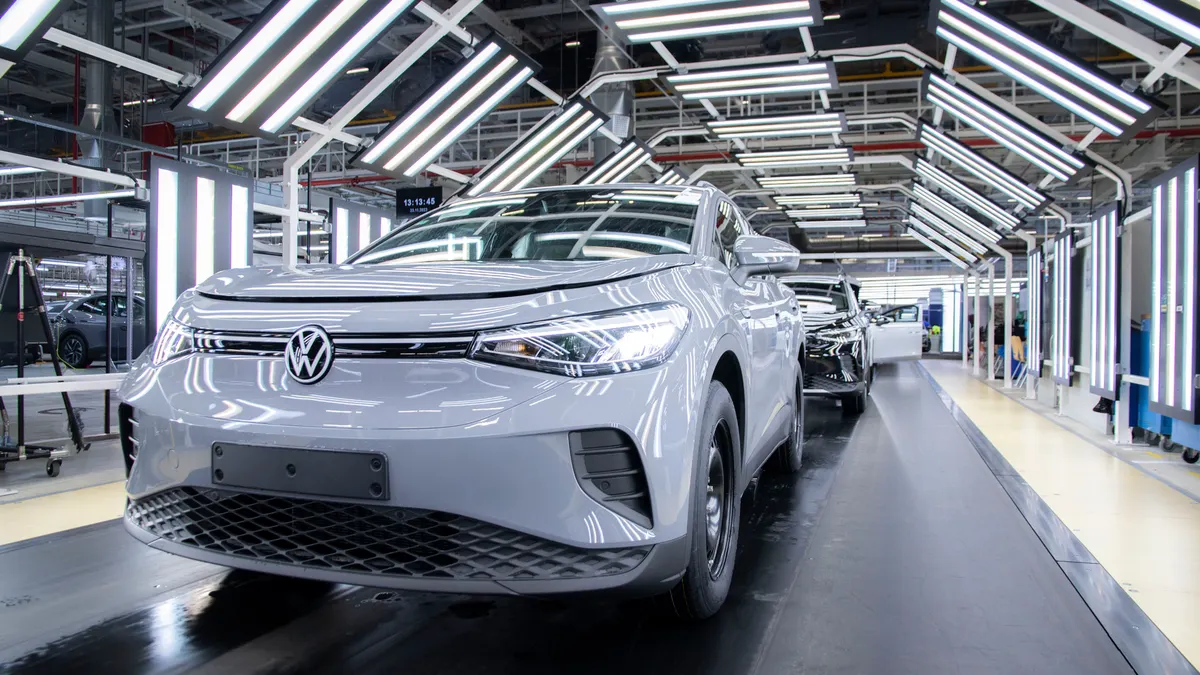
The company plans to develop a more competitive production structure for four plants in Germany by the end of June 2027. It says that production capacity at the plants in Emden, Zwickau, Hanover and Neckarsulm cannot be secured from 2031 to 2034, and that alternative uses for the facilities are being assessed.
The four plants currently employ around 45,000 workers out of the roughly 50,000 the automaker plans to eliminate. Other roles include management positions.
As the Future Plan 2030 moves forward, all of the measures already under way will be pursued consistently and further steps will be initiated immediately, the company said. Agreements with employee representatives in Germany, including labor unions, are required before any job cuts. Volkswagen said that all stakeholders will be involved and discussions will begin soon.
Volkswagen's Executive Board will be responsible for implementation of Future Plan 2030 and will drive the program forward with clear governance at the required pace, per the release. The Supervisory Board will also be closely involved in this process, the automaker said.
“The Supervisory Board received a thorough briefing on the transformation concept developed by the Executive Board, said Hans Dieter Pötsch, Chairman of the Supervisory Board, in a statement. “As the Supervisory Board, we are convinced that implementation of the Future Plan will secure the long-term viability and competitiveness of the Volkswagen Group.”