

Dive Brief:
- “Scion by Toyota” is arriving in the U.S. to a small subset of Toyota dealers in the second half of 2027, the automaker confirmed with a Nov. 10 press release and events in Michigan and Texas. This time it’s “a new brand built around curiosity, possibility, and the freedom to explore mobility in new ways.”
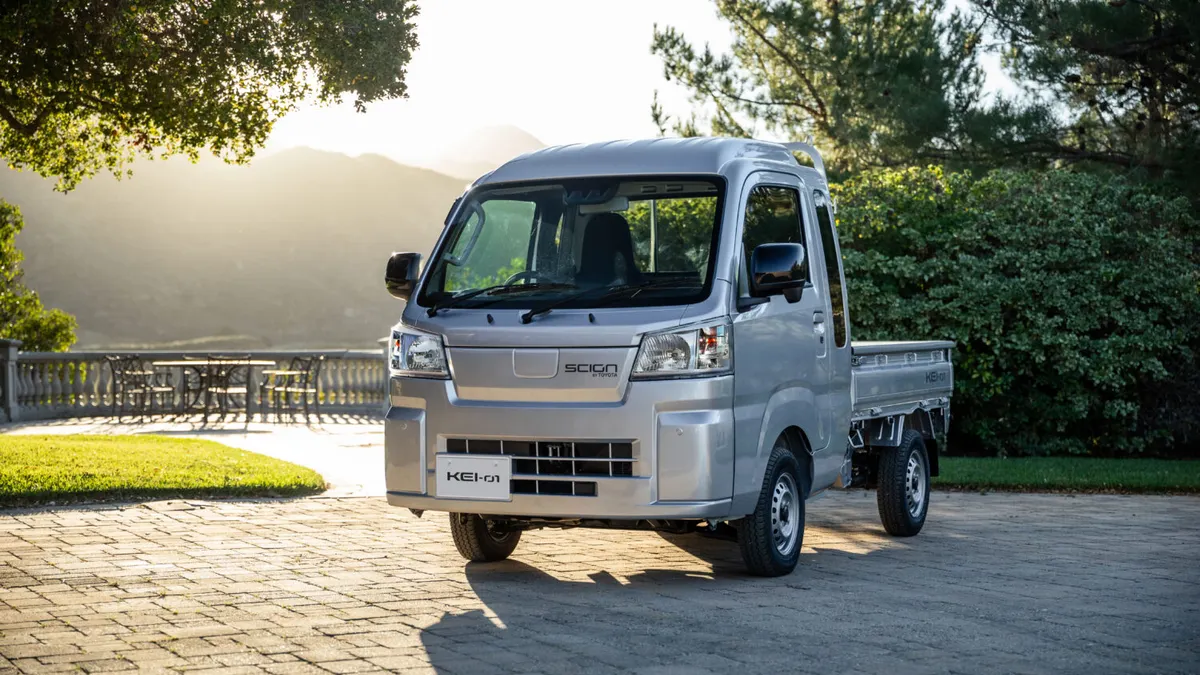
- Shown alongside two other potential products, the KEI-01 will lead the Scion by Toyota lineup as an adapted version of a very compact product designed for the Japanese domestic market but remixed for U.S. fleet customers and initially set to be assembled at Toyota’s Indiana Plant.
- “Scion by Toyota gives us a place to challenge conventional thinking, explore new possibilities and create mobility in new ways,” said Simon Humphries, Toyota Motor Corp. chief branding officer and head of design. “The KEI-01, SxS and BKE concepts each represent a different possibility — and together, they show what can happen when curiosity leads the way.”
Dive Insight:
While the KEI-01 is clearly not a high-volume model, Toyota says that it will be supported by a $34 million investment and will add about 50 new jobs. The assembly will be via a knockdown kit, according to Automotive News — a path that may spare Toyota the 25% “Chicken Tax.”
The KEI-01, which is just over 11 feet long and less than five feet in width, is a size smaller than the smallest current U.S.-market passenger cars, and it will comply with federal requirements as a Low-Speed Vehicle — meaning it will be limited to 25 mph. That narrows the U.S. scenarios in which it might be used, initially, to situations like commercial urban delivery fleets, corporate campuses, golf courses or for farm duty.
With the steering wheel on the right side, the KEI-01 is, true to its badging, effectively a Japanese “kei” truck, employing the 660-cc 3-cylinder engine and continuously variable transmission expected for this genre in Japan. With selectable four-wheel drive, it can tackle mud, snow, or uneven terrain, according to Toyota, carry up to 600 pounds in its cargo bed, and tow small trailers.
Toyota emphasizes that this isn’t heralding a revival of Scion as previously known to the U.S. market. The automaker said in its press release that the network of authorized Scion by Toyota dealers will be selected from the existing Toyota dealer network.
Scion launched in 2002 as a youth-oriented compact-car brand — and a way to tap into compact-car tuner culture and Gen X’s perceived willingness to embrace simplicity but still spend extra to customize their vehicles. The brand was discontinued in 2016, but Scion by Toyota’s revival could effectively remix the approach for present-day mobility needs at select dealers.
In 2015, longtime Toyota executive Bob Carter, then senior VP for Automotive Operations of Toyota Motor Sales U.S.A., cited to WardsAuto an evolving consumer base, shifting technology priorities, and a market swing toward trucks as reasons why the brand needed to change its selling techniques and its product lineup. The next year it pulled the plug on the brand.
In a description similar to what the automaker has applied to its multi-billion-dollar Woven City test course for mobility in Japan, Toyota called the new Scion by Toyota brand “a freedom lab — a place where ideas can be tested, challenged and evolved, and where something capable from day one can become uniquely yours.”
“Scion by Toyota explores what becomes possible when mobility supports personal expression, adventure and capability,” the brand said in its release.
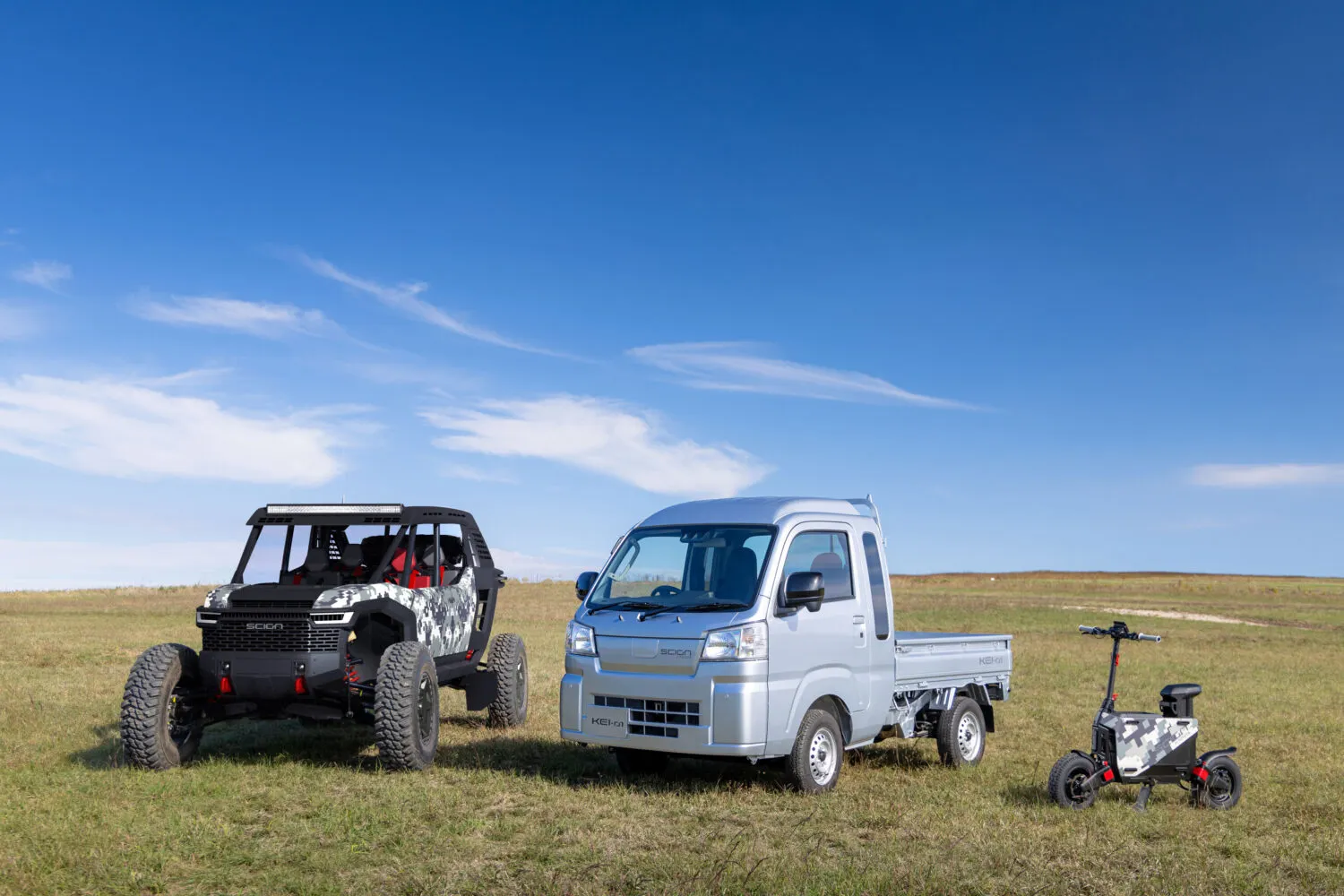
Two other concepts testing the range of mobility were shown by the brand. One, the SxS side-by-side concept, offers a hybrid turbocharged 4-cylinder powertrain making more than 300 hp, along with an off-road configuration good for desert-running or rock-crawling — including an electric Silent Mode.
Toyota says that it will “continue advancing the concept,” exploring its potential and evaluating how it could bring it to enthusiasts.
The other concept unveiled was the BKE, a collapsible, scooter-style electric two-wheeler that Toyota says is “designed to expand the possibilities of how people move through and experience the outdoors.”