STUTTGART, GERMANY — Mercedes-Benz has put a complete stop to all financial investments at its domestic manufacturing facilities.
The freeze was detailed in an internal broadcast by Michael Schiebe, Mercedes-Benz’s member of the board of management responsible for production, quality and supply chain management. It comes after four months of deadlocked negotiations with labor unions over productivity and working hours.
"The board has jointly decided to stop all further investments in the German locations," said Schiebe, adding that the company cannot sustain capital expenditure in Germany under the current financial framework.
The remarks were first reported by Germany's Handelsblatt, which said it had seen the intranet interview. WardsAuto has confirmed the interview's existence and the substance of Schiebe's comments with a Mercedes-Benz spokesperson, who declined to provide a full transcript.
The root cause of the freeze is a stark disparity in operating costs. Schiebe noted that a single production hour in Germany can cost up to five times more than at facilities in Eastern Europe. To illustrate this gap, Mercedes-Benz Group CEO Ola Källenius recently inaugurated a 1 billion euro expansion at the company's Kecskemét facility in Hungary, describing the site as a benchmark for efficiency in Europe.
Kecskemét, which opened in 2012, is now the brand's largest European plant, with an annual capacity of 400,000 vehicles rolling off a single mixed-production line.
This cost advantage is driving a strategic change. Mercedes-Benz intends to double its European production volume in low-wage countries from 15% to 30%.
At the heart of the current dispute with German labor unions is the country's 35-hour work week. Mercedes-Benz management is pushing for longer hours to boost output without an increase in base monthly pay.
With four months of talks failing to yield a viable compromise, the board is being forced to make long-term new model decisions now, Schiebe said. Because vehicle development and production planning require years of lead time, he warned that without an immediate shift in the domestic cost structure, future successor models to those on sale today could be manufactured entirely outside of Germany.
"I very much hope that we will find a joint solution at short notice," Schiebe said. He acknowledged the tension, saying, "the measures under discussion ask a great deal of our employees."
However, he maintained the company's official stance: "We stand by our strong roots in Germany, and we want the next vehicle generations to be built at our German sites too."
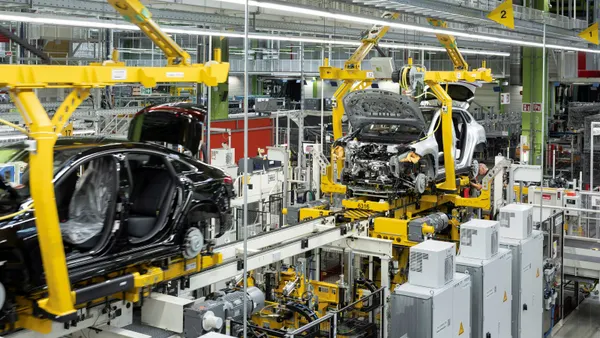
The freeze casts a shadow over the group's extensive domestic footprint, which includes twelve facilities in Germany. Only three — Sindelfingen, Rattstatt, and Bremen — are dedicated to vehicle assembly. The remaining nine sites, including Untertürkheim, Affalterbach (the home of Mercedes-AMG), Berlin, Hamburg, Kamenz, Kölleda and Arnstadt produce drivetrains, batteries, and components.
Schiebe had already cautioned in September that without significant progress, two sites, one assembly and one drivetrain facility, could face closure.
Mercedes-Benz is not alone in demanding tighter cost control on German sites. Rival Audi recently said that its Neckarsulm plant in Germany, which produces the A5, A6, and E-Tron GT, is one of four Volkswagen Group sites under evaluation for closure after 2030. Audi is simultaneously committing roughly $4 billion to a new manufacturing hub in Georgia, its first in the United States, with construction slated for 2027 and production beginning “in the early 2030s.”