Stellantis is working to substantially improve its sales and profitability in multiple regions around the world. In May, the automaker revealed a five-year strategic plan called FaSTLAne 2030. Set to “maximize capital efficiency, avoid duplicate spending and support profitability,” it promises a renewed portfolio of vehicles, with more than 60 new-vehicle launches and 50 significant refreshes across all brands and powertrains by 2030.
Of those, 11 all-new nameplates and 12 refreshed existing products will be for North America. By that year, Stellantis is planning to have 50% of its global annual volume built on three new, highly modular global platforms, with the key STLA One set for a 2027 debut — and a U.S. arrival soon after that with the next Jeep Cherokee. It’s also aiming by 2030 to have seven new products starting under $40,000 and two under $30,000.
North America leads that effort, with 60% of the plan’s 60 billion euro ($68 billion) global investment. Tom Sacoman, Stellantis’ SVP, North American Product Planning and SRT Performance Division, and head of North America Motorsports Operations, has played central roles in portfolio planning and Dodge brand development over his three-decade career, including for the automaker’s advanced vehicle architecture and electrification strategy. We recently interviewed him by phone.
WARDSAUTO: What are your visions for your four key U.S. brands going forward?
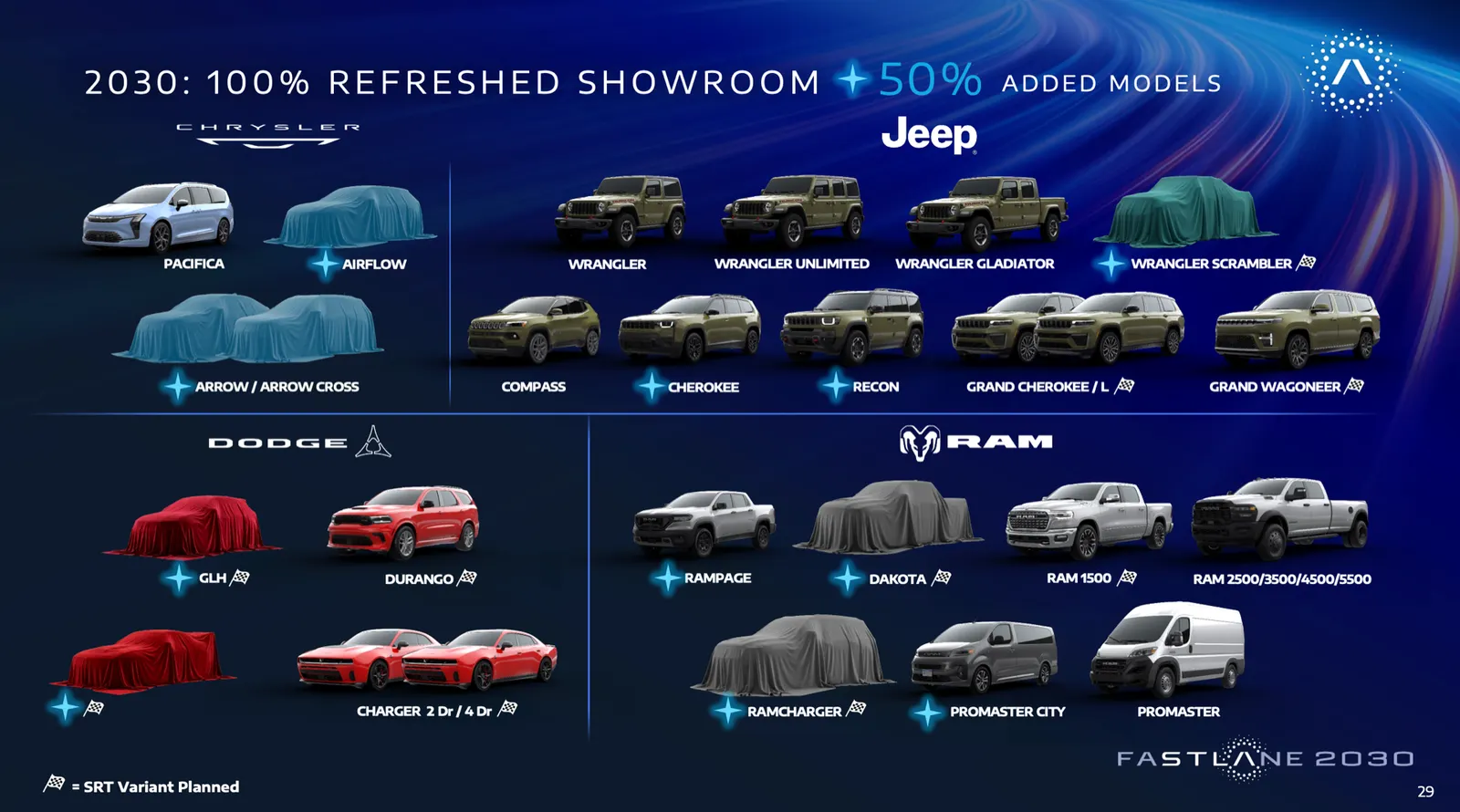
SACOMAN: Chrysler has been up and down in volume and today has just one product [Pacifica], a very good one that is emblematic of the brand. But we want to expand that, and Chrysler will be our core product addressing affordability. It has drifted away from that in recent years but will spearhead our initiative to get back into more affordable products, value and volume growth.
Dodge is America's performance brand. I was in charge of Dodge product from 2014 to 2023, and one key thing we did was distill the Dodge brand into performance. We had Darts, Caravans and Journeys in addition to Challengers, Chargers and Durangos. But now we will focus Dodge on core muscle and performance — not just super-high-performance, top-end, big-power stuff, but also more affordable performance, entry versions that will still be about sportiness and performance.
Ram is about capability, and that is where we're going to focus on growth with the most complete line of capability products including the full-size ProMaster and mid-size ProMaster City vans. The core of the Ram brand is the light- and heavy-duty pickups and cab chassis trucks, all of which will be refreshed, and we will be adding a lot of new products. We'll have a compact pickup entry called Rampage, then we'll bring the Dakota back as mid-size and the Ramcharger full-frame SUV, based on the Wagoneer chassis, after a 35-year absence from the market.
Jeep is the go anywhere, do anything brand. It's all about off-road capability. We have two families within Jeep: the legendary Wrangler off-road series -- two-door, Unlimited four-door and Gladiator pickup. And we'll add a new Wrangler Scrambler lifestyle vehicle, which I call a mash-up between a Wrangler, a “trophy” truck and a minivan in a weird sort of way.
Then there is the lifestyle series, which will be a full line anchored by Grand Cherokee, starting with an affordable Compass and the Cherokee we launched last year, which is 100 percent HEV. The Jeep Recon, an authentic open-air Jeep based on the Cherokee platform, will be coming soon as a BEV…then we’ll add an ICE to it. The Grand Cherokee two-row and Grand Cherokee L three-row are core vehicles for us that we'll continue to feed with additional powertrain options and content. And the flagship Grand Wagoneer, which will also continue to get revisions and more content capability.
How do you see the mix of powertrains going forward -- ICE vs. BEV, HEV, PHEV and EREV?.
Some of all of those, and ICE will continue to play a major role. I think we will see increases in BEVs and hybrids. And when I think of series hybrids, the next step is range-extended EVs, and we are just about to launch those in the Grand Wagoneer, then in the Ram 1500 pickup. That configuration blends the benefits of BEV and the unlimited range of ICE.
Your STLA One global platform will support B, C and D segments?
Global scale is king. The benefit is being able to have a high degree of sharing of modules and systems more than how you form the sheet metal, which ends up being somewhat local for the region. It is a modular and scalable architecture with a front module, a center module and a rear module, and the center module can be multi-energy. You can do an ICE or a BEV without having to carry the weight and the impacts of the BEV into the ICE.
How much are you affected by tariffs?
When the tariff situation came down the pike, we had daily meetings with Mr. Filosa [CEO Antonio Filosa]. We had an existing playbook, but you never know the details until they are defined. Our North American footprint includes plants in Canada and Mexico so it’s a super complex equation…and it’s not just about the production location but also the sources of all the parts. And not just Tier One parts, but you have to come down to Tier 2, Tier 3 and Tier 4 and understand their origins.
It has been a massive undertaking, but we think we have a good handle on it. Production location is determined on a case-by-case basis. We have announced some patriation steps in the last 12 months, and we continue to evaluate all the future products to understand what is best for the business.
How much does the relaxation of future fuel economy and emissions requirements help you?
Two things will drive what we'll do moving forward. One is regulatory, the other is customer preference. So, part of my job here — because I also have powertrain planning — is to understand both situations as deeply as possible. What is the situation today, what is going to happen with compliance elements? And we need to understand customer behavior. In some segments, you don't know if customer preference or regulation will drive what we need to do.
One of the strengths of being a global company is having all the answers in the different regions. We're doing a lot of BEV work in Europe, so we continue to develop those technologies. What I need to do as a region is stay connected with our global colleagues and anticipate when I will need to bring other technologies in, and then do it quickly. We can source from around the globe for each one of the different regions.