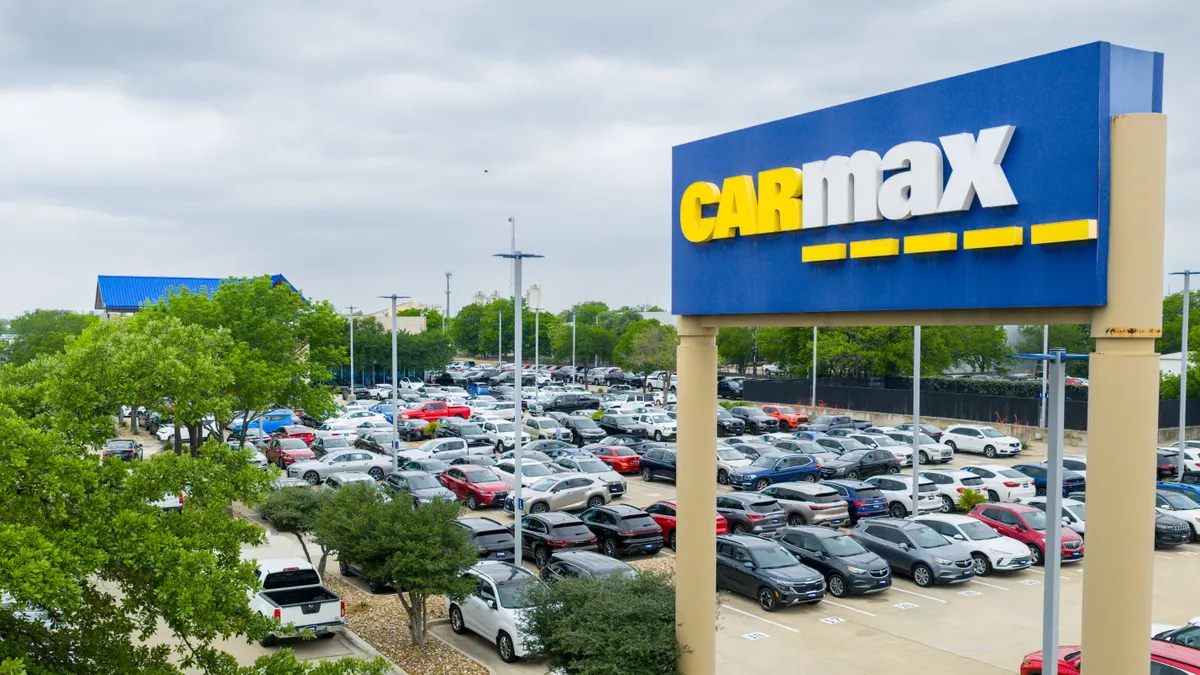
Used-car retailer CarMax posted a strong increase in sales in the latest fiscal quarter, and it even managed to achieve a higher average selling price, the company announced in its second quarter earnings on Sept. 29.
Total net revenues in Q2 for the 2027 fiscal year ending Aug. 31, were $7.9 billion, an increase of 19.5% vs. Q2 a year ago. Combined retail and wholesale unit sales were up 14.7%, to 387,735. Net earnings were $165.3 million for the quarter, up 73.3%.
Meanwhile, CarMax’s average retail, used-car selling price for the second fiscal quarter was $27,623, a year-over-year increase of $1,630 per unit, or 6.3%. Average gross profit per retail used unit was $2,205, down $111, or 5.3%.
This comes despite a short- to medium-term strategy intended to cut retail prices and margins to stimulate sales.
“During the second quarter, we further strengthened our price competitiveness to support retail sales growth. We did this by continuing to drive efficiencies in reconditioning, dynamically managing GPUs, and then passing savings on to customers,” said Keith Barr, CarMax president and CEO. GPU is gross profit per unit.
Barr has served as CarMax president and CEO since March 16, 2026, and is the former CEO of InterContinental Hotels Group.
CarMax launched the start of its current turnaround strategy late last year, including an executive search to replace then-CEO Bill Nash, a CarMax veteran executive. At the time, CarMax was under fire from some investors for overpricing its cars, and for a disjointed customer experience online. Barr’s appointment was announced in February.
Following the company’s earnings call, Barr told WardsAuto in a phone interview that the poor results in Q2 a year ago made the comparisons easier. But he also noted that CarMax deserves credit for cutting costs and taking other efficiency measures to offset a decline in gross profit per unit.
For example, CarMax CFO Enrique Mayor-Mora said in the earnings call that CarMax is saving money by sourcing fewer used cars at wholesale auctions, and obtaining more vehicles from dealers and directly from customers.
“In terms of profitability, the most profitable buy that we’ll have is directly from a customer. That is the most profitable buy, as we’ve always talked about. The least profitable is going to an auction house and buying a car at an auction house,” he said. Dealer sourcing is in between, Mayor-Mora said.
CarMax is also increasing business at its captive finance company, CarMax Auto Finance. The captive is originating a greater share of auto loans to customers with credit scores that are still prime-rated, but below the highest, super-prime tier.
CarMax Auto Finance originated 22% of its low-prime finance contracts in Q2, up from 10% a year ago. Last year, the captive routinely referred most of its low-prime tier customers to third-party lenders, who paid CarMax a fee.
The captive finance company has also increased sales with a revamped lineup of Extended Protection Products, such as extended-service contracts and wheel, tire and dent packages, CarMax said.
The new lineup also includes a new, 30-day warranty in place of a previous, 90-day warranty. The shorter warranty is cheaper than the longer one, and CarMax passes the savings along to the consumer, Mayor-Mora said.
The CFO said CarMax isn’t changing its guidance issued earlier this year, predicting the average gross profit per retail used unit would decline around $200 in FY2027.
So far this fiscal year, CarMax is outperforming that prediction, but the company still expects grosses to be lower than the previous fiscal year on average, including lower prices in the third and fourth fiscal quarters.
“I would expect GPUs for this year as a whole, and by quarter, to be down year-over-year in support of driving sales,” Mayor-Mora said.