Ben Sporn didn’t go straight into the auto retail business after college: After a stint in marketing at Google, Sporn worked for a handful of startups, many of whom used artificial intelligence.
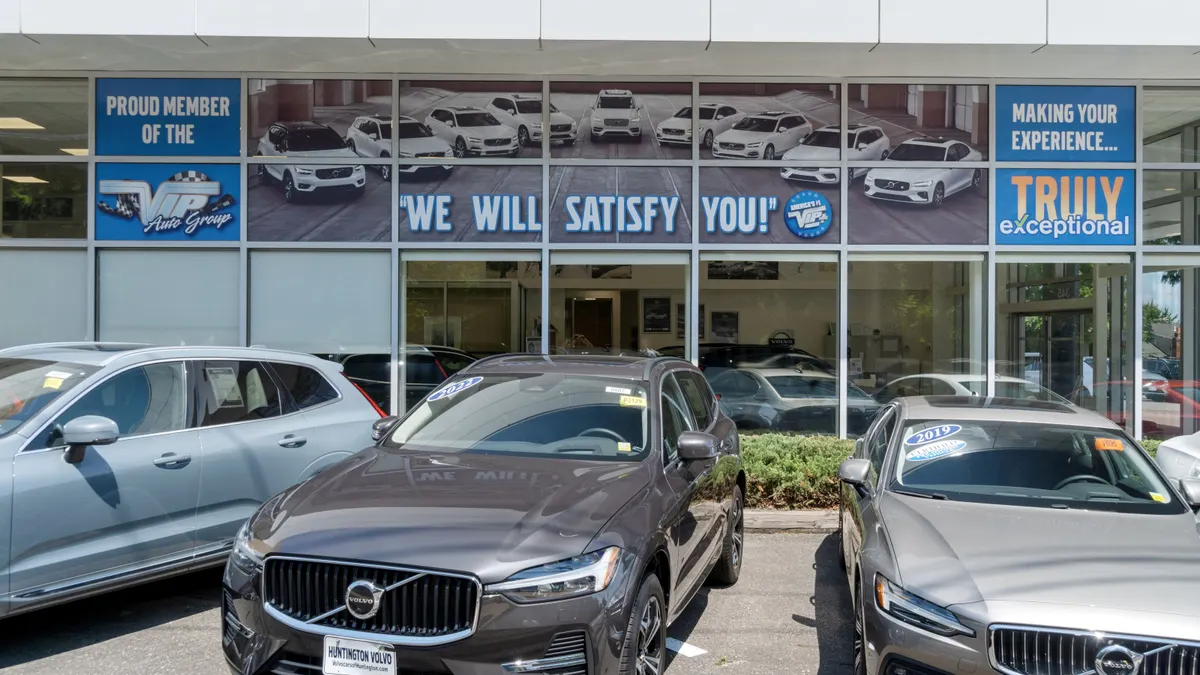
In January of this year, he founded his own business creating AI-powered business systems. That brought him back to his family’s VIP Auto Group, he said, where Sporn has already created more than a dozen AI-based solutions as chief marketing officer of his family’s dealership group.
From streamlining the group’s wholesale parts business to answering Google reviews, Sporn figures his AI tools have saved the dealership group hundreds of thousands of dollars, all without cutting staff.

And the VIP Auto Group staff are clamoring for more, according to Sporn.
“There’s so much negative press about AI,” he said. “The people in our company love it. They’re like, ‘Ben, we need more of it, how do we design more things?’ They’re getting really excited about all the opportunities for them to save more time and money.”
VIP Auto Group, based in Long Island, New York, encompasses 10 rooftops and 15 brands. With the exception of a Chevrolet store in New Jersey, all are on Long Island.
When he came to work at the dealership group, Sporn immediately realized it was spending far too much money on AI-powered software that wasn’t always meeting the group’s exact needs, and that it wasn’t using AI-powered software when it could make a big difference.
The problem, Sporn said, is that AI-based solutions are often built “in a very cookie-cutter way” that meet the need of 80% of the users but for the remaining 20% the mismatch is “not like an inch, it’s like a mile,” Sporn said.
He set about using AI to craft custom software for situations where VIP Auto Group does not follow the herd, and in doing so, found several successful applications of the technology — such as in parts sales, insurance claims, and maintenance records — that ultimately saved the company money.
In parts sales, email drafts and ticket handling go a long way
VIP Auto Group has a large e-commerce business selling wholesale parts, but when Sporn looked deeper, he figured out it wasn’t making as much money as it could selling parts.
Instead, it was being run as a break-even operation to get volume discount money back from manufacturers. “We’re like a freight logistics profit company but happens to sell auto parts,” he said.
Sporn completely overhauled each dealership’s wholesale parts sales page, including AI email drafting at scale to improve response time, ordering and fulfillment monitoring, and a self-service return platform.
The e-commerce department is now the most AI-enabled department at VIP Auto Group, Sporn said, leading to what he described as “explosive revenue and net profit growth.”
The growth was helped by a tripling of customer service representative ticket handling, which Sporn said also benefitted from custom AI tools.
The e-commerce department has trouble maintaining the right number of customer service representatives, who kept customers updated on order status. Either it added people before it grew, which wasn’t efficient, or it grew without adding customer service reps, which left customers who received no update annoyed.
Using AI, Sporn created a “customer service draft” function, which takes several actions every 15 minutes:
- Checks for incoming customer emails referencing ordered parts
- Looks at the database to determine the ordered part’s status
- If the part is shipped, it provides the CSR a shipping label and tracking number.
- If it has not been shipped, it provides context, checks other databases for useful information, and crafts a reply for the customer service representative to review before sending.
It boosted the CSR’s productivity threefold, Sporn said, because they didn’t have to check multiple systems to track the part. Instead, they reviewed the reply in the folder, made any changes, and hit send.
“It’s like, as easy as possible” Sporn said. The AI does a lot of the work, he said, “but you still want to keep a human in the loop to verify that the information being provided is accurate.”
Using AI has actually boosted the dealership’s e-commerce headcount, Sporn said.
Automated the insurance claim process
One individual was handling insurance claims for the entire group.
“She was managing like, Google Sheets, spreadsheets, emails, and staying up to date and notifying internal stakeholders, external stakeholders,” Sporn said.
Using AI, he built software around her exact process to manage the operation, he said. Not only did it make her more efficient, insurance companies reduced their rates because “we’re now, like, a AAA-rated technology firm,” Sporn said.
Tracking customer’s service records
Sporn also used an AI agent to map out every service customer’s maintenance schedule including service performed and service recommended but declined. It printed a PDF with all that information and included a human in the loop to ensure accuracy.
While software does exist to track a customer’s service record, none was able to be customized to the level VIP Auto Group required, including trim levels and other specifics, Sporn said. Plus, there was that 20% tail of incorrect information. Sporn figured the answer was to keep a human in the loop.
Using AI, he created a program that daily looks at a database he created, and that the service manager curates. AI continually updates the PDF by checking off boxes when maintenance has been performed or other services the customer needs.
Sporn also programmed it to ingest recall data after he learned service advisors spent a lot of time checking recalls. That recall information is also included on the internal document delivered to the service team. “Now, we can order the part ahead of time,” Sporn said.
But the real innovation, Sporn said, is on the back of that PDF, where there is a list of declined services. That has “provided a huge transparency for our service advisors to advise as opposed to just trying to sell.” It has saved the service manager about two hours a day, he said.
The next step Sporn said he is working on is having the PDF sent directly to the printer the night before the customer arrives so it will be ready and waiting for the service advisor the next morning.
Replace costly reputation management software
Sporn created an AI system that reads every online review and, for five-star Google reviews, it automatically crafts and sends a response. Using his experience working in marketing at Google, Sporn programmed the software to inject Search Engine Optimization terms into those responses.
The program sends the general manager a daily email with all the reviews, positive and negative, from the previous day. The good reviews have already received an AI-generated response. For the bad reviews, the GM reviews an AI-generated response which they can send, or they can forward it internally “to someone who can figure out, kind of, what went wrong, basically,” Sporn said.
Measuring the impact
The latest Cox Automotive AI in Automotive Retail Tracker, which combines first- and second-quarter survey results, found 82% of dealers use AI today. But while 69% expect AI to drive sales and revenue growth, some 33% aren’t measuring AI’s impact or “have no clarity on how they’re measuring — so most can’t see what it is delivering,” Cox Automotive said in a press release.
For VIP Auto Group, measuring the impact is easy. By creating its own AI tools, it has saved hundreds of thousands of dollars it would have paid to outside vendors, Sporn said.
He has built software that replaced five or six vendors, he said. “We were spending half a million dollars easily on software that we’ve replaced internally,” Sporn said.
For example, Sporn created a vehicle record tool that has been approved by Dealer.com and other website providers, saving that money, with the added benefit that it is VIP Auto Group branded, he said.
And he has also built a tool called Pronto that allows a salesperson to send a customer personalized videos after they leave the salesroom. That also replaces one from an outside vendor.
Now, rather than look for external AI-powered products to use, the auto group has a moratorium on new software.
“Don’t’ sign up for new software until we figure out if we can build it ourselves,” Sporn said.