Among the major announcements at Stellantis’ Investor Day event on May 21 was the unveiling of its new STLA One vehicle platform the automaker plans to utilize for over 30 Stellantis models totaling 2 million units by 2035. The new vehicle platform will be a key part of Stellantis’ new five-year strategy to accelerate growth and profit, which includes a planned investment of up to 60 billion euros (approximately $70 billion).
But like other automakers working to launch new software-defined vehicles and advanced levels of autonomous driving technology, Stellantis has tapped the specialized expertise of industry partners, including Qualcomm Technologies and Applied Intuition.
“As vehicles continue to evolve to be more centralized and technology-driven, the need for high-performance compute and AI capabilities is accelerating, Stellantis said in a press release announcing its expanded partnership with Qualcomm.
As part of our continuing coverage of Stellantis’ Investor Day event announcements, WardsAuto took a closer look at how these companies and others are contributing to the automaker's next-gen vehicle platform.
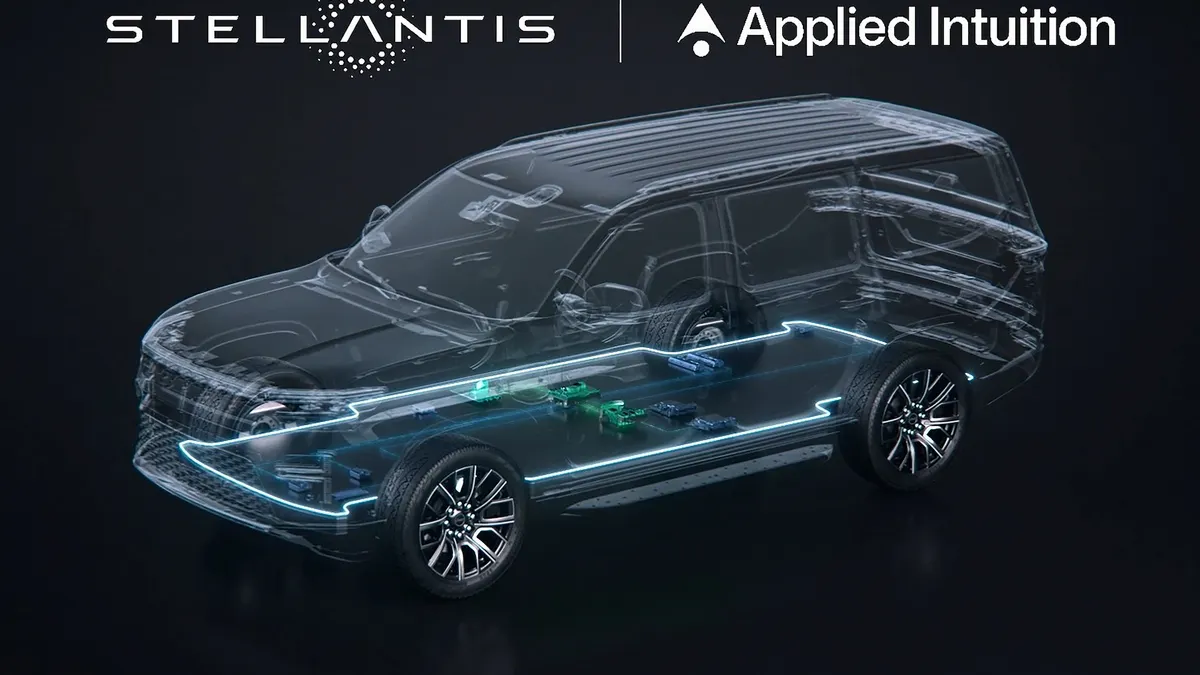
Stellantis previously worked with California-based software developer Applied Intuition on its STLA SmartCockpit vehicle intelligence platform, now that partnership is being expanded, the automaker announced in a May 21 press release. Applied Intuition’s Cabin Intelligence software platform allows Stellantis to create customized infotainment features and in-vehicle experiences.
The collaboration will support the further development of Stellantis' STLA Brain intelligent vehicle platform, with Applied Intuition contributing its expertise in software, simulation, validation and deployment in vehicles. The STLA Brain connects all of a vehicle’s electronic systems and is designed to simplify system integration and support continuous over-the-air updates for its entire service life. It's a service-oriented architecture that separates vehicle software from hardware, supporting OTA updates that are independent from the software used in a vehicle’s physical hardware layer.
“Speed, scalability and quality are critical as we bring new technologies to our vehicles,” said Ned Curic, Stellantis’ Chief Engineering and Technology Officer, in a statement. “Our collaboration with Applied Intuition helps us accelerate the development of a common software foundation across our technology platforms. For customers, this means a faster delivery of new features, a more seamless in-vehicle experience and continuous improvement over time.”
The partners are also developing an AI-powered Vehicle OS that will serve as a foundation for future Stellantis models, while shortening development timelines and speeding time to market.
“The expanded partnership positions Applied Intuition and Stellantis at the forefront of the transition to AI-defined vehicles,” said Qasar Younis, co-founder and CEO of Applied Intuition, in a statement.
As part of the agreement between the two companies, Applied Intuition and Stellantis can continue to pursue additional collaborations in the software space, and the final scope of the partnership will be subject to subsequent agreements.
Stellantis’ expanded partnership with Qualcomm includes adopting the company’s Snapdragon Digital Chassis solutions to support an advanced, unified compute platform for the entire vehicle, including cockpit, connectivity and advanced driver assist systems. The two companies also plan to develop a more scalable technology foundation across Stellantis’ portfolio, driving cost efficiency with a higher level of component standardization, per the release.
The collaboration also includes adding Qualcomm’s Snapdragon Ride Pilot ADAS technology stack and system-on-chips to future Stellantis vehicles, enabling globally validated and scalable Level 2+ automated driving capabilities. The Ride Pilot platform integrates high-performance system-on-chips, advanced computer vision and specialized software for hands-free highway driving, automated lane changing, urban-assisted driving and more.
The platform is also adaptable and can scale from active ADAS up to Level 2+ autonomous driving, enabling Stellantis to add more advanced features to millions of vehicles via software updates, per the release.
“Our customers deserve seamless, next-generation experiences that continuously evolve to meet their driving needs,” said Curic. “By deploying this intelligent platform across our global portfolio, Stellantis is delivering on that promise with unprecedented speed and efficiency.”
Last month, Stellantis also announced a strategic initiative with technology consulting firm Accenture to advance the use of digital twin capabilities for the automaker’s assembly plants using Nvidia’s Omniverse development platform.
The project will tap Accenture’s physical AI and digital manufacturing expertise with the accelerated compute capabilities of Nvidia’s Omniverse to explore the development of a virtual manufacturing environment supported by real-time data from the automaker’s factories.