Dive Brief:
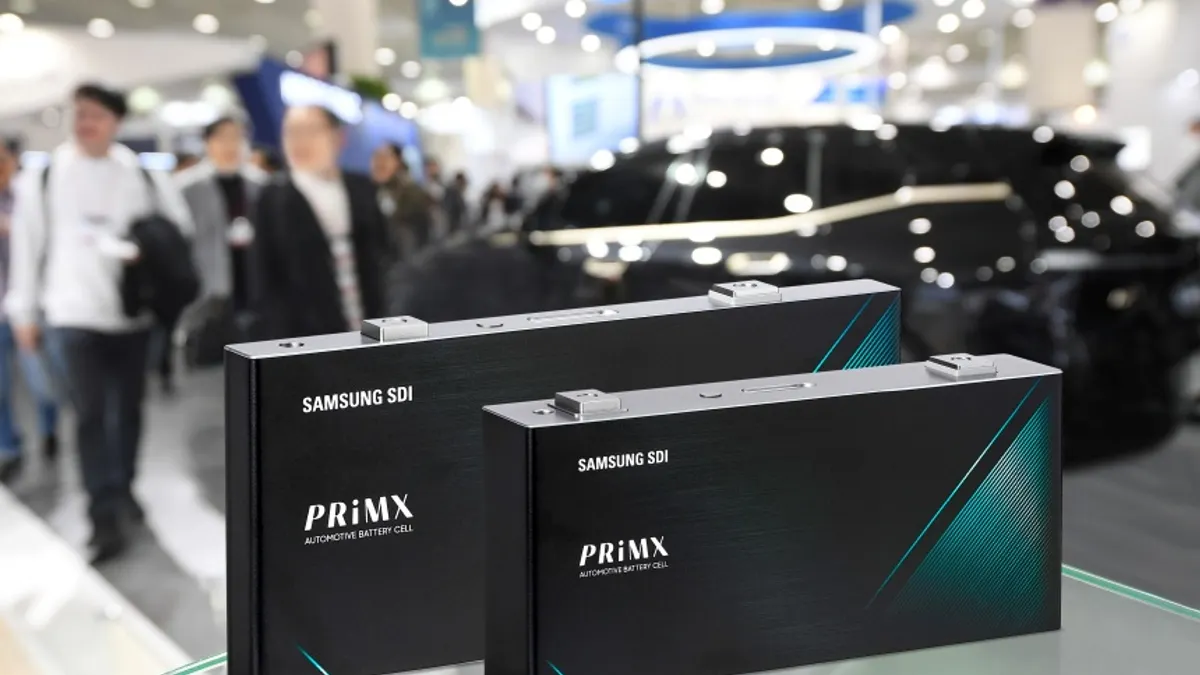
- Battery maker Samsung SDI has acquired General Motors’ entire 49.99% stake in the joint venture SynergyCells electric vehicle battery plant in New Carlisle, Indiana, the company announced in an Aug. 11 press release.
- GM’s decision to exit the JV was due to market changes since the plant was announced in 2023, including the slower-than-anticipated EV demand that prompted the automaker to revise its previous electrification strategy.
- Samsung SDI plans to utilize the Indiana plant, which is still under construction, to manufacture stationary energy storage system batteries to meet growing demand in the U.S., along with high-tech batteries for other applications, per the release.
Dive Insight:
By acquiring GM’s ownership stake in the battery plant, the facility will become Samsung’s SDI’s first wholly owned battery factory in North America.
The two companies initially planned to invest roughly $3.5 billion in the battery JV, with production of high-performance nickel-rich prismatic batteries slated to begin in 2027 and supporting around 1,600 jobs.
GM, however, is not abandoning its partnership with Samsung SDI. As part of GM’s divestment, the two companies have signed a new agreement to develop high-energy-density and fast-charging prismatic cell batteries for potential EV applications in the future, per the release.
“While reflecting recent market changes, this acquisition decision is to continue the strategic partnership with GM,” said a Samsung SDI official in a statement. “We will continue our commitment to an electrified future with the partner, while utilizing the plant to proactively respond to the fast-growing ESS market in the U.S.”
GM’s decision to sell its stake in the JV battery plant follows similar moves by Ford Motor Co. and Stellantis, both of which have recently dissolved their respective battery JVs in North America due to market conditions. The two automakers have also revamped their mid- to long-term electrification strategies.
Last December, Ford and its former joint venture battery partner SK On reached a mutual agreement to dissolve the BlueOval SK battery joint venture. The JV was established in September 2021 as part of a planned $11.4 billion investment by the two companies to build three large-scale battery manufacturing plants in the U.S.
Ford said it was repurposing the Kentucky battery plant to manufacture 5-megawatt-hour, advanced energy storage batteries for large-scale energy loads under its new Ford Energy battery subsidiary, which launched in May. These industrial-scale batteries are in demand due to the rapid growth of AI data centers.
In February, Stellantis announced it was selling its 49% equity stake in the NextStar Energy EV battery joint venture in Canada to LG Energy Solution for just $100, allowing the South Korean battery maker to take full ownership and control of the plant in Windsor, Ontario. The move was part of a broader $26 billion EV write-down and strategic shift toward building more profitable vehicles.
LG Energy Solution aims to fully utilize the former JV plant in Canada to produce lithium iron phosphate energy storage batteries. The company aims to boost its global ESS capacity to more than 60 GWh in 2026, with more than 50 GWh of that in North America.
Also last December, LG Energy Solution announced an agreement to sell its stake in its JV battery plant building in Ohio to Honda Development and Manufacturing of America for $2.85 billion.
LG said its decision to diversify was to increase the operational efficiency of its JV with Honda. The Ohio plant was originally slated to manufacture EV batteries in the U.S. for Honda and its luxury brand Acura.