

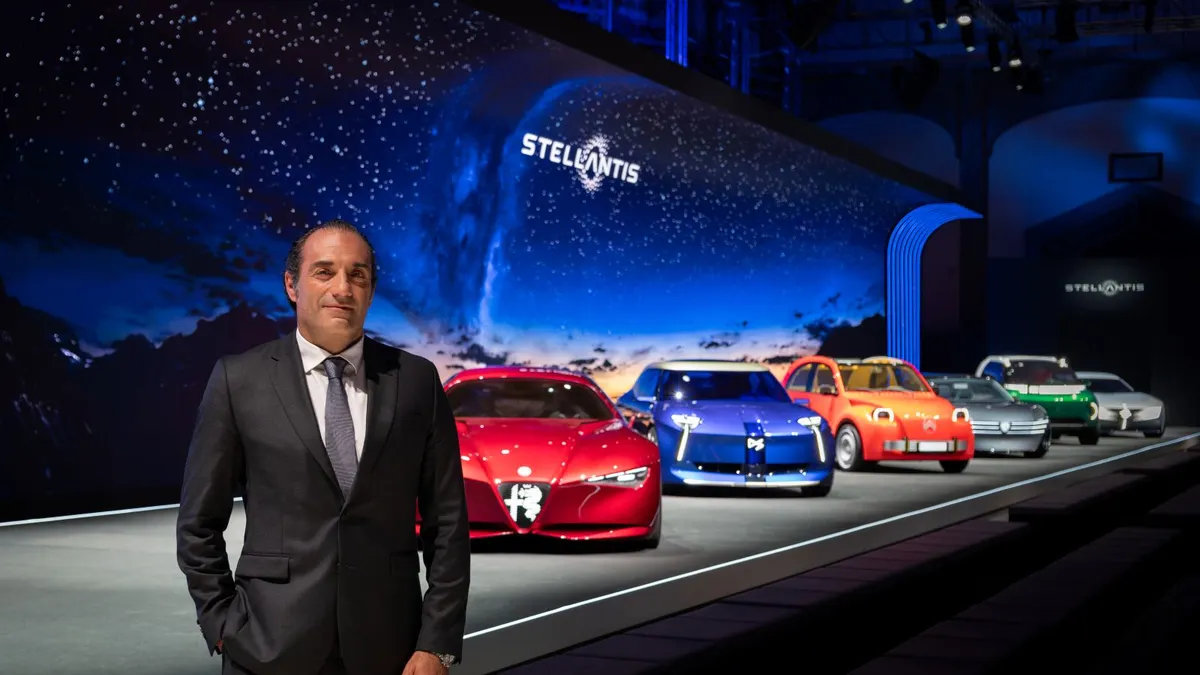
As a host of new brands from China revealed their products at this year’s Paris Motor Show, Europe’s automakers unveiled a raft of new concept cars.
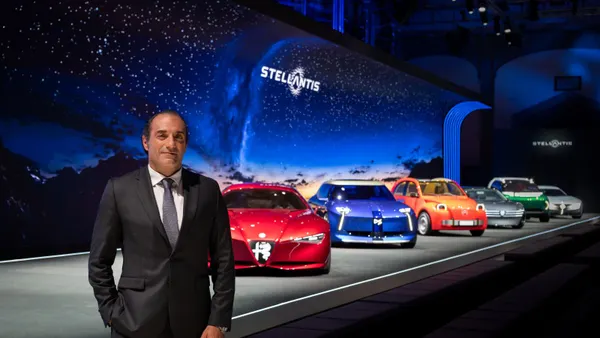
The strategy was led by the Stellantis with six new concepts targeting affordable electric vehicles for consumers in Europe, as revealed in its Oct. 11 “The Night Before” event.
Among the biggest headline grabbers was the new Citroën 2CV Concept reimagining the iconic micro workhorse as an affordable EV.
That’s because the automaker expects to be able to market the little car from as little as 15,000 euros ($16,800). It also plans a light commercial vehicle model harkening back to the old 2 CV small business delivery van.
Alfa Romeo revealed its Cuorerosso claiming a hybrid model employing a 2.9-liter gasoline engine as part of the powertrain paired with all-wheel drive, torque converter and a carbon fiber driveshaft. The automaker says the model has a clear focus on driving dynamics at the heart of the sporty brand.
Its multi-energy architecture, with models up to 15.4-feet long, enables the prospect of high-performance Quadrifoglio versions in the future.
DS Automobiles showed off its DS F3VER design-led concept to illustrate the possible future of the premium lifestyle-focused brand.
Fiat pulled the wraps off its Multiplay compact people carrier, inspired by the brand’s mold-breaking Multipla. The automaker claims the model combines the versatility of a pickup with the comfort and flexibility of an SUV.
The Vauxhall STX Concept is said to present a working vision for future station wagons with external illuminations of the brand’s more prominent logos.
Peugeot unveiled its sporty RCZ Vision EV built on an architecture based on the group’s STLA One platform and using new steer-by-wire technology. It also gives a preview of the next generation of the Peugeot onboard experience through Hypersquare, an all-new digital cockpit.
“This event brings our FaSTLAne 2030 strategy to life,” said Stellantis CEO Antonio Filosa in a company statement. “It reflects the extraordinary effort of our teams and our commitment to shaping the future of mobility through iconic brands, compelling design and innovative technology, giving customers more choice and more reasons to be excited about what’s ahead.”
Renault MPV
Meanwhile, Renault gave the public the first look at its reimagined Espace midsize family people carrier first launched in 1984, the electric E-Space Concept, revealed in the automaker’s Oct. 12 release.
It claims to create the latest attempt to create a mobile living area flooded with light from huge windows on both sides and roof, all without B-pillars to make access to the interior easier.
A sizable beast, the Renault E-Space Concept is 15.4 ft. long, 6.6 ft. wide and 5.5 ft. tall, but with short overhangs and riding on 23-inch wheels.
With a low stance on the road, the bumper splitter can be lowered even closer to the road to aid aerodynamics at high speeds.
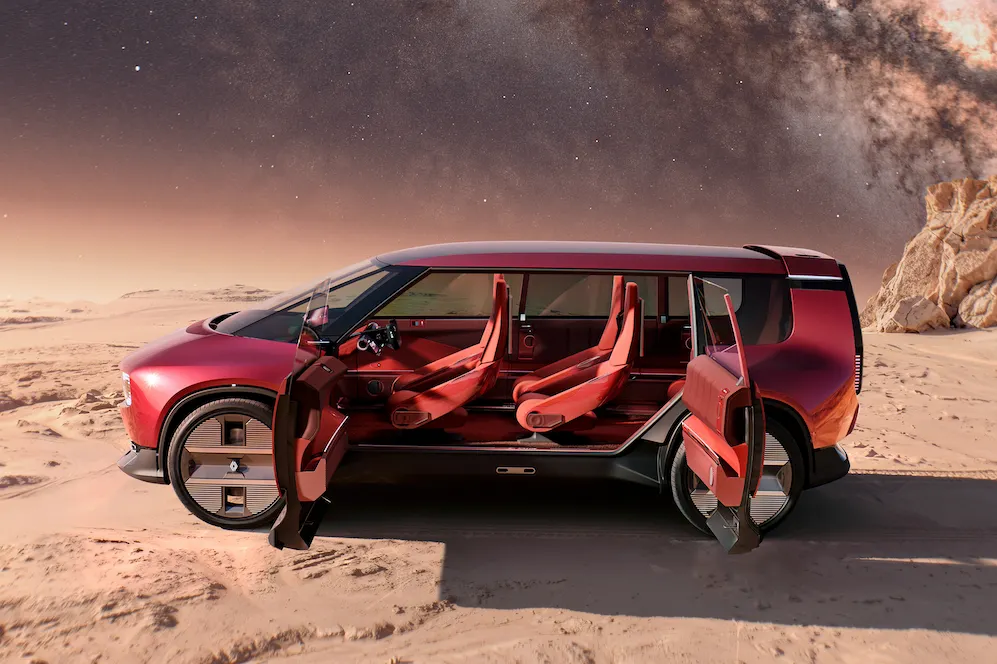
Inside, all the seats are identical in size and design and can rotate slightly on their axis. The two seats in the second row swivel through 180° to form a train-like seat arrangement with the third-row units.
In the standard forward-facing positions, passengers in the second row get folding tray tables with a 12.3-inch screen mounted on the backs of the front seats. In the four-seat configuration, the two seats in the second row fold down completely to form a large table for people in row three, who can see the screens on the backs of the front seats.
“Inside the car, the soft features – such as the textiles on the door panels – convey a sense of comfort, forming a strong contrast with the high-tech finish of the screens, console and other details,” Renault brand design director Alexandre Malval said.
“In the ever-changing world of global automotive design, currently dominated by SUVs, Renault E-Space Concept proves that the brand has everything it needs to make its mark with intelligence and appeal,” he added.