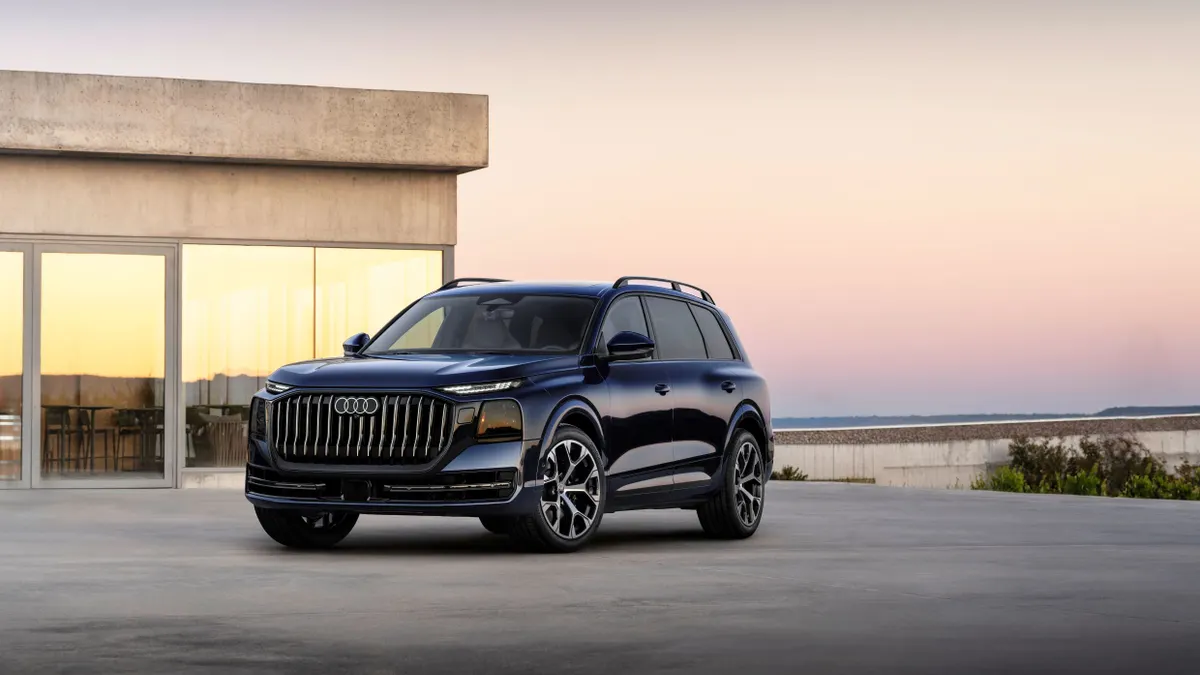
Audi has unveiled the Q9 and SQ9, two new flagship SUVs in the luxury brand’s lineup and the automaker’s first direct rival to the likes of the BMW X7, Cadillac Escalade and Mercedes-Benz GLS.
Confirmed for U.S. deliveries in Q4 2026, prices start at $87,700 for the Q9 and $118,000 for the SQ9 before destination charges. The three-row models have been conceived to fill the last major gap in Audi’s SUV lineup, while providing it with a presence in the expanding full-size luxury SUV segment.
Sporting an appearance with clear design links to the recently released third-generation Q7, the Q9 arrives five months after Audi began phasing out the A8, its traditional range-topping sedan. Measuring about 209 inches long, 87 inches wide and 71 inches high, on a 123.5-in. wheelbase, the SUV is the largest production model Audi has ever sold.
For North America, the 2027 Q9 will be powered by a twin-turbocharged 2.9-liter V6 gasoline engine delivering 429 hp and 442 lb-ft of torque. Mated to an 8-speed Tiptronic automatic transmission with the latest version of Audi’s quattro all-wheel-drive and a 48-volt mild-hybrid system, acceleration from 0-60 mph takes 4.9 seconds, before reaching an electronically-limited top speed of 130 mph.
The performance-oriented SQ9 gets a twin-turbocharged 4.0-liter V8 producing 591 hp and 590 lb-ft, with 0-60 mph time of 3.8 seconds and a top speed of 155 mph when fitted with summer performance tires.
Every 2027 Q9 and SQ9 receives an adaptive air suspension, variable rate steering and four-wheel steering as standard equipment. The rear wheels steer up to five degrees, turning opposite the front wheels at lower speeds to reduce the turning circle before steering in parallel at higher speeds to improve stability. Buyers can also specify an adaptive sport air suspension that Audi claims provides added comfort. Maximum towing capacity is rated at 7,700 pounds.
The SUV family also receives Audi's latest suite of driver-assistance systems, including automatic emergency braking with pedestrian and cyclist detection, blind-spot monitoring, rear cross-traffic alert, adaptive cruise control, automated parking, trailer maneuvering assistance and a revised emergency assist function capable of steering the vehicle onto a highway shoulder before bringing it to a controlled stop if the driver becomes unresponsive.
New Digital Matrix LED headlights are coming to the U.S. for the first time, which can project lane guidance, hazard warnings and other driver-assistance information directly onto the road surface. Audi also claims to have a world-first application of curved digital OLED tech in these models’ taillights.
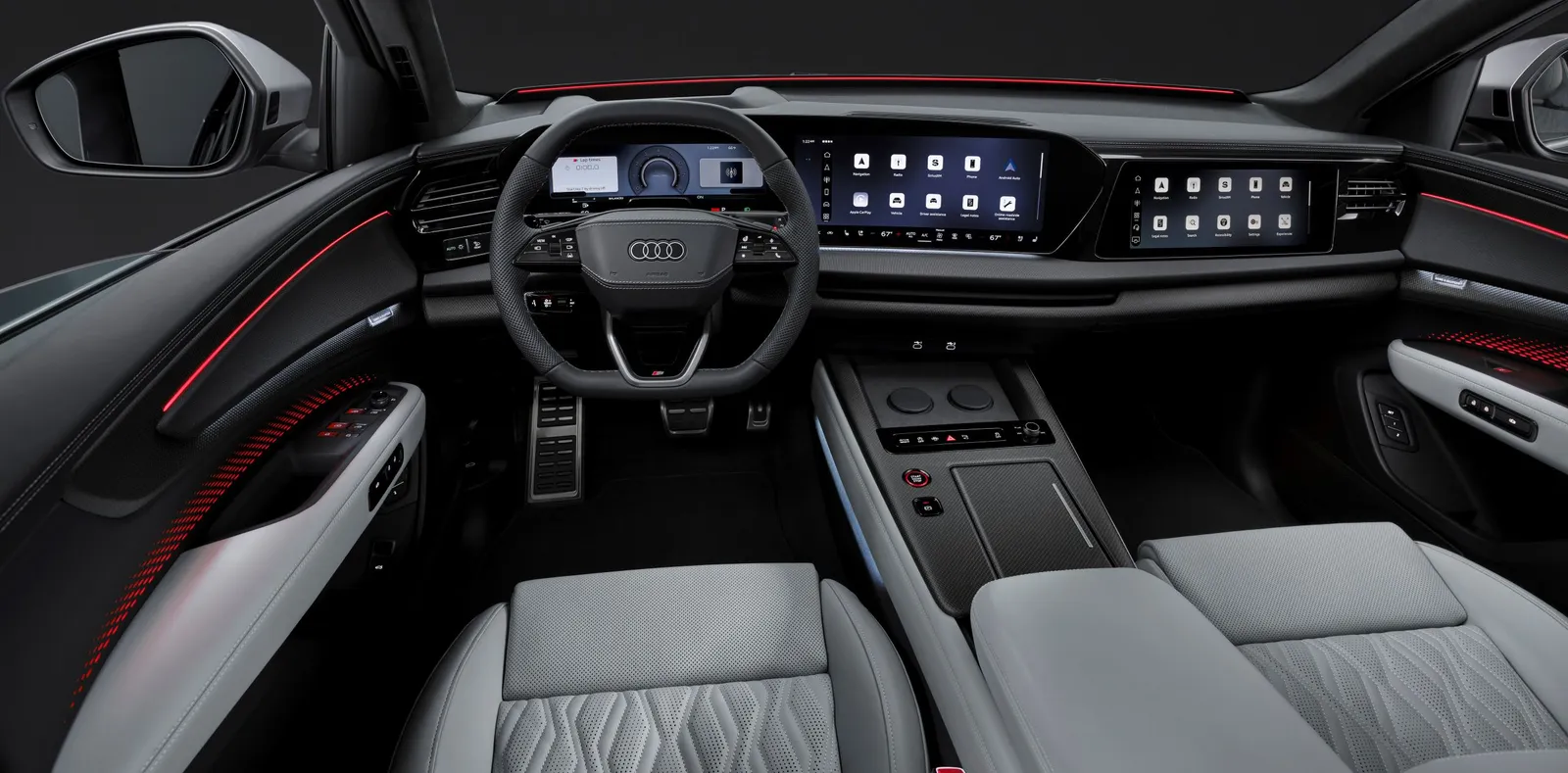
Inside, the 2027 Q9 adopts Audi's newest digital architecture. Running Android Automotive OS, the infotainment system integrates ChatGPT through the Audi Assistant when the vehicle's native voice-control system cannot answer general information requests.
Audi claims five-zone climate control among the options, and an available 22-speaker, 1,360-watt Bang & Olufsen premium audio system uses headrest speakers and seat actuators to create what Audi describes as a 4D listening experience.
These models come in six- or seven-passenger layouts, and Audi says the third row is designed for full-size adults. Cargo volume is rated at 19.3 cubic feet behind the third row, expanding to 50.0 cubic feet behind the second row and 87.7 with both rear rows folded.
The Q9 is Audi's first production model to offer power doors with integrated obstacle detection and soft-close functionality. A panoramic glass roof comes standard, while an optional electrochromic version allows occupants to vary transparency across nine independently controlled roof sections. According to Audi, the laminated glass blocks more than 99.5 percent of ultraviolet radiation while reflecting infrared heat, eliminating the need for a conventional sunshade.
Audi has also focused on everyday usability. A redesigned center console incorporates dual wireless smartphone chargers, while USB-C outlets deliver higher outputs for charging tablets and laptops. A new aluminum rail system in the trunk uses movable hooks and adjustable tie-down points to secure luggage, and the front cupholders have been sized to accommodate the drink sizes common in the U.S.
The Q9 is produced at Audi parent company, the Volkswagen Group's, plant in Bratislava, Slovakia.