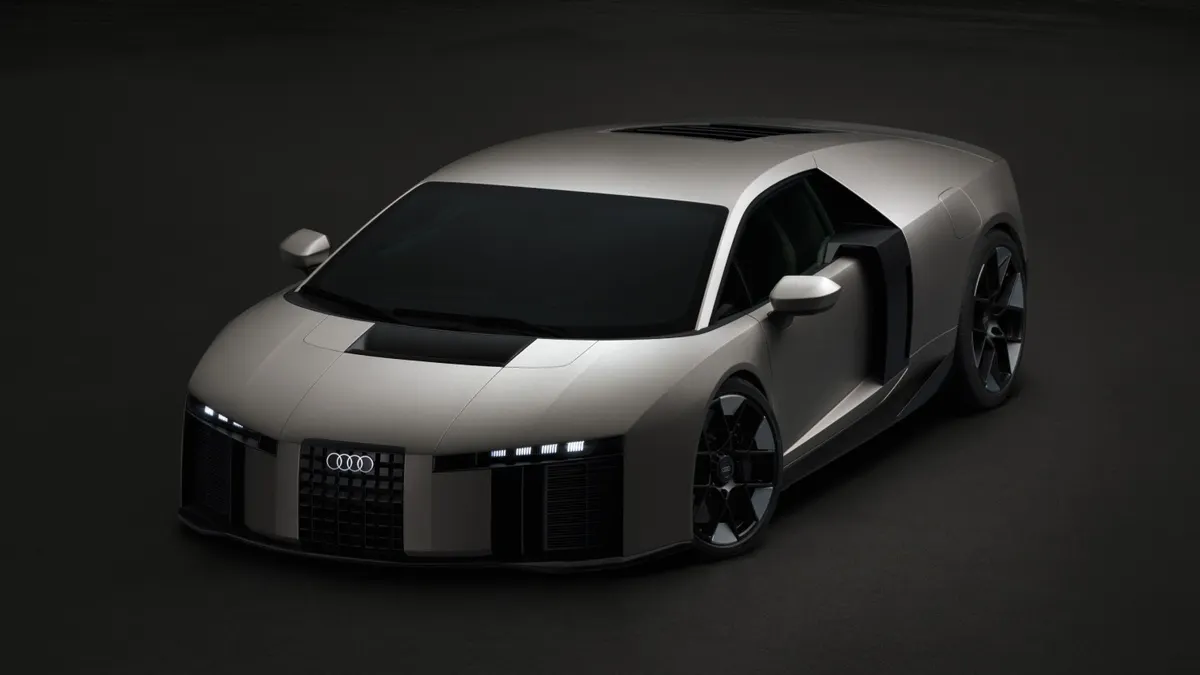
Audi has revealed the Nuvolari, a new limited-production supercar powered by a 987-hp plug-in hybrid drivetrain that combines a Lamborghini-produced twin-turbocharged V8 gasoline engine with three electric motors and delivers a claimed top speed of more than 217 mph.
Nuvolari sales are set to begin later this year, with deliveries starting in early 2027, and it marks Audi's return to the supercar segment three years after the end of R8 production. Rather than replacing that car directly, it slots into the lineup well above it, in what is set to become the most expensive and exclusive road-going Audi model yet.
Limited to 499 examples, all in left-hand-drive, and to be priced from around $685,000 in North America, the two-seat coupe will be the most powerful and fastest road-going Audi ever produced.
Despite inevitable comparisons with the discontinued R8, Audi’s V-10-powered supercar, the automaker describes the Nuvolari as an entirely separate model. It has been conceived as a low-volume flagship showcasing the company's latest hybrid, aerodynamic and chassis technologies alongside a bold new design lineage.
"This was never intended as a successor to the R8," Audi chief technical officer Rouven Mohr said May 29 at a preview of the supercar in Ingolstadt, Germany. "The brief was different from day one. The Nuvolari is a technological flagship for Audi and a showcase for what is possible when performance, electrification and lightweight construction are developed together."
Power comes from a plug-in hybrid drivetrain closely related to that of the Lamborghini Temerario. At its core is a twin-turbocharged 4.0-liter V8 producing 789 hp and 538 lb-ft of torque. The internal combustion engine is supplemented by three axial-flux electric motors, each rated at 148 hp.
Two of the electric motors are mounted on the front axle and provide torque-vectoring functionality, while a third sits between the V-8 and eight-speed dual-clutch transmission.
Mohr, who headed up technical operations at Lamborghini between 2022 and 2026, said the development team deliberately focused on the character of the drivetrain rather than output numbers. "The objective wasn't simply maximum power," he said. "It was to combine the emotional qualities of a high-revving V-8 with the responsiveness and precision that electric drive can provide."
The Nuvolari's V-8 revs to 10,000 rpm, making it one of the highest-revving turbocharged production-car engines in production today.
Energy for the trio of electric motors is supplied by a 7.3-kWh lithium-ion battery and managed through a range of operating modes including E-Hybrid, Balanced, Dynamic and Dynamic+. There’s also a dedicated Track setting featuring Wet, Dry, Race and Electronic Stability Control (ESC)-off calibrations.
Audi claims the Nuvolari is capable of accelerating from 0-62 mph in 2.6 seconds and from 0-124 mph in 6.8 seconds before reaching a top speed of more than 217 mph. The official performance figures place it among the fastest-accelerating production cars currently on sale.
The comparison with Audi's former supercar flagship is also noteworthy. The final R8 produced 611 hp and 417 lb.-ft. of torque from its naturally aspirated 5.2-liter V10, achieving 0-62 mph in 3.4 seconds and a top speed of 199 mph.
The new Audi model takes its name from Tazio Nuvolari, one of the most celebrated racing drivers of the last century. Although best known for his exploits with Alfa Romeo and Maserati, the Italian forged a particularly close association with Auto Union during the 1930s. His victories in the German company's grand prix cars helped establish a motorsport legacy that remains central to Audi's identity today, with Auto Union forming one of the four brands that later combined to create the four rings of Audi's logo.
It is also the second time Audi has used the Nuvolari name. The Nuvolari Quattro concept was unveiled at the 2003 Geneva Auto Show, but beyond the name the new supercar shares no direct connection with the earlier one-off grand tourer.
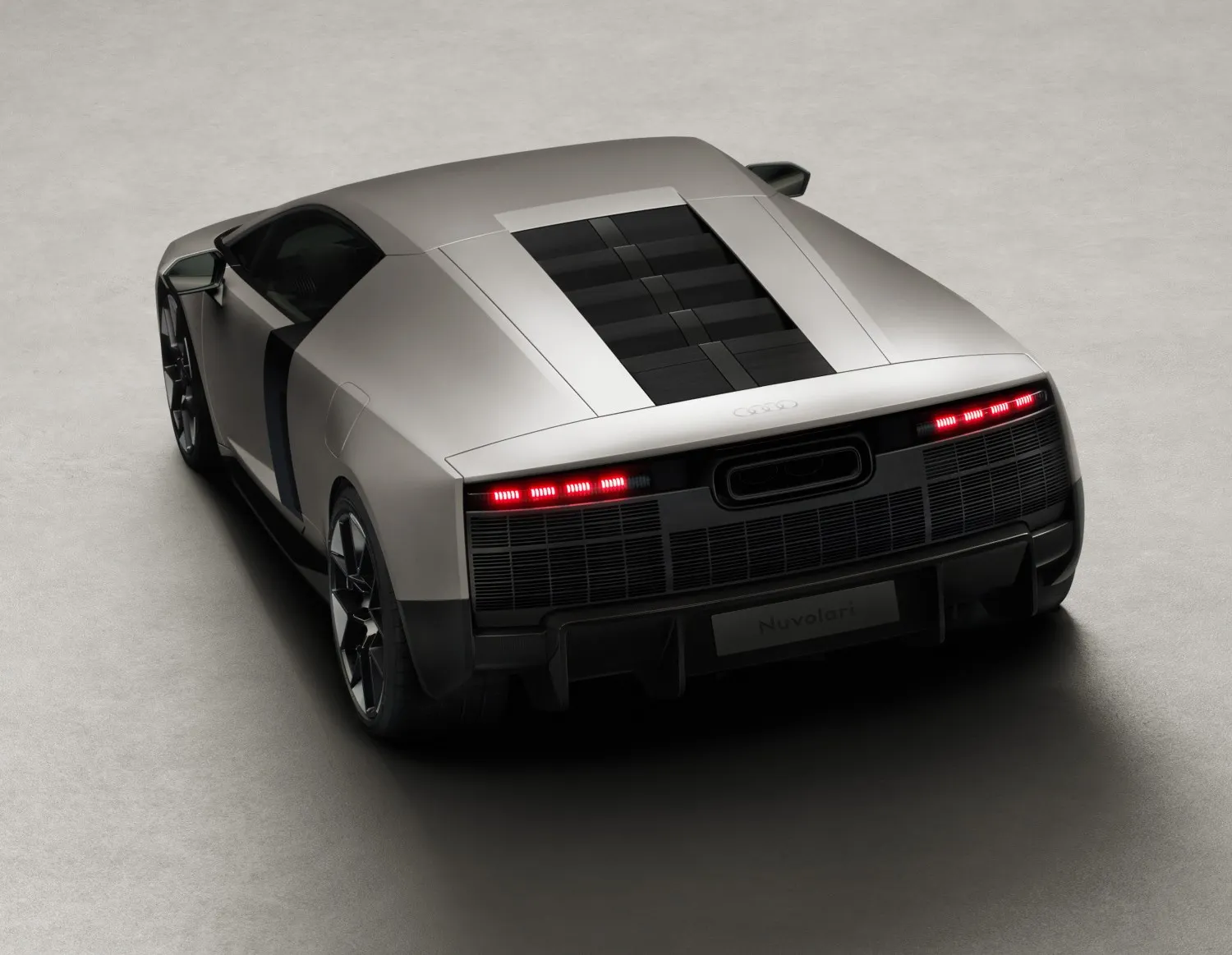
The Nuvolari is significant because it becomes the first production Audi to adopt the company's new Radical Next design language.
First previewed by the Concept C at last year's Munich Auto Show, the design philosophy introduces cleaner surfacing, simpler detailing and a stronger emphasis on proportion than recent Audi models.
One of the most distinctive features is the absence of a conventional rear window. Instead, the rear bodywork flows uninterrupted into a louvered engine cover and an electronically operated rear wing that deploys from the bodywork, prioritizing cooling and aerodynamic efficiency over rearward visibility.
Each major exterior panel is formed from carbon-fiber-reinforced plastic and sourced from an unnamed supplier in Modena, Italy. Audi describes the supporting structure as an evolution of the Aluminum Space Frame (ASF) used by the R8.
Official dimensions are yet to be revealed, though Mohr says the new Audi is "slightly longer but significantly wider than the Temerario." There is no dedicated luggage compartment, though the area behind the two seats is claimed to accommodate two pieces of luggage.
Chassis development has centered on a new all-wheel-drive control architecture known as quattro Predictive Ride. Audi claims it is capable of anticipating changes in vehicle behavior before they occur, helping to improve both stability and agility at high speeds.
Aerodynamics also play a major role in the Nuvolari's development. Active systems alter the aerodynamic balance according to speed, steering angle and selected drive mode, while a three-position rear wing can switch between closed, low-downforce and high-downforce configurations. A Formula 1-inspired drag reduction system is also incorporated. Audi says the Nuvolari is capable of generating more than 882 pounds of downforce in its most aggressive aerodynamic setting.
Braking is handled by a brake-by-wire system integrating regenerative and hydraulic braking functions. Standard carbon-ceramic brakes feature 16.5-inch front discs and 16.1-inch rear discs.
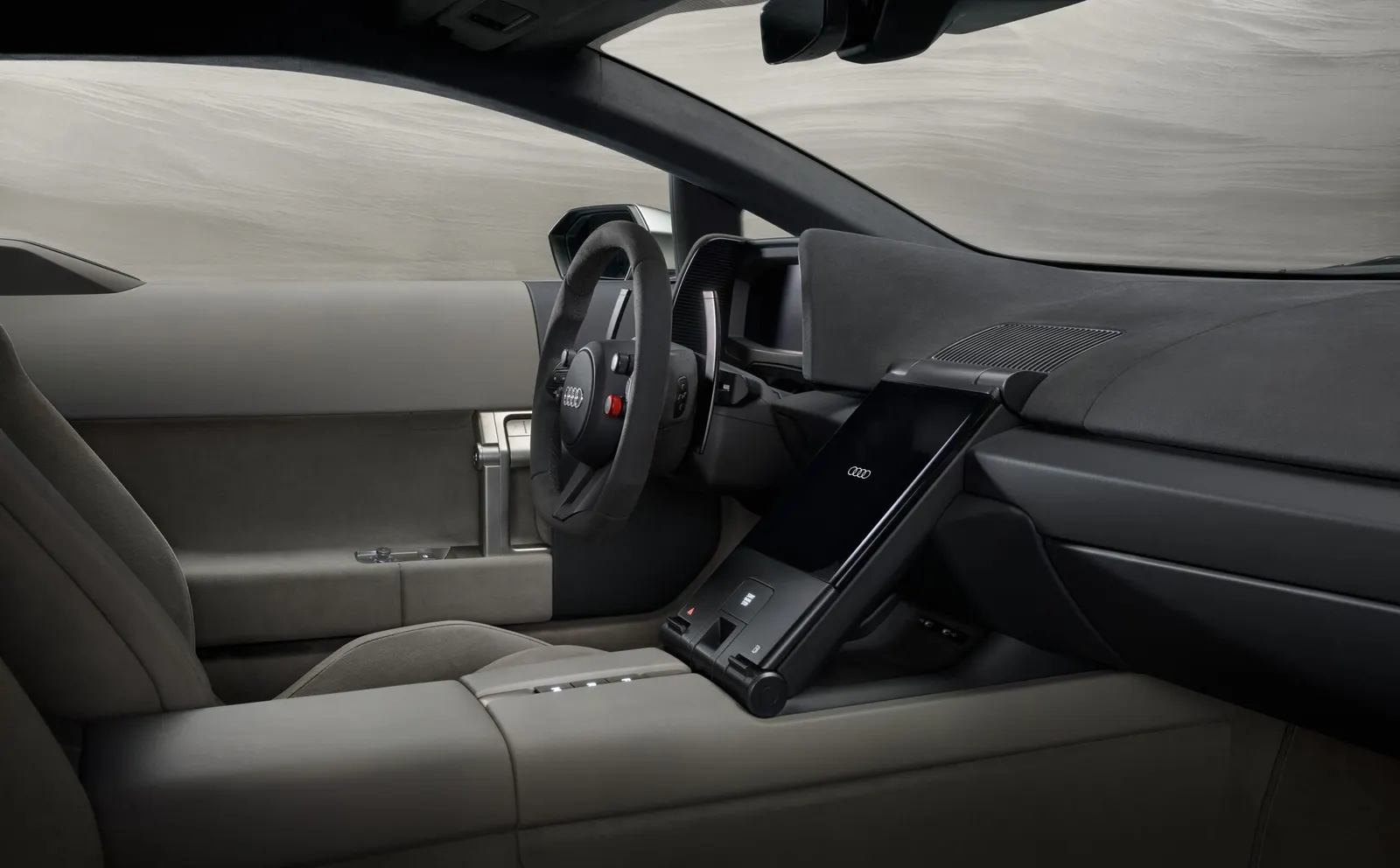
Inside, the Nuvolari adopts a driver-focused layout featuring a simplified interface, lightweight carbon-fiber seats and extensive use of aluminum and exposed carbon-fiber trim. Audi says the cabin has been designed to prioritize essential information and reduce distractions during high-performance driving.
Production is scheduled to begin during the fourth quarter of 2026, with the entire production run expected to be completed over approximately 18 months. Audi plans to build the Nuvolari at a rate of around three cars per day, with assembly taking place in both Germany and Italy.
The new German supercar is claimed to have been developed in just 13 months following a production greenlight in March 2025. The highly secretive project initially involved only a handful of top-ranking Audi officials, said Mohr.
Mohr described the Nuvolari as an important milestone for Audi's future performance ambitions.
"Cars like this define what is possible for the brand," he said. "They allow us to develop technologies, ideas and experiences that ultimately influence much more than a single model."