Dive Brief:
- Toyota Motor Corp. reported the highest-ever revenue in company history in FY2026 of 50.7 trillion yen ($324 billion) with positive vehicle sales growth in the key markets of North America, Europe and Japan, the company reported in its full-year earnings results.
- Total vehicle retail sales for Toyota and Lexus were up 2% to nearly 10.5 million units globally, according to its earnings presentation, with an 8.5% year-over-year jump in North America to 2.93 million vehicles, the highest since 2017.
- But despite record-setting revenue and positive sales growth, the impacts of U.S. tariffs erased all of Toyota’s profits in North America for FY2026, resulting in a rare operating loss of $1.9 billion for the year ending March 31.
Dive Insight:
The automaker said the total impact of U.S. tariffs on the company was 1.4 trillion yen for the year, resulting in a margin of -1.4% in North America, which turned its sales stronghold into a loss-making region. “We were not able to fully offset the impact of U.S. tariffs,” said Toyota accounting group chief officer Takanori Azuma in an earnings briefing.
It’s the first time in 16 years the automaker posted losses in North America following the fallout of the global financial crisis of 2008-2009 and massive safety recalls that occurred simultaneously.
Toyota also reported that its YoY operating income in North America declined by 402.9 billion yen in FY2026. The company’s total operating income fell 21.5% to approximately 3.76 trillion yen in FY2026, also due to declines in its key markets of Japan, Europe and Asia. The company cited high labor costs and rising material costs, as well as tariff impacts.
Toyota had warned last year that tariffs and other market uncertainties would likely impact its full-year earnings in FY2026. In May 2025, the automaker lowered its full-year guidance and forecasted that its operating income would decline by 20% YoY for the fiscal year ending March 31.
Taking into account the Middle East conflict and other factors which are also impacting Toyota’s profitability, the company is forecasting operating income of 3 trillion yen in the fiscal year ending March 2027, which would represent a YoY decline of 766.2 billion yen or roughly 20%. The automaker also forecasts that its margins will further slip to 5.9% in FY2027.
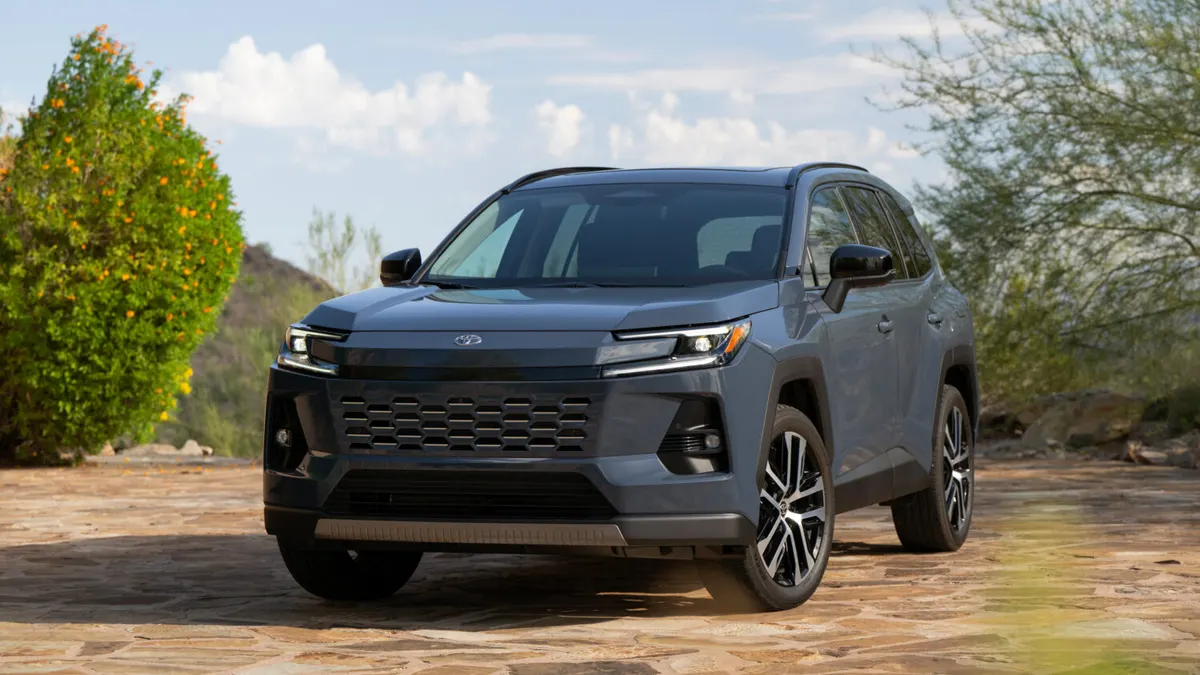
Toyota may get some additional tariff relief by boosting manufacturing in the U.S., although it won’t happen overnight. In November 2025, the automaker announced a planned investment of $912 million in its U.S. manufacturing operations over the next five years to boost hybrid vehicle production. It's part of a larger $10 billion investment commitment to increase vehicle manufacturing in the U.S. Toyota sold nearly 480,000 RAV4s in the U.S. in 2025, the highest volume ever, with hybrid powertrains accounting for around 42% of all models sold.
In March, Toyota announced it would invest $1 billion in its U.S. manufacturing operations, split between its Kentucky and Indiana facilities. It will be used to produce a second EV and boost capacity of Camry and RAV4 hybrid models and the Grand Highlander SUV. But the automaker did not give a specific timeline for when it plans to implement the investment.
Earlier this year, Toyota hosted a supplier clinic in Washington, D.C., giving its suppliers that operate roughly 600 facilities across the U.S., employing over 200,000 workers, an opportunity to share how tariffs are impacting them. The meeting was designed for Toyota to get feedback ahead of the review of the United States-Mexico-Canada Agreement, which is set to begin July 1.