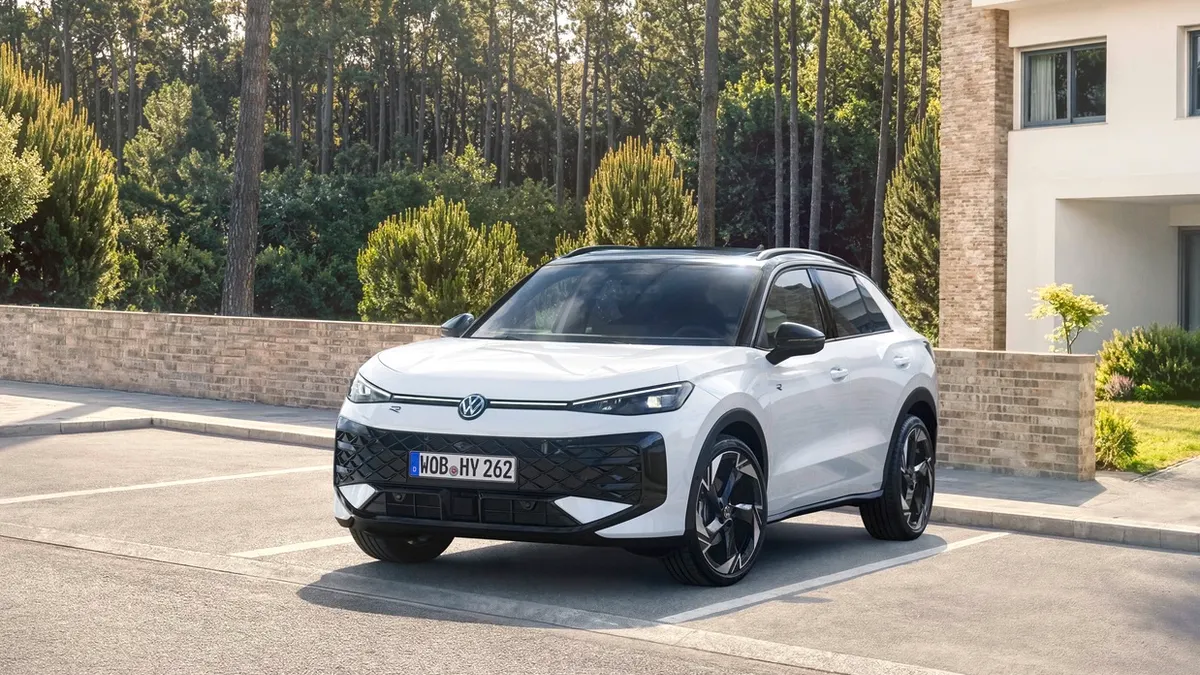
Volkswagen is rolling out new hybrids, in a move that marks a significant reversal.
The global automaker had previously prioritized plug-in hybrids and pure electric vehicles over more conventional hybrid and electrification technology, both in Europe and in the U.S.
Now hybrid versions of the Golf and T-Roc have just been announced, and detailed, for Europe.
While the automaker says it does not plan to offer these hybrids in the U.S., officials at VW’s headquarters in Wolfsburg, Germany recently told WardsAuto that a hybrid version of the U.S.-market Tiguan SUV, a model sold in Europe under the Tayron name, is planned to be launched as a rival to hybrid versions of the Toyota RAV4, Honda CR-V, and Nissan Rogue.
At present the Golf is now sold only in GTI and R performance guises in the U.S., and the T-Roc is not offered in the U.S. at all.
The new hybrid system, which employs a turbocharged 1.5L inline 4-cylinder gas engine with two electric motors and a 1.6-kWh lithium-ion battery, allows for electric-only driving at urban speeds. The battery is recharged both through regenerative braking and by the engine with one of the electric motors serving as a generator.
Volkswagen’s new hybrid drivetrain produces 168 hp and 228 lb-ft of torque, sufficient to provide the new Golf Hybrid with a 0-62 mph time of 7.5 seconds. On the European WLTP cycle, fuel consumption represents a 10-15% improvement over the mild-hybrid 1.5 eTSI model currently on sale across Europe, rising to a 35% improvement in urban driving, according to Volkswagen.
Volkswagen's adoption of full hybrid technology instead turns to follow a strategy that Toyota has pursued for more than two decades, following a start in the Prius and now rolled out across much of Toyota's global lineup.
“The new hybrid models are not dependent on a charging cable, socket or charging infrastructure,” declares VW in its press release on the new system and these first vehicles using it.
Volkswagen had previously dismissed such “self-charging” hybrids, as Toyota’s Lexus brand has marketed them as in Europe, as a technological dead end, favoring plug-in hybrids and the pure electric drivetrains of its ID electric vehicles.
The new full hybrid system sits between Volkswagen's existing mild-hybrid eTSI models and the plug-in eHybrid and GTE variants. The new system offers three operating modes: electric-only propulsion at low speeds, series-hybrid where the engine generates electricity for the electric motor, and parallel-hybrid where both power sources work together to power the drive wheels at higher speeds.
Drivers will be able to choose between Eco, Comfort and Sport profiles, with Eco limiting output to 70% and disabling a boost function for added efficiency and fuel savings.