

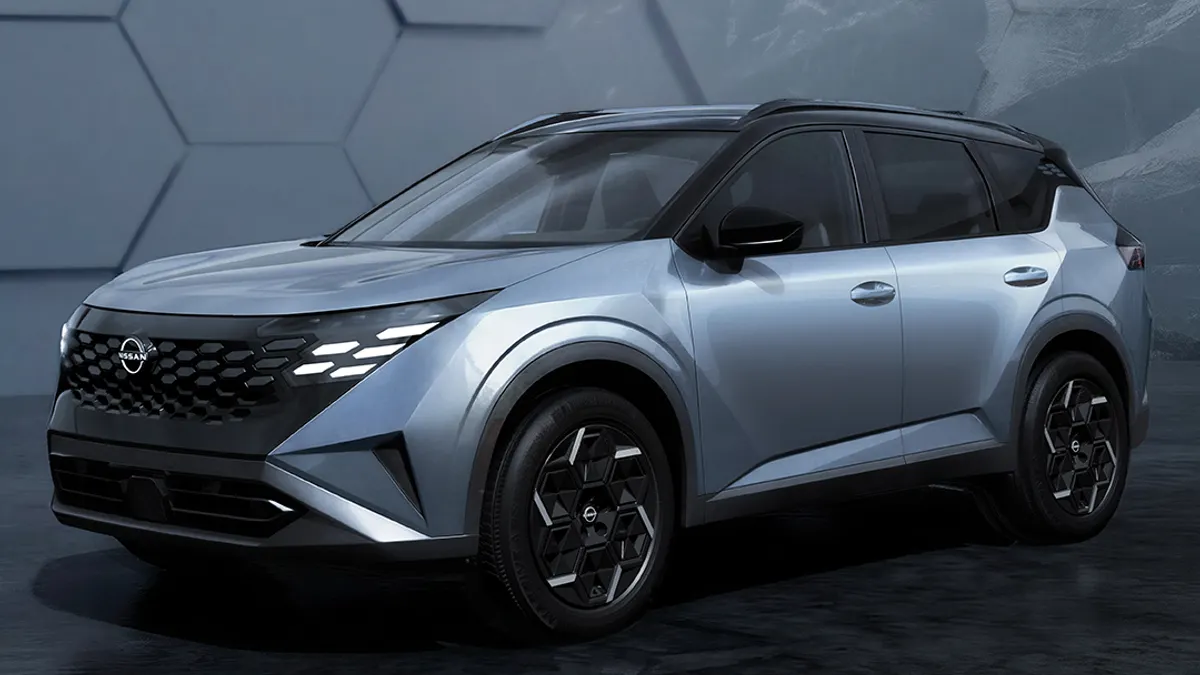
When the 2027 Nissan Rogue Hybrid e-Power arrives at dealers later this year, it will likely be the first modern U.S. mass-market model to boast a series-hybrid layout. Niche models like the Fisker Karma and Karma Revero aside, its noteworthy layout means the engine always functions as a generator and isn’t ever connected to the drive wheels.
While the series-hybrid layout merely applies a battery buffer to an idea exemplified by decades of train locomotives and other heavy machinery, it’s been easier said than done when it comes to applying the idea to Americans’ daily driving. GM touted its Voltec system as a series-hybrid configuration, but by the time it came to market in the 2011 Chevrolet Volt it relied on a parallel-hybrid mode for highway efficiency.
Then a decade ago, Honda engineers conceded they had also aimed for the simplicity of a series-hybrid system but arrived at their two-mode hybrid solution out of necessity. That Honda system, which arrived on the Accord for 2014 and is now also used in the CR-V, Civic, and Prelude, is a series hybrid most of the time but clutches the engine to the wheels at a tall gear ratio in highway cruising.
Now Nissan essentially believes it has cracked the code to achieving great fuel economy at U.S. highway speeds— and while Nissan’s EV expertise is certainly a factor in making e-Power work in America, that’s not it.
A different kind of engine
The key is that the series hybrid layout itself needs a different kind of engine, explained Christian Spencer, Senior Manager of Marketability at Nissan Technical Center North America in Michigan. The engineer and longtime product manager has been responsible for making sure that e-Power delivers at our faster cruising speeds.
“The U.S. has the most demanding acceleration and fuel economy requirements globally,” Spencer said via a video call with WardsAuto last month. “It’s the toughest market; it’s the most competitive market.”
E-Power started with small cars, the Asian market and front-wheel-drive only, with a much gentler driving cycle. The second generation of E-Power went more global, notably with the inclusion of Europe and the X-Trail, which had a version adding all-wheel drive.
What makes it work now in its third-generation form, Spencer explained, is that the e-Power version has a 1.5L turbo 3-cylinder engine — a completely different engine than the 1.5L turbo VC 3-cylinder in non-hybrid Rogues.
“If you do a teardown, there’s not a single component that’s the same,” said Spencer.
“What we did was, we made a dedicated engine that serves only as a generator,” he elaborated. “When you want a generator, you want it to be super-efficient at just one single point; everything else you don’t care about — which is the opposite of direct drive, which needs to have power and fuel economy across a wide range.”
Spencer wouldn’t yet disclose to WardsAuto exactly what the sweet spot is for the engine in terms of rpm and load, because he said Nissan is still working on some late-stage tuning for fuel economy and acceleration numbers.
“What I can say is that it operates generally at a narrower rev range and at a lower rpm on balance, and that’s where you get the fuel economy savings — and you also get the quietness.”
Nissan says that this latest engine for e-Power, designed around a combustion concept for electricity generation situations, achieves a net thermal efficiency of 42% — with the same technology potentially reaching as high as 50% efficiency in “fixed-point operation.”
It’s this engine’s 42% efficiency, and the system’s ability to run it in the range to achieve that often, that allows this hybrid to achieve the efficiency numbers others haven’t been able to achieve with the series hybrid layout alone, Spencer explained.
Growing more from the Leaf
That effort to maximize efficiency goes beyond the engine to the propulsion system, which in many respects overlaps with what’s installed in Nissan’s EVs.
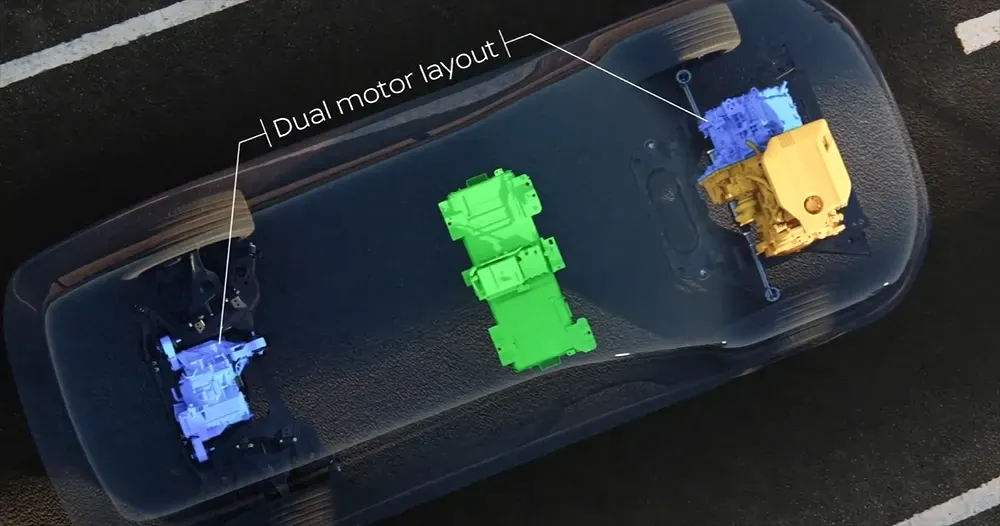
The Rogue e-Power’’s battery pack has a 2.1-kWh capacity, larger than those used in the CR-V and RAV4 hybrids. The battery acts as a buffer, allowing the Rogue e-Power to deliver its acceleration — and regenerative braking — like an EV, through dual electric motors at the front and rear wheels. Nissan also confirmed to WardsAuto that e-Power for the U.S. will only be an all-wheel-drive, dual-motor configuration.
“The previous generations were a little bit more about using components we had and integrating them the best we could, and this latest iteration is much more of a clean sheet of paper — make it light, make it efficient, really from the ground up.”
In the Rogue e-Power hybrid, that means taking advantage of a modular 5-in-1 motor-generator that employs some of the same components Nissan also uses in its EVs, allowing economies of scale.
Nissan made a sweeping move in 2023 to synergize components across its EVs and e-Power vehicles — a decision that not only helped distribute costs, but also may help enhance drivability. Meanwhile, e-Power remains one of the core technologies for a long-term product strategy outlined in April 2026.
“When we started developing e-Power, we developed it alongside the original Leaf,” said Spencer. “That is part of the reason why we have those series hybrid strategies, because we based our hybrid on an electric vehicle versus our competitors that started with an ICE vehicle and added it.”
As such, Spencer suggested that the 2027 Nissan Rogue Hybrid e-Power will drive more like an EV than its other hybrid rivals, which include versions of the top-selling Honda CR-V and Toyota RAV4.
Spencer noted that versus other parallel hybrid setups, the engine tends to be off for longer periods. But just like standard (non-plug-in) hybrids from Toyota and other brands, the Rogue e-Power will get its cabin heat from engine coolant, so the engine will be running somewhat more in cold weather.
“Our general philosophy and our general strategy was to tune it as an electric vehicle performance-wise,” said Spencer. “Because it’s being propelled by motors, there’s no mechanical connection whatsoever and we took some lessons learned from Ariya and from Leaf to apply to e-Power.”
“Our car is not electric assist; our car is motor drive only, and so we wanted to make sure that those benefits were realized from the acceleration and the quietness,” he added.