


Dive Brief:
-
The three-year collective agreement between Ford Motor Co. and Canada’s Unifor labor union covers the automaker’s workers across Canada, including members of various locals working at Ford’s Oakville Assembly Complex, as well as its Windsor and Essex Engine Plants, according to the union.
-
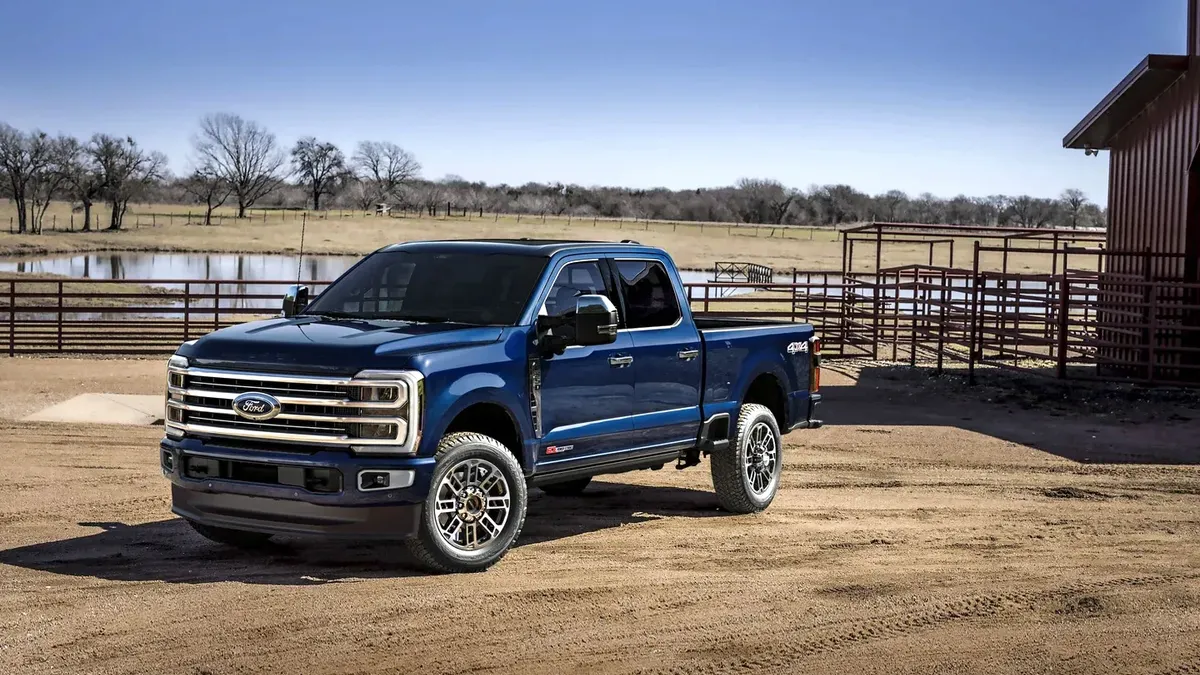
Job security provisions summed in a bargaining report include the renewal of a no-closure agreement, a third shift at the Essex plant anticipated for 2029 and “program commitments at all Ford facilities,” according to the union. That includes a $400 million investment in Oakville to support Super Duty truck production and a $500 million investment in Windsor operations, according to the union.
-
“With multi-hundred-million dollar investments in our facilities and a plan to return every laid off member in Oakville to work, this agreement means our members at Ford are in a solid position now and over the next three years,” said Ford Master Bargaining Chairperson John D’Agnolo.
Dive Insight:
The agreement’s ratification Monday follows a tentative deal that was announced on July 13 and was unanimously recommended by the union’s bargaining committee. As ratified, the agreement takes effect on Sept. 21, 2026, and expires on Sept. 19, 2029. Ford members covered under the Master Agreement voted 74% in favor, according to Unifor.
As analysts told WardsAuto in a recent deep dive into labor agreements as it relates to the state of the auto industry in Canada, it’s expected to be a template for similar agreements with GM and Stellantis. However, several other automakers who build vehicles in Canada, including Toyota and Honda, are not unionized.
Ford had already announced a $3 billion commitment to the Oakville plant in 2024, including new assembly and stamping equipment aimed at boosting the output of its Super Duty truck lineup.
The automaker clarified to WardsAuto that the $400 million investment announced Monday with the labor ratification is an additional amount that, according to an emailed statement, “builds on our previously announced C$5 billion investment to transform the plant into Canada’s Super Duty assembly plant, and also includes Ford of Canada’s first-ever stamping operations.”
The automaker had previously planned for Oakville to be the assembly site for a three-row electric SUV but even after pivoting to heavy-duty pickups continued to emphasize the flexibility of the plant for future electrified vehicles.
At the time of the previous labor agreement, in 2023, Unifor touted that hourly workers employed by Ford of Canada would earn 35% more than similar Ford employees in the U.S.
By the end of the new three-year agreement, Skilled Trades workers’ wages in Canada will increase to $62.71 Canadian dollars per hour, while full-rate production workers’ wages will increase to CA$50.20 per hour. Those wages amount to US$44.60 and $35.71 at current exchange rates.
According to the union the agreement includes annual wage increases of 3%, along with cost-of-living adjustments over the life of the agreement. It introduces a Productivity and Quality bonus, plus increases in retiree healthcare payments. And it adds a program that gives workers laid off from the Oakville plant a pathway to full employment.
For Canadian auto workers, the agreement adds some certainty at a generally uncertain time, as continued negotiations on tariffs with the Trump administration are now wrapped into the review of the United States–Mexico–Canada Agreement.
“There are many who counted us out, who wrote our industry, our autoworkers, and our union off,” said Unifor National President Lana Payne, in a release. “Those who said we should just accept Trump’s goal of eliminating us. This contract shows we refuse to be counted out. This round of auto bargaining was about making progress for our members, but also it was about sending a message that we are not going anywhere.”