
Dive Brief:
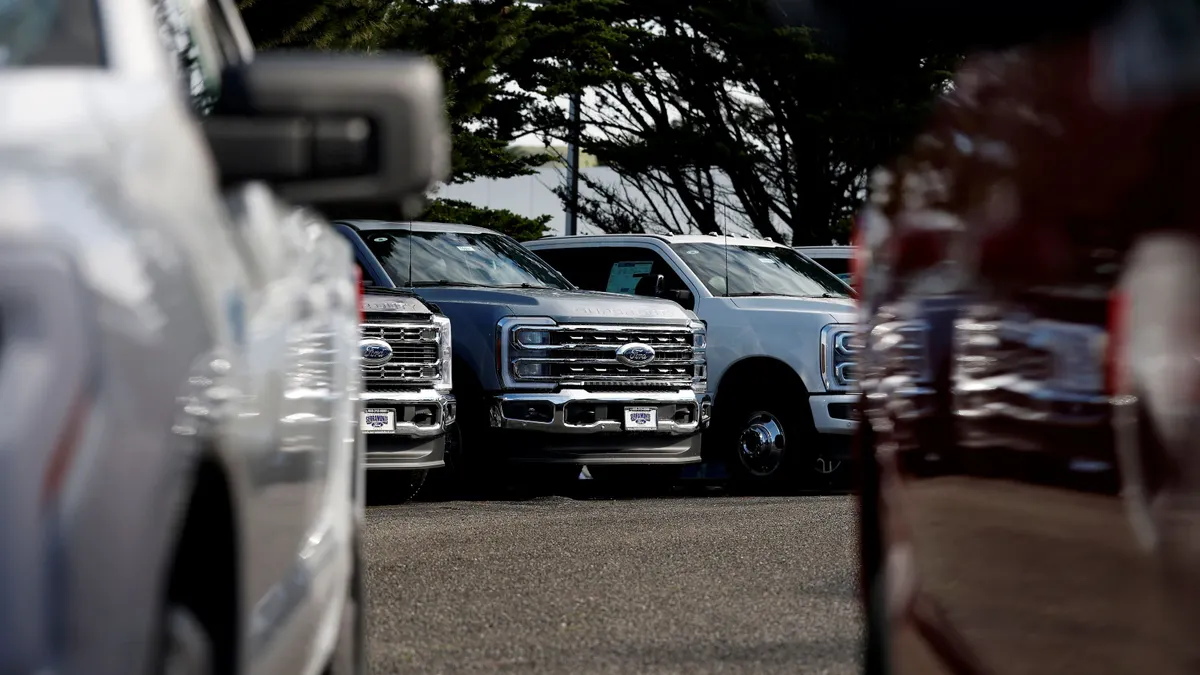
- Ford Motor Co. is projecting $1.3 billion in tariff refunds for invalidated levies it paid between February 2025 and March 2026, according to the automaker’s latest earnings call.
- The returns will primarily benefit its Ford Blue and Ford Pro business divisions, with the former expected to account for $700 million and the latter $500 million, CFO Sherry House said on the April 29 call.
- However, the company did not predict when it might begin receiving the returned funds while stating it was preparing for a $1 billion full-year impact from still-intact tariffs.
Dive Insight:
Ford is one of several major automakers that are planning for massive tariff refunds in 2026, with General Motors forecasting a $500 million return and Stellantis eyeing a roughly $469 million ($400 million euro) windfall. Ford also expects to deliver more than $1 billion in material and warranty cost improvements this year, according to President and CEO Jim Farley.
However, Ford is still working through supply constraints and higher costs in other parts of its supply chain, expecting $2 billion in commodity headwinds largely due to higher aluminum prices driven by global supply constraints, House said.
Ford has already struggled for months with aluminum supply due to multiple fires at a facility owned by Novelis, which is a key provider of the metal to the automaker. House said Ford will incur $1.5 billion to $2 billion in onetime incremental costs for alternatively sourced aluminum as the facility continues to work back toward full throughput.
On that front, COO Kumar Galhotra said it expects the equipment damaged in the fire will restart operations later this month, keeping with a previous projection that the site would be fully functioning again in Q2 2026.
“The restart date is on track. All the enablers for the ramp-up are on track,” Galhotra said, adding that Ford is particularly confident in aluminum supply in the second half of the year.
“If anything does go off, we have contingency plans, which means we have additional aluminum supply to ensure production,” he added.
House said that the automaker has several types of supplier contracts for commodities used in its vehicles, including fixed costs and multiyear contracts.
“We have a lot of contracts that are based on indices and the impact is a quarter lagging. So you're going to have a range there,” House said.