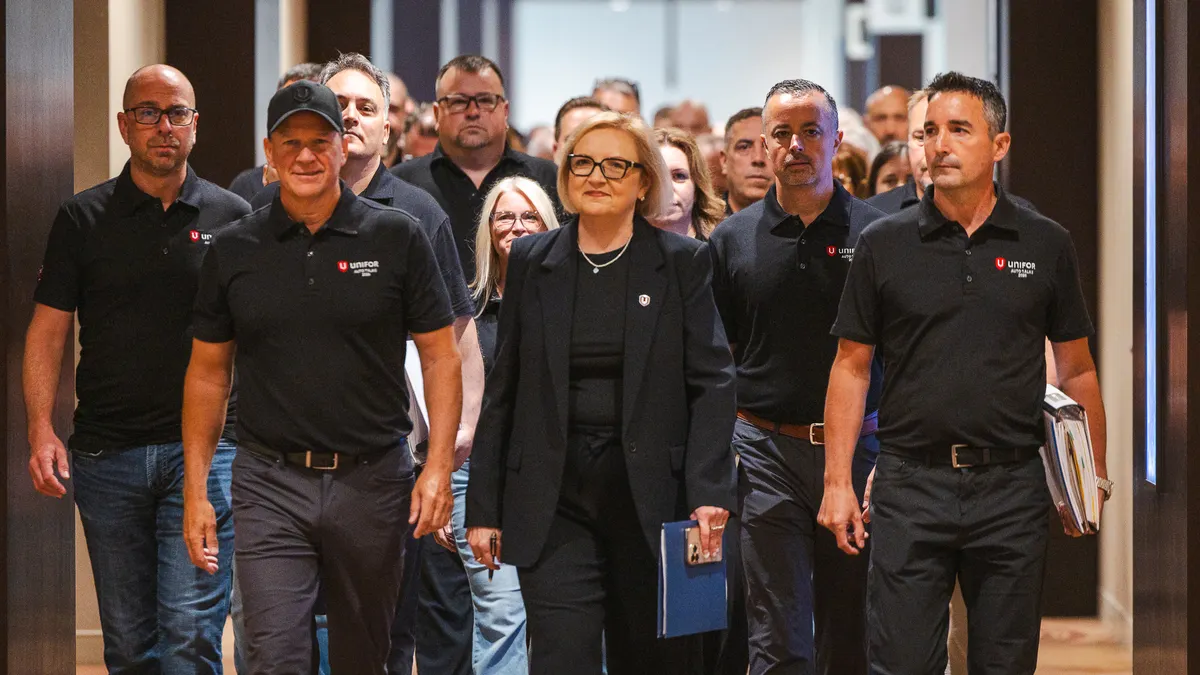
Canada’s main automotive union Unifor on Saturday secured a tentative deal with Ford Motor Co., a landmark development that the union hopes will set it up to pursue similar agreements with GM and Stellantis.
The deal with Ford was reached after marathon all-night talks, and must still be ratified by union members during meetings set to take place between July 17 and July 19. Results will be released following the final vote. The deal is being unanimously recommended by the bargaining committee, according to the union.
The talks are taking place at a "critical moment for Canada's auto industry," John D’Agnolo, chair of Unifor's Ford Master Bargaining Committee, said in a speech at the start of negotiations on June 22, citing U.S. tariffs on Canada's auto sector and the federal government's recent decision to allow entry of electric vehicles made in China as threats to the country's automotive outlook.
"The challenges surrounding the auto industry is the reason why our members need a strong pattern agreement now," D'Agnolo said, noting Ford was an ideal "pattern-setting company" for the union.
Unions like Unifor sometimes pursue what is known as a "pattern bargaining" strategy to negotiate similar deals across an industry. As part of the strategy, a union may select one company to negotiate first with, then use the deal to craft a "take it or leave it" offer for subsequent companies, according to a 2001 paper from the University of Pennsylvania.
In this case, Unifor is looking to strike a new deal with all Detroit Three automakers. D'Agnolo said the union selected Ford as its first negotiation partner thanks to its recent manufacturing investments in Canada and its history of reaching pattern-setting agreements.
Other automakers in Canada, such as Toyota and Honda, are not unionized.
Details of the tentative deal between Ford and Unifor have not been publicly released yet. However, in a speech at the start of negotiations, Unifor National President Lana Payne stressed the union would not allow anything "that is less than a fair agreement."
“We expect an agreement that protects jobs as well as Ford's commitment to auto manufacturing in Canada and delivers real and meaningful improvements for the workers who have made this industry successful for more than a century,” Payne said.
That meant enhanced pensions and retirement security benefits, she said, as well as improving wages and strengthening income security, plus clarity on future investments and product commitments from Ford, and ultimately all Detroit Three companies.
“This agreement must deliver economic progress for working people,” she emphasized.
Ford declined to discuss the specifics of the deal in a public statement sharing the news of the tentative deal on July 11. However, at the start of negotiations, Meredith Keenan, Ford Motor Company of Canada’s VP of human resources, said the company's goals included "providing stability for our workforce while securing the long-term competitiveness of our Canadian manufacturing operations."
The previous collective bargaining round in 2023 culminated in three-year agreements, which are about to expire. In interviews with WardsAuto, auto sector specialists said this next round of collective bargaining may be a tough one for Unifor.
Ross McKenzie, former managing director of the Waterloo Centre for Automotive Research, stressed how the union will struggle to threaten industrial action to stiffen its negotiating position.
“What do they have to go on strike for? GM has shuttered production for the BrightDrop in Ingersoll; Ford has dropped plans to build EVs in Oakville; Stellantis has shuttered a plant at Brampton. How much longer will GM continue production volumes they have in Oshawa? There's so much uncertainty."
With the Detroit Three walking away from investments in autonomous vehicles and EVs, that were supposed to be the future of the Canadian sector, and the industry still suffering from American tariffs, Unifor is in a "position of weakness,” he said.
“It's a matter of survival of the industry in Canada. It's not inappropriate to say that the D3 are in the driver's seat in this set of negotiations.”
Unifor is a multi-industry union of 320,000 members, serving workers in communications, engineering, forestry, paper mills, aerospace, healthcare and other sectors, along with auto employees. The auto worker component of this union behemoth (mainly for the Detroit Three) is only around 18,000 members working in auto assembly and powertrain operations, although it was boosted in June 2025 by an agreement to represent workers at the Windsor battery cell-maker NextStar Energy.
In April, there were 36,205 workers in Canadian motor vehicle manufacturing (not parts), including non-union workers, according to Statistics Canada. The pattern setting agreement for Ford will cover 5,000 workers, according to both Ford and Unifor.
Farid Ahmad, CEO of Toronto-based Dealer Solutions Mergers and Acquisitions, an auto sector M&A advisory firm, said that while Unifor was in a weak position, the Detroit Three might baulk at imposing a really tough deal that cuts costs — which may have been borne out by the Ford deal.
"I think the Big Three would like to break the unions. I think they've looked at other successful [non-union] manufacturers in Canada, and they're just booming. But with the amount of turmoil going on right now, is this the time to pick that battle?” said Ahmad.
A dispute with Unifor would deliver "more negative, unnecessary news on the Big Three,” he said. “They're already being beaten up in the media for tariffs and the expense and the increased cost.”
Moreover, if the Detroit Three decided to try and bully Unifor, it might spark fears in the U.S. within the United Autoworkers Union — damaging union relations in America.
"I think these unions are going: 'What are you going to do, manufacturer? What are you going to do? You've got problems. You don't want to be dealing with me right now. You've got enough problems.’ And the last thing these manufacturers need is more interference in their production line,” he said.
So, peace and a saleable deal between Unifor and the Detroit Three might be the best mutual outcome, predicted Ahmad: “I don't think anybody has the kahunas for a dispute. Hopefully, common sense prevails at this stage.”