Casa Auto Group uses artificial intelligence across its organization, but it isn’t a replacement for people, Jarrod Kilway, the group’s vice president of digital operations, told WardsAuto on a Zoom call.
Instead, he views AI as an accelerator, eliminating repetition and helping employees make faster decisions.
“I think everybody’s goal of internal AI usage in store should be more about making our employees more productive and enhancing that customer experience,” Kilway said.
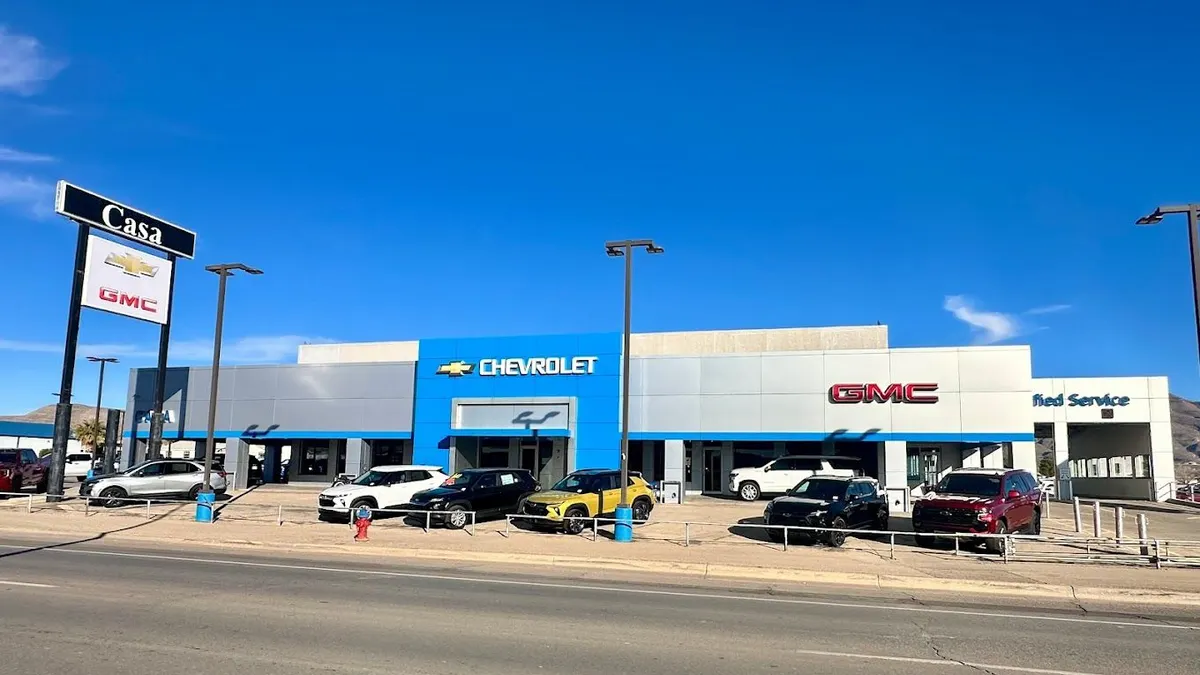
Casa Automotive Group, headquartered in El Paso, Texas, has 14 new car dealership rooftops — four in El Paso; four in Alamogordo, New Mexico; four in Las Cruces, New Mexico; and two in Prescott, Arizona — representing both import and domestic brands. Aside from a Cadillac franchise in Prescott, all are volume brands.
The group, which has been testing ways to use AI in its operations, has already found viable use cases across sales, marketing and fixed operations. Here are 3 success stories and one concern Kilway shared with WardsAuto as Casa Auto Group deploys the technology.
Deeper insights into customer defections
On the sales side, after lead follow-ups, the group used AI to assess data from Urban Science showing their purchase capture rate; where those lost sales migrated to; and what they ended up buying, among other data.
Urban Science already analyzes data to provide actionable insights to dealers, manufacturers, and automotive marketers. It measures defections as leads who have bought a vehicle somewhere else, and its defection data shows dealers in general have 120 unrecorded defections per month while dealers spend 30 to 50 hours monthly pursing leads that already bought something from a competitor.
But by using AI to further analyze the Urban Science data specific to Casa Auto Group’s stores, Kilway said he can discover how many customers Casa is winning, which customers defected, and whether the defection was to a brand that is represented in the group’s rooftop count.
He gave an example to illustrate the point: Imagine a customer came into Casa’s Ford store but did not buy a vehicle. Instead, the customer bought a Nissan from a non-Casa store. In the past, the auto group could not specifically identify that pattern.
But now, knowing that specific defection occurred, Kilway said they can assess “what could we have done better on the Ford sales side to ask better questions, to potentially shift that to a Casa Nissan customer rather than someone else down the street or in our market?”
In the future, Kilway said he will use that knowledge to work with micro-training module firm RockED to develop targeted coaching tools.
Creating faster marketing material
On the marketing side, one use case is to reduce the time to create compliant marketing material
Casa Auto Group creates many of its own marketing materials for sales events. That can be onerous. For a group with multiple brands such as Casa, those marketing materials have many requirements. They must be compliant with both the auto group and manufacturers’ guidelines, as well as any state and federal trade commission rules.
Using AI, “something that usually takes four or five days is now able to be done in a few hours,” Kilway said.
More effectively routing customer calls
On the service side, AI can also help business development centers use time more productively.
Casa uses Numa software as a backstop for afterhours service. Besides capturing calls that would have been lost, it has provided data on the percentage of calls where people are trying to schedule a service appointment, and what percentage of calls are just seeking a service status update.
It turned out up to 67% are just seeking a status update. With that AI-generated data, Casa began routing the status updates to service advisors, which led the group to acquire additional service advisors so they can provide better status updates.
As a result, the business development center was able to focus more on outreach and awareness of service product offerings, special order arrivals and applicable recall warranty components. The business development center became “more of that awareness factor for people who have purchases and/or serviced with us, to continue to nurture that relationship we have,” Kilway said.
An observation: AI reveals a lack of pricing information
As an issue to watch, Kilway said he suspects AI is contributing to a rise in customer defections for vehicle maintenance, as customers seek out more transparent pricing than dealerships always provide.
“What I’m seeing right now is one of the biggest issues with fixed ops on the franchised operation is the defection to independents for maintenance,” Kilway said
Indeed, Cox Automotive’s November 2025 Automotive Service Industry Study found dealers’ share of service visits in 2025 fell to 29% from 33% in 2018. That included Quick Lube shops earning 14% of service visits, up two percentage points from 2018.
Kilway figures customers are using AI to seek out information before they make a service visit, AI offers more pricing information than is revealed on many dealership websites. Based on Kilway’s own Google AI query, fewer than 5% of franchised dealers in the U.S. have a transparent price for an oil change on their website, he said. By comparison, some 92% of independents had an oil change price on their website.
“It’s the transparency factor,” Kilway said, “and where that hurts us as we move into AI, and it’s already happening.”