Dive Brief:
- BMW Group has announced a supply agreement with Samsung SDI and LG Energy Solution for cells used for its sixth-generation high-voltage batteries, the automaker announced in a press release.
- LG Energy Solution will supply battery cells for BMW electric vehicles in the North America region, while Samsung SDI will supply cells for EVs manufactured in Europe, beginning in the late 2020s.
- "Our global partner network with leading cell manufacturers ensures that we have a resilient, flexible and competitive battery cell supply,” Hendrik Lang, head of purchasing and quality of high-voltage batteries at BMW, said in a statement.
Dive Insight:
BMW’s goal to localize its supply chains, with cell production in close proximity to the five high-voltage battery manufacturing facilities recently built near to its vehicle plants, including sites in Irlbach-Straßkirchen in Lower Bavaria; Debrecen, Hungary; Shenyang, China; Woodruff, South Carolina; and San Luis Potosí, Mexico.
Having regional infrastructure to produce batteries near its existing facilities helps secure jobs according to Lang, while reducing the geographical distances between suppliers, batteries manufacturing facilities and vehicle assembly plants boosts the automaker’s competitiveness.
In Europe, in addition to BMW’s supply deal with Samsung SDI the automaker previously secured two additional supply agreements — with China-based battery makers CATL and EVE Energy.
“Diversifying procurement is an integral part of the BMW Group’s purchasing strategy. We aim to ensure our products’ global competitiveness and to be successful in different markets,” Nicolai Martin, member of the board of management of BMW responsible for purchasing and supplier network, said in a statement. “To achieve this, we operate as locally as possible in our value chains, leveraging the potential of our global procurement markets.”
BMW also sees the timing of these supply partnerships as key success factors. The automaker said that establishing a localized battery supply chain demands significant investment and is dependent on the willingness of global technology companies to establish local operations near its global manufacturing facilities. Having a favorable regulatory climate is also necessary, per the release.
Along with strengthening its global battery cell supply chain, the automaker has also established in-house expertise in the development, production and recycling of batteries across three EU facilities.
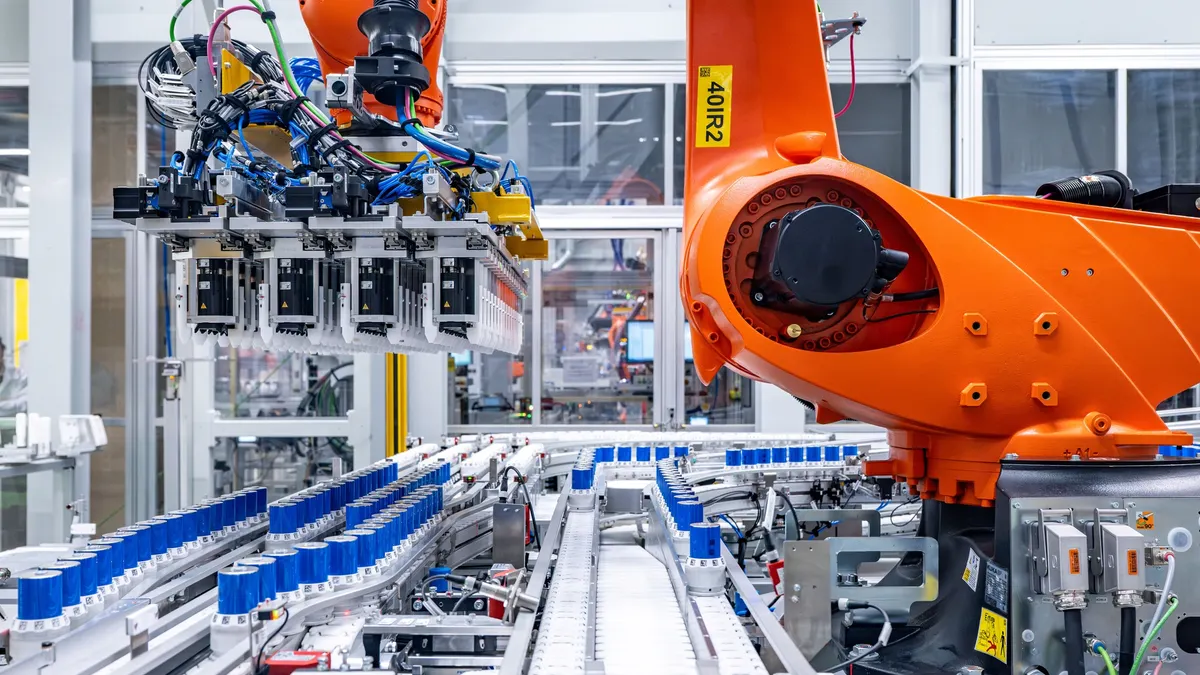
BMW operates a Battery Cell Competence Center in Munich where it is exploring future battery cell technologies. A second site, the Cell Manufacturing Competence Center in Parsdorf in Upper Bavaria, is studying how future cells can be produced with higher quality and maximum efficiency, per the release. The third location, the new Cell Recycling Competence Center in Salching, Germany, is recovering raw materials using a recycling concept developed by BMW, which will be used to produce new batteries.
“Our competence centers enable us to actively shape technological developments and meet our partners on an equal footing,” said Lang.
Along with establishing a localized battery cell supply chain with Samsung SDI and LG Energy Solution, BMW has completed recent investments to ramp up EV production in both the U.S. and Europe.
In February, the company announced it was investing roughly 650 million euros ($760 million) on facility upgrades at Plant Munich to produce electric vehicles built on its updated Neue Klasse platform. Internal combustion engine vehicle production is due to end at the plant by late 2027, after which BMW says the factory will only build EVs.
Over the summer, BMW completed a $1.7 billion investment project at its Plant Spartanburg in South Carolina to expand the factory and fund the construction of the Woodruff EV battery plant to support expanded electric vehicle production in the U.S.
Earlier this year, the automaker launched its new electric iX3 SUV that includes a new battery design using cylindrical cells with 20% higher energy density and a 800-volt electrical system. Executives said on the company Q1 earnings call that future Neue Klasse platform vehicles will be a key driver for the company’s future growth.