Dive Brief:
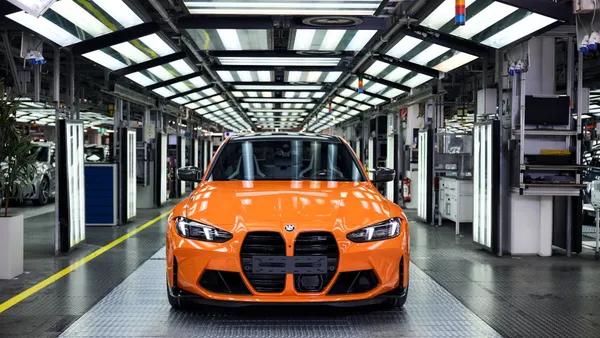
- BMW Group has completed a $1.7 billion investment project in its South Carolina manufacturing facilities, the automaker confirmed Wednesday in a press release. The project, announced in 2022, has allowed expansion of its Spartanburg assembly plant and the construction of its Plant Woodruff EV battery plant to support the production of fully electric vehicles in the U.S.
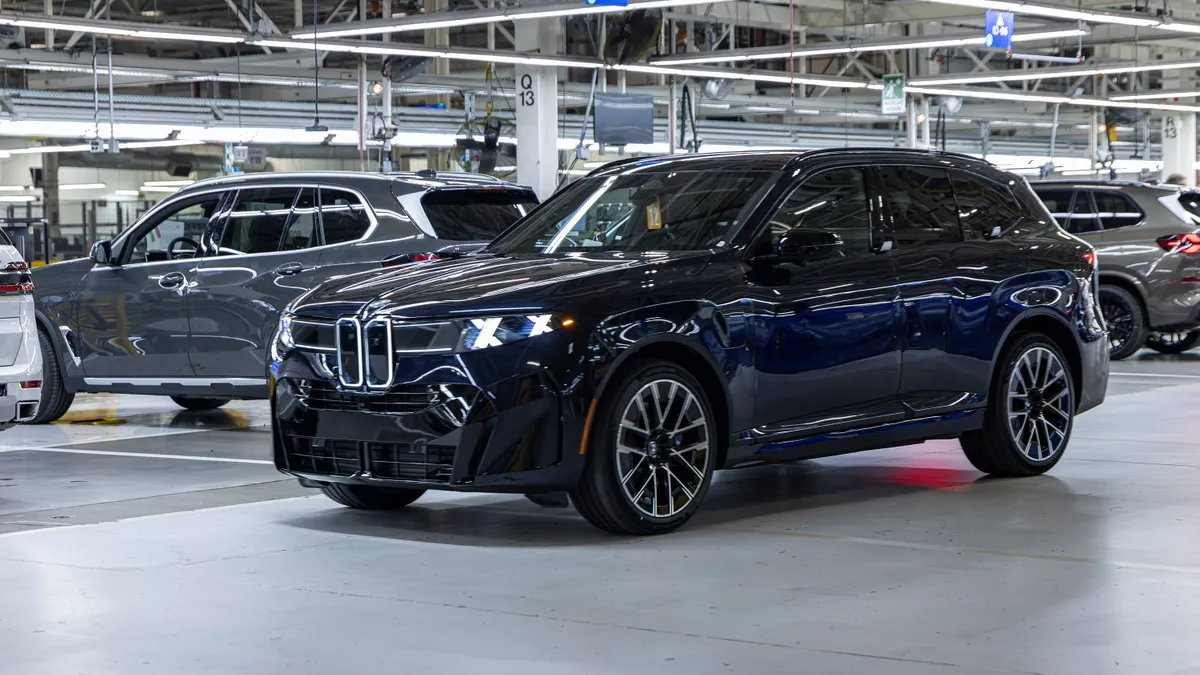
- BMW also unveiled its new fifth-generation X5 SUV, which will be built at the Spartanburg plant for global markets beginning in August. The automaker said it will also begin assembling the new fully electric iX5 later this year as part of its commitment to boost manufacturing in the U.S.
- “The completion of our investments in Plant Spartanburg and Plant Woodruff demonstrates our confidence in the United States and reinforces South Carolina’s role at the center of BMW Group’s global operations,” said Milan Nedeljković, BMW’s Chairman of the Board of Management, in a statement.
Dive Insight:
Following the completion of the expansion project, Plant Spartanburg will be BMW’s first global production site capable of assembling a single vehicle with five different drivetrain configurations on one assembly line, according to BMW.
The new X5 is the first BMW vehicle being offered with five drivetrain options, including a gasoline engine with 48-volt mild-hybrid technology, battery-electric and plug-in hybrid. A hydrogen fuel cell X5 will be launched at a later date, and a diesel mild hybrid will be built at the plant but not sold in the U.S.
"The future of BMW X models will continue to be shaped in South Carolina," said Dr. Robert Engelhorn, president and CEO, BMW Manufacturing Co., in a statement. "From highly efficient combustion engines and plug-in hybrid systems to battery-electric and future hydrogen-powered vehicles, Plant Spartanburg will be able to assemble a broad range of drivetrain technologies for customers in the U.S. and around the world.”
By 2030, BMW said it will assemble at least six fully electric BMW models in South Carolina, which will use high-voltage batteries assembled at Plant Woodruff.
BMW says the new Woodruff plant reduces complexity and sets new standards for high-voltage battery assembly. Using what’s known as a “cell-to-pack” manufacturing process, the cells are assembled directly into the battery pack housing instead of integrating them into individual battery modules, which frees up space for more cells to increase power and range without requiring a larger battery pack.
BMW also adopted digital twin technology and AI at both plants to boost manufacturing efficiency. The use of digital twins and 3D virtual simulations allows manufacturing processes to be optimized and refined in a virtual environment before being deployed on the physical assembly line.
Among the AI-supported applications are self-correcting robotics and vision-based quality controls, which helps ensure consistently high standards, according to BMW. The company also developed an in-house IT platform called “Artificial Intelligence Quality Next,” which employs sensors and camera systems along the production line to automate quality control processes. The AI is used to evaluate data and can provide real-time feedback to employees on the line to correct any production issues.
The automakers also plan to deploy additional humanoid robots at the two plants to support associates in physically demanding and repetitive tasks, enabling workers to focus more on precision and craftsmanship, according to BMW. The automaker completed a successful pilot using humanoid robots in August 2024.
BMW says the projects in South Carolina reflect its commitment to manufacturing vehicles in the U.S. The automaker supports over 120,000 jobs nationwide and contributes over $43 billion to the U.S. economy annually, per the release. Plant Spartanburg, which opened in 1994, is BMW’s largest global production facility employing more than 11,000 workers.
Last year, BMW assembled over 400,000 X SUV models at Plant Spartanburg, marking the seventh time the plant’s annual output exceeded 400,000 vehicles. Since the plant began operating in 1994, more than 7.3 million vehicles have been assembled there for both U.S. and global markets. BMW is also the leading automotive exporter in the U.S. by value.
The X5 remains one of the automaker's most successful models, with more than 3.1 million units sold globally since its launch in 1999.