Dive Brief:
- Volkswagen of America on Thursday announced updates to its existing IQ.Drive advanced driver assist system for model-year 2027 Atlas, Golf, ID. Buzz and Tiguan models.
- Updates include driver-initiated, automatic lane changes and a predictive algorithm for smoother adaptive cruise control. Select vehicles add a rearview camera system capable of detecting pedestrians, while VW offers a subscription data service on the ID. Buzz electric van to boost performance of the vehicle’s ADAS.
- “The protection and peace of mind of our customers is fundamental to all of us at Volkswagen,” said Thomas Zorn, VP of vehicle safety at Volkswagen of America, in a statement. “These improvements to the existing features reflect our ongoing commitment to helping drivers navigate the road with greater confidence through continuous innovation.”
Dive Insight:
Automakers are continuing to build out and deploy advanced driver assistance systems across their vehicles, as consumers have repeatedly indicated they value those features in vehicles.
An AutoPacific survey of 19,000 licensed drivers in 2026 found demand for features like automated parking, lane change assist, and automatic emergency braking were among the 15 most desired vehicle features of the 160 options in the survey. The same survey found more drivers trust the systems in 2026 than they did in 2024, while older studies have suggested consumers may be willing to pay a premium for vehicles with those features.
Drivers want heated seats, parking sensors most
As of model year 2026, all Volkswagen vehicles sold in the U.S. equipped with an automatic transmission come standard with IQ.Drive, which otherwise includes frontal automatic emergency braking, blind-spot monitoring, and a rear traffic alert.
Volkwsagen’s recent updates include amendments to the following features: travel assist, an on-hold wait-to clear function, predictive adaptive cruise control, popups for automatic speed limit adjustments, emergency assist plus, road experience management, and automatic emergency braking when pedestrians are detected in rearview cameras.
Read a more detailed summary of the updates below.
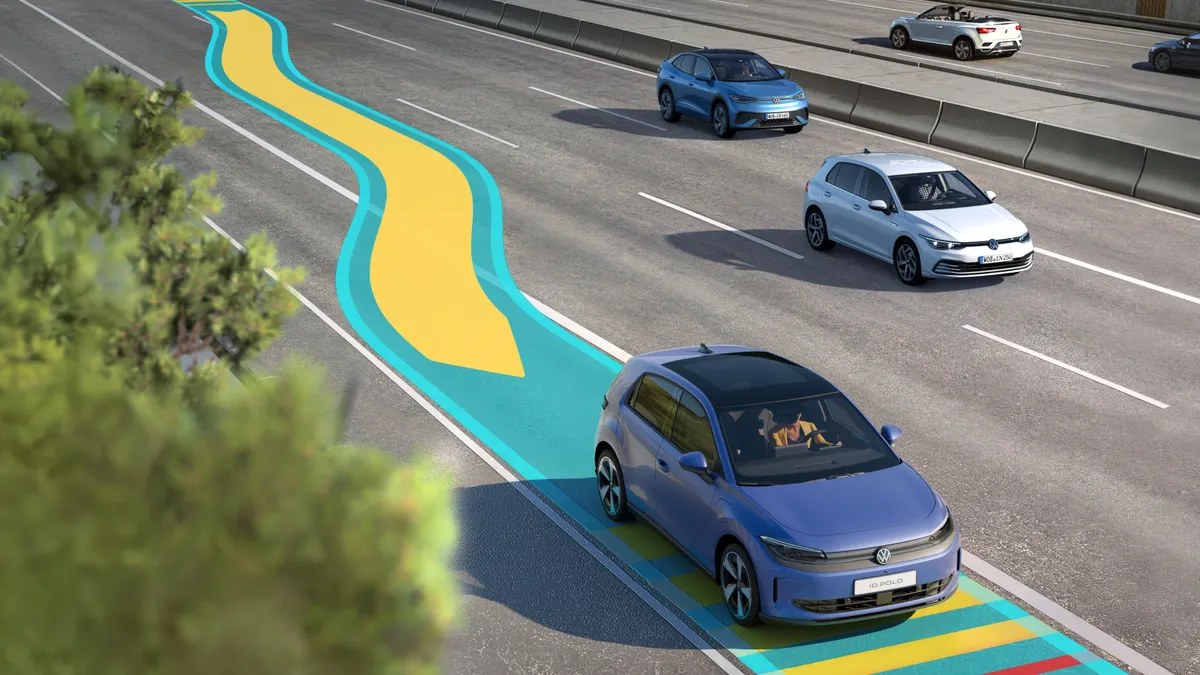
The upgraded Travel Assist lane-change feature for IQ.Drive, when activated, allows drivers to initiate an automatic lane change by using the turn signal stalk at speeds greater than 45 mph. The system confirms with three blinks of the turn-signal indicator, then uses rear radar sensors to check for other vehicles in adjacent lanes to ensure the maneuver can be completed safely.
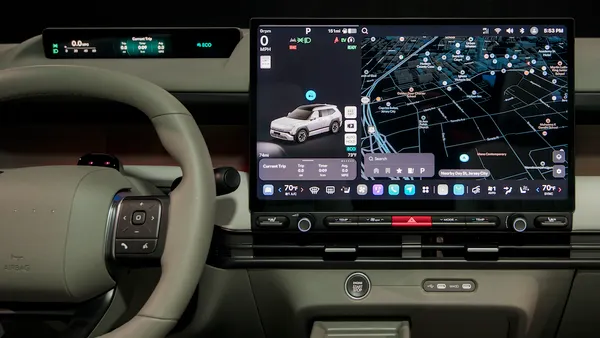
Volkswagen also added an “on-hold wait-to-clear function” that will pause a lane change for up to 12 seconds until any traffic clears and it can be made safely. Drivers will see an indicator on the instrument cluster if the desired lane is blocked by another vehicle. But once adjacent lanes are all-clear, a green arrow animation will appear indicating to drivers that a lane change will proceed.
Updates to IQ.Drive’s predictive adaptive cruise control feature for 2027 models is intended to deliver a more comfortable and confident driving experience, per the release, with earlier adoption of increased speed limits and reduced delays from traffic-sign recognition.
Prior to an automatic speed limit adjustment, a popup will appear prompting drivers to accept or reject a change in speed, which can be performed by tapping the accelerator or pushing the “Res” button on the steering wheel.
A safety feature called Emergency Assist Plus can steer the vehicle to the side of the road if it senses a medical emergency with a driver. Two other IQ Drive features — Lane Assist or Travel Assist — must be activated for this to work. Once the vehicle is stopped on the shoulder or in the farthest right lane, the vehicle automatically shifts into “Park” with hazard lights flashing and horn honking. The system also unlocks the doors and turns the lights on before an emergency call function is activated.
The new data feature on the 2027 ID.Buzz EV, called Road Experience Management, will be part of an In-Vehicle Premium subscription service. A one-year free trial of In-Vehicle Premium is included on the 2027 ID. Buzz. A paid subscription is required after the trial period ends. This cloud-based system gathers real-world data including lane markings, signage, and street lighting to improve map quality, which in-turn improves the vehicle’s ADAS capabilities, according to Volkswagen. For example, if painted lane markers are not visible, the map data can still keep the ID.Buzz centered in its lane without relying 100% on the vehicle’s cameras.
Finally, in the 2027 Atlas, ID. Buzz, and Tiguan, the new rearview camera system that will be standard on some trims can detect a pedestrian behind the vehicle while in reverse at speeds between 1 and 6 mph. If a pedestrian is present, the feature will automatically apply the brakes to avoid a potential collision.