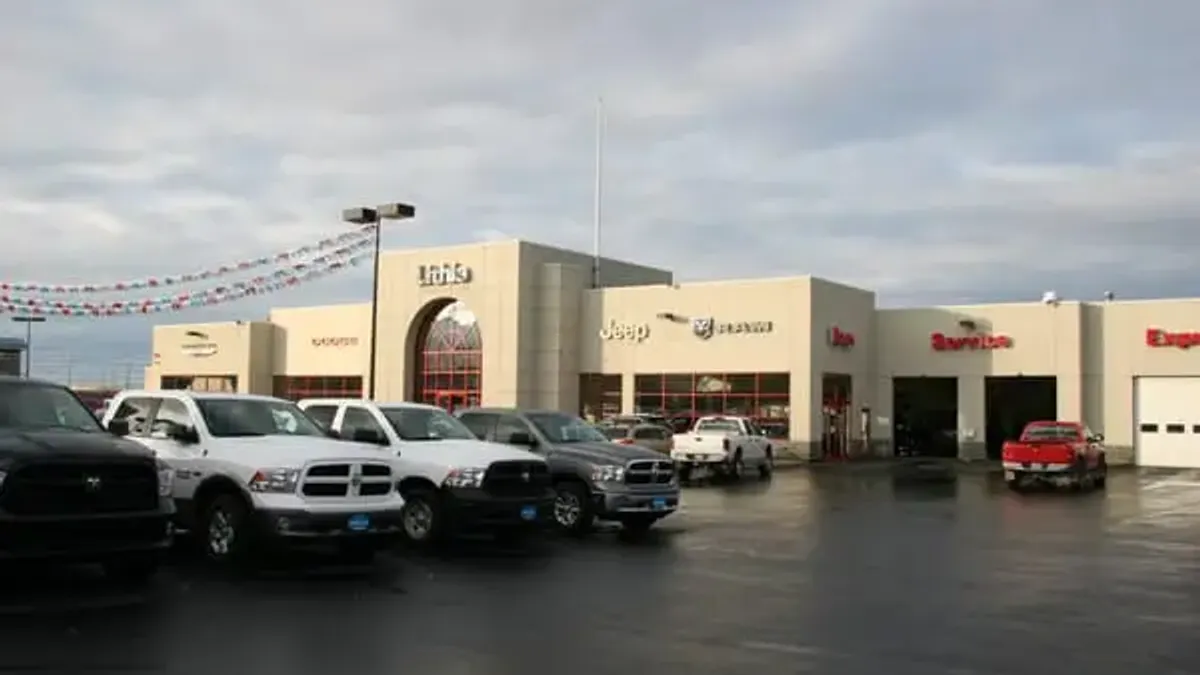
Lithia Motors, the biggest U.S.-based megadealer group, reported record revenues in the second quarter, but despite the big numbers, customers are worried about affordability, and Lithia is working overtime to get more efficient.
“I think when we think about affordability, I think it is top of mind with our people,” Bryan DeBoer, Lithia president and CEO, said in an earnings conference call on July 29.
In pursuit of greater efficiency and productivity, Lithia has a new dealership management system from Pinewood.AI, which is already in use in its U.K. operations and in the pipeline for its U.S. dealerships.
Lithia is also redesigning its U.S. dealership organization charts, with some individual managers filling what are now two jobs, such as one manager for both new and used cars, or one for both parts and service. In addition, some F&I managers are working remotely, DeBoer said.
“Our remote F&I is gaining traction in about a dozen of our stores. That’s a big cost savings in the future. Again, it’s a massive time savings and convenience to not only our customers, but allows our F&I people to be doing F&I wherever they really choose,” he said.
New-car margins down
Lithia’s consolidated revenue was a second-quarter record $9.8 billion, up 2.2% compared with the year-ago quarter. In the first half, Lithia’s revenue was $19.1 billion, up 1.6%.
On a same-store basis, controlling for recent acquisitions and disposals, revenue was down 1.6% to $9.2 billion in Q2. For the first half of the year, revenue was $18 billion, down 1.5%. Figures cited in this story are same-store unless otherwise noted.
DeBoer pointed out that year-ago comparisons were tough, because customers were rushing to take delivery last year ahead of new tariffs.
Lithia’s average new-vehicle gross profit per unit was $2,718 in the second quarter, down 11.1% from a year ago. In contrast, average used-vehicle gross profit per unit was $2,019, up 6.3%.
Fixed ops to the rescue
Parts and service revenue, which Lithia calls aftersales, reached $1 billion in the first quarter of 2025 and $2 billion in the first half of the year, an increase of 2.4%.
“Aftersales continues to be our largest business line, contributing 42.2% of our gross profit, with significantly lower SG&A [selling, general and administrative expenses] than retail vehicles, and driving the majority of our operating profit,” DeBoer said.
In Q2, customer-pay gross profit increased 2.6% versus a year ago, while warranty work increased 5.4%, DeBoer said.
Retaining service customers after their new-car warranty expires is high on the list of priorities for Lithia and for all new-car dealers. “If we can service our customer’s car for 10 years rather than three to five years, we all win a lot more,” DeBoer said.
Sticky business
Service retention — and ultimately sales retention — are an important part of the rationale for the Lithia Driveway online business platform, for captive finance company Driveway Finance Corp., and for the My Driveway service portal customers can use to schedule their own service appointments, he said.
“We can have multiple touch points each month rather than once every three to five years. That’s really what the My Driveway portal does. It’s what Chuck’s doing in DFC, that we can chat with the customer every time they make a payment. We can give an update on what the valuation of their trade-in is, and what their equity position is — or dis-equity position — that we can help them in all these different ways,” DeBoer said.
Chuck Lietz, SVP of finance, oversees Driveway Finance Corp. He said in the conference call that Lithia’s captive has a target of 20%-plus penetration — 20% of financing for all units sold. Lithia launched its captive finance company in 2012, according to the company’s quarterly earnings presentation.
In the second quarter, the captive had a penetration rate of 18% for all units sold in the U.S. market — or 28% of all units financed, according to the presentation. The percent of all units financed doesn’t include cash customers, or customers who financed somewhere else.
The U.S. market accounted for 77.4% of Lithia’s total global revenue in Q2, and 82.2% of total gross profit – both slightly higher than a year ago, according to Lithia’s quarterly earnings press release. The U.K. market accounted for 18.7% of revenue and 14.8% of gross profit. Canada was 3.9% and 3%, respectively.
DeBoer said in the call, “DFC is doing exactly what we built it to do, converting vehicle sales into reoccurring, countercyclical income, with considerably greater customer impressions and earnings power,” compared with not having a captive.