Editor’s note: This is a reported column, in which Steve Finlay periodically explores the relationship between automakers and dealers for WardsAuto.
It’s not in the Constitution, but there’s a right of transportation.
It’s the right to take goods to market and to go to market to buy those goods. It’s the right to geographically expand work possibilities rather than settle for a lower-paying job because it’s close to home.
Until the advent of the automobile, average people didn’t usually go far from where they lived.
Modern society depends on personal vehicles to get around. But trends indicate rising car prices are pushing some consumers of modest means out of the market.
Sure, if they can’t afford a brand-new car, budget-minded consumers can walk over to the used-car lot. But now supply-and-demand dynamics are making even used cars out of reach for many in low-income brackets.
Not every region has public transit. Rural folks don’t take the subway to work. And some big-city transit systems aren’t so hot. My home, metro Detroit, is one of them.
My wife and I recently drove about 10 miles to a hospital to visit a patient. My wife wanted to stay longer, so I told her she could drive our car home, and I’d take the bus that stops right outside the hospital on Woodward Avenue, the area’s main thoroughfare.
I figured the weekday wait for the bus would be around 15 minutes. It was 1 hour and 40 minutes.
For me, that was inconvenient; I was just going home. But a fellow waiting toe-tapper was a young man headed to work. He was becoming distraught. There are only so many times you can blame the bus for being late, no matter how valid that excuse is.
Some abjectly poor people will never own a car. But the way things are going, with the average price of a new vehicle around $50,000, people of means are the ones keeping the auto industry going relatively strong. They’re buying new, high-end vehicles filled with features.
For many others, expense has outpaced income.
How real is the possibility that many consumers, who once could afford at least a basic inexpensive vehicle, won’t be able to afford one as prices rise?
“It’s very real,” said Sam Abuelsamid, vice president of market research for consulting firm Telemetry.
“The number of people who in the past were able to buy a new car has shrunk,” he told me. “We still have about 60% of consumers that can afford a new car. But the other 40%, who could afford a new car a decade ago, can no longer afford one.”
So, many of them have shifted to the used-car market. But sticker shock is found there, too.
“You’ve got more demand for used cars, so that’s driving up that market as well,” Abuelsamid said. “The average price for a three-year-old car is something like $30,000.”
You can go cheaper with high-mileage old-timers. But the cost of keeping those relics running becomes a challenge as service work prices rise, too. Some people of limited means can’t afford essential repairs on their aging econoboxes.
“It’s getting worse,” said Abuelsamid.
Mainstream automakers once produced a range of vehicles, from entry-level to luxury.
But now, a lot of automakers have abandoned the entry-level market and cut right to people with wherewithal.
Bucking that trend is upstart automaker Slate Auto, based in Troy, Michigan, outside Detroit.
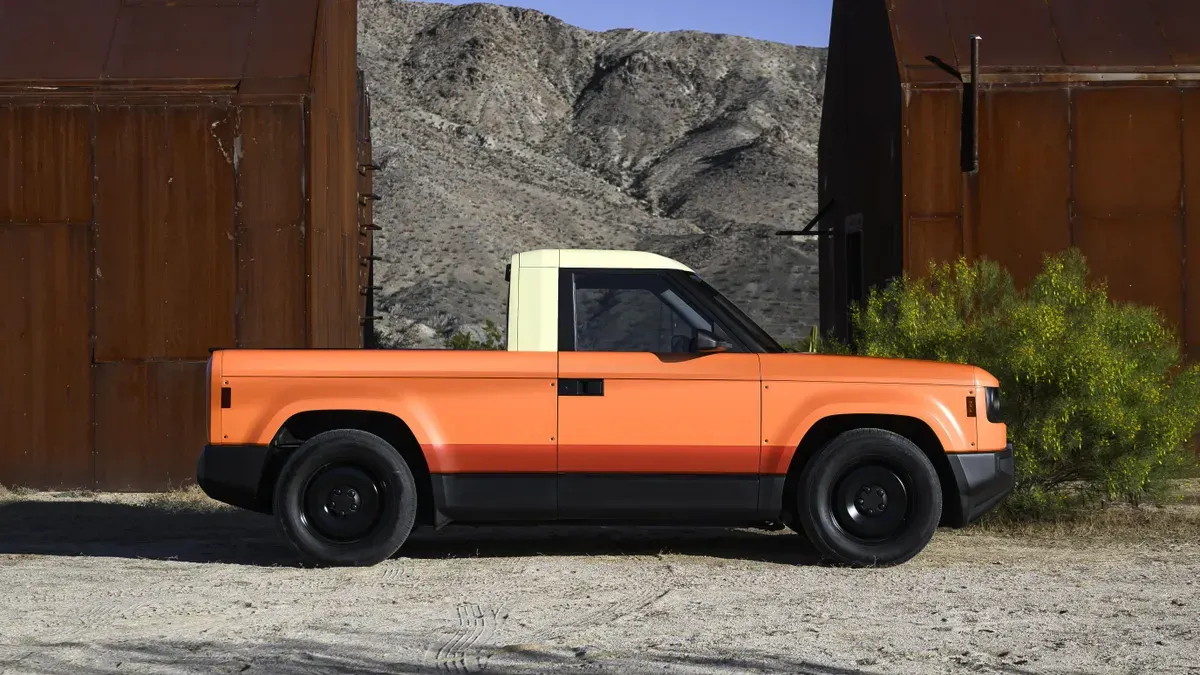
It plans next year to sell a no-frills 2-door electrified pickup truck with a starting price of about $25,000. The company, backed by Jeff Bezos of Amazon fame, calls it “a radically simple vehicle.”
But some industry people express skepticism about the Slate business model.
“I like the concept of a stripped-down vehicle,” said Abuelsamid. “The problem is, there is a limited market for a two-door pickup. In the 1990s, we used to have 2-door small pickup trucks and SUVs. Those are all gone.
“Since manufacturers introduced 4-door pickups, people said, ‘These are more useful to me.’ The usefulness of the Slate vehicle will be very limited.”
Charles Chesbrough, Cox Automotive’s senior economist and senior director of automotive insights, wonders about Slate’s viability.
“At the $25,000 starting price, it has crank windows, no infotainment — nothing much else,” he told me.
Nor are they painted. Slate will offer optional body-wrap kits of different colors.
Chesbrough said: “I like what Slate is trying to do with a simplified vehicle. But it’s still too expensive for what it is. By the time people equip it to what they want, it’s not going to be 25 grand. It will be in the mid-30s.”
But in going downmarket, is Slate on to something?
Chesbrough pauses, then says: “I don’t know yet.”
“Part of me says absolutely have a low-cost vehicle for people who want solid, basic transportation,” explained Chesbrough. “Another part of me says, ‘Do I want a brand-new stripped-down vehicle, or do I want a used vehicle for the same price with more features?’”