

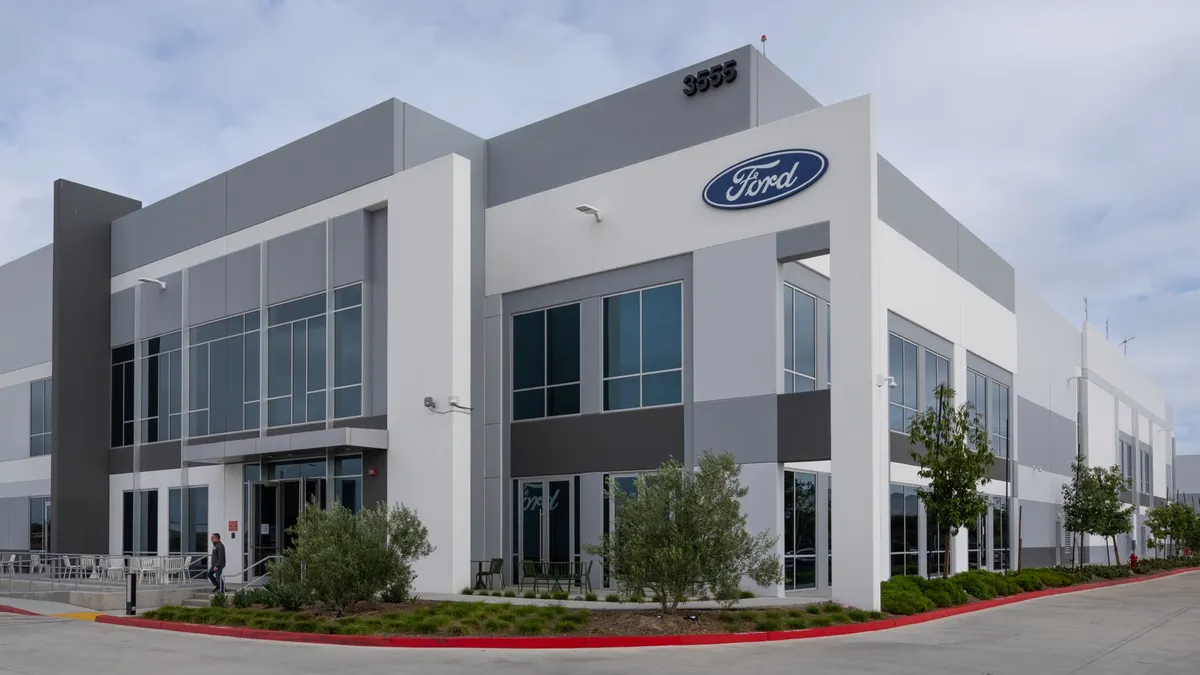
To say that Ford Motor Company’s Electric Vehicle Development Center in Long Beach, California, is moving at the speed of a startup wouldn’t be doing the project justice.
Neither would trying to summarize the operation, nested among two large warehouse-style buildings at the fringes of Long Beach Airport near various aerospace startups, as a lab or R&D facility.
Ford’s EVDC, which was established about a year ago and is leading development of the automaker’s affordable electric truck, and its Universal Electric Vehicle platform, has been hustling quietly on the sidelines as an under-the-radar development skunkworks developing what will underpin five affordable vehicles Ford has promised to launch by 2030 — starting with a midsize electric pickup the company will build at its Louisville Assembly Plant in Kentucky for deliveries in 2027.
As WardsAuto attended one of the first opportunities to get a glimpse inside this facility, Alan Clarke, Ford vice president, Advanced Development Projects, called the Long Beach project a skunkworks, a term first coined by Lockheed for its accelerated jet fighter development during World War II. According to Clarke, the automaker has mostly adhered to Lockheed’s “14 Rules and Practices” of skunkworks, drawn up by company founder Kelly Johnson in 1943. The guidelines include a reduced number of people working on the project, limited access by outsiders, a vastly streamlined reporting structure and minimized reports on progress with frequent cost reviews — all while having access to the resources of the larger company.
Ford incubated the project at its design studio in Irvine, explained Clarke. The company then shifted the project to its current location partly because of the talent pool in Long Beach. It likely helped that Ford operated an assembly plant in Long Beach until 1958. Now the automaker seeks to reinvent with its UEV platform and what it touted last August as a “Model T moment” for the company.
WardsAuto was among a group of invited media to take a 90-minute tour of the facility’s two buildings last week. We learned that Ford’s reinvention takes a clean-slate approach, which includes rapid prototyping and fast-paced iteration at almost every step. At its EVDC, Ford isn’t relying on traditional development resources in Dearborn, Michigan, to move things along. Instead, it’s created parallel operations for all phases, designed around a situation in which the EV team’s needs are prioritized and each sub-task doesn’t get derailed by competing interests with other vehicles.
“This facility is about us iterating, going quickly and being able to ultimately get to that Model T, the same way that the predecessors at the start of this company were able to get to something that ended up being incredibly successful,” summed Clarke. “All the architecture work, all the development work, we want to know what happens when you get to the end, and therefore we can continue to innovate. We can also have new ideas as a result of that, and then we can fix the mistakes that we’ve made along the way.”
According to Clarke, this process is going to benefit the second UEV product, which he says the team is already working on. The first product of the UEV was developed “everywhere else,” he said. But having engineers and other key support next to the vehicle as it’s developed will help speed the process.
At the facility’s two buildings, one houses design concepts, development and prototyping, while the other hosts testing, validation, measurement and more. At the EVDC, teams with expertise in manufacturing, program management, the supply chain, power electronics and software “all rub shoulders,” Clarke explained. “Building empathy is really important, because then they can understand one another’s issues and they can help solve each other’s issues together,” he said.
About 350 employees work at Ford’s EVDC in Long Beach, with another 480 split between Palo Alto and Dearborn, aiding with program management, engineering and software.
Hunting bounties
As officials emphasized, the development of Ford’s universal electric vehicle platform and the vehicles that result is very much focused around an iterative process, with “bounties” attached to potential improvements along the way. Its engineers recognize that changes in weight and aerodynamics have cascading effects on vehicle efficiency as a whole.
Throughout the project, engineers and designers frequently evaluate potential ideas or refine designs on the testbed, saving weeks or months from each potential step that adds up. Ford emphasized on the tour that allowing the team to chase those bounties provides the flexibility that a more formal development process might not allow.
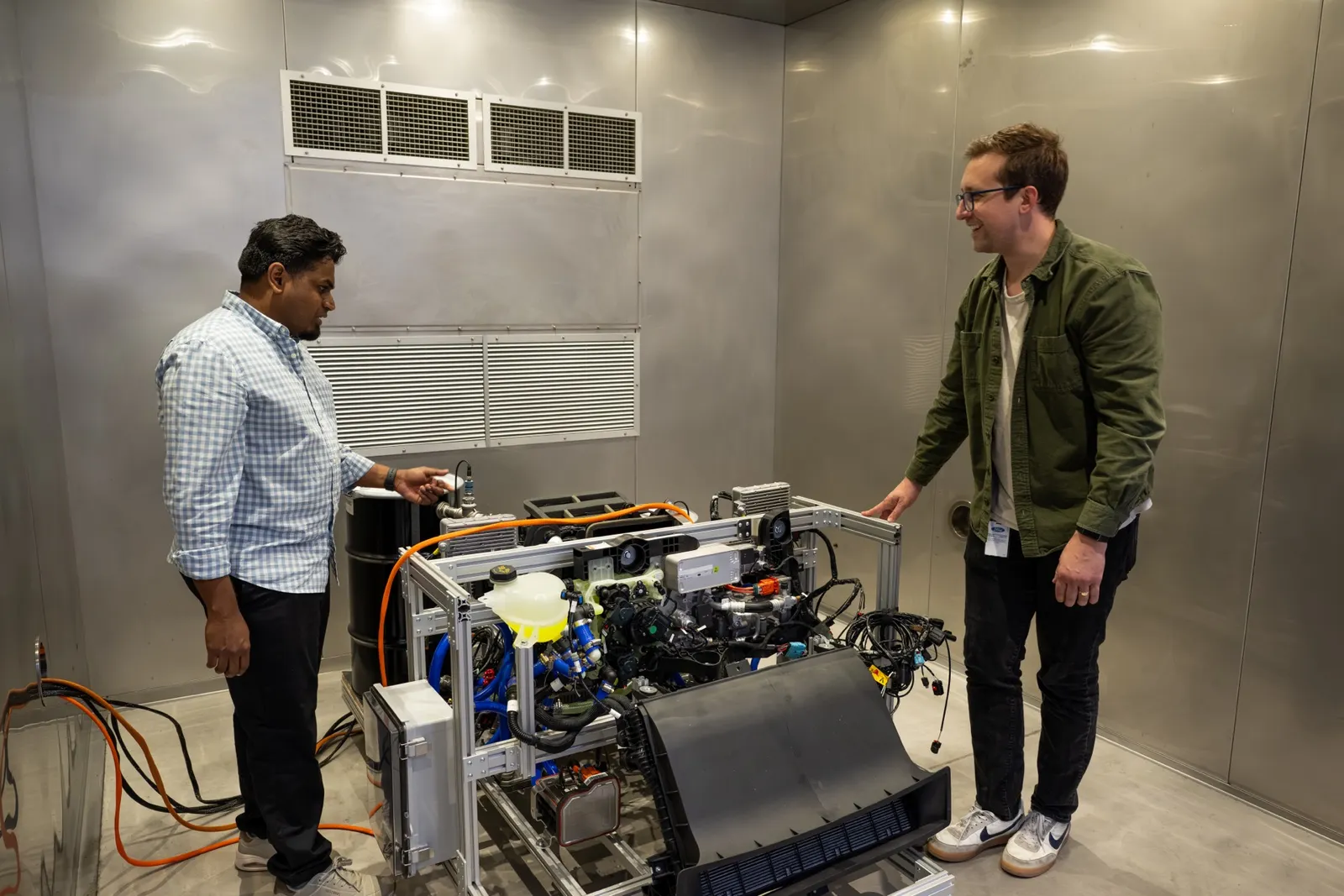
The EVDC includes a gantry mill, 3D printing facility, metal fabrication and wood shop. Ford can paint vehicles or run climate testing from -40 degrees F all the way up to 150 degrees. There’s also a dynamometer capable of doing road load simulation, adding tire resistance and mechanical drag. It’s surrounded by a climate chamber with a full solar array that can simulate humidity up to 95%.
Ford is using full-vehicle clay mills to test body designs. There is also a visualization studio staffed with body, chassis, thermal, powertrain and performance teams nearby with no barriers. The automaker also has a dimensional engineering team and metrology tools on premises to help engineer parts and verify specs with greater precision amid frequent iteration. That includes an industrial-grade CT scanner that can look inside a component like an electric motor and measure tolerances within nanometers.
“We can come up with a million ideas, and 99% of those are genuinely no good, right?” said Scott Anderson, the senior manager for seating. “The quicker we can find out the no-good ideas, the quicker we can move forward…the better it is for everybody concerned.”
Rapidly testing out ideas
The team utilizes various forms of 3D printing as part of a rapid prototyping process. The quicker it can pinpoint good solutions, the more time it buys Ford’s downstream engineers to work on improving noise, vibration and harshness, or cut mass and improve structural efficiency.
The facility houses a battery cell testing lab, too. “They’re charged and discharged millions of times under different temperature conditions,” said Akshaya Srinivasan, director of range, performance and battery systems modeling, noting that a lithium iron phosphate cell was undergoing testing at the moment.
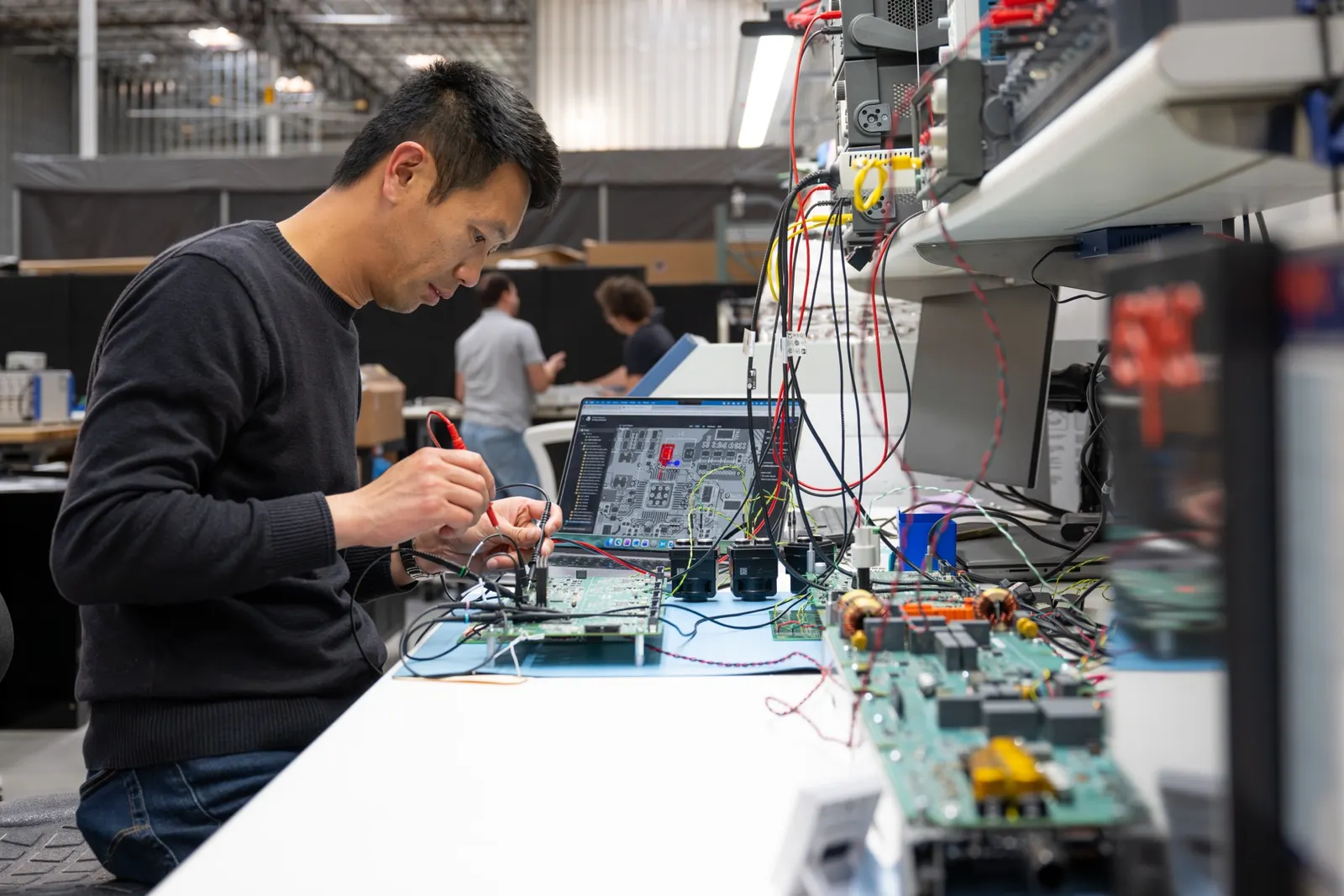
Ford’s battery management system team sits next to those testing cells, and the battery lab in Long Beach is one of three locations where Ford can build its UEV battery pack. They’re equipped with what Andrew Eyerman, the project’s senior battery manager, called “production-like equipment,” with automated-dispense systems for adhesives and robotic laser welding.
Eyerman said that allows them to build production-level packs on-site, with testing and teardown all within days. “And this is important, so we can continue to do that quick iteration loop,” he said, which has helped eliminate complexity for manufacturing and assembly.
AI is a driver — off-vehicle for now
Somewhat oddly absent from our tour of this leading-edge facility was one of the buzzwords of our time: AI. Clarke quipped to WardsAuto that some of the reason we didn’t hear it mentioned is “investor fatigue” — but also because the facility is staffed with engineers and technical people who would split hairs between algorithmic development or machine learning.
Clarke was quick to outline that AI is now a bigger piece of the development process as well. “The velocity that you can go with a small team has profoundly changed, even from when we started, and luckily from the skunkworks principles, I think it’s really given us a kick in the pants — because the productivity, I think we’ve gone to 90%-plus code gen for anything off the vehicle,” he said.
“On the vehicle, we’re still figuring out exactly how we want to do that because we want it to be structured a very specific way from a safety standpoint,” he said.
Officials stressed that while this particular project is being conceived and pushed to production from Long Beach, Ford is a global company, with development offices in Australia and Europe. So the space serves as another asset in its global portfolio.
Although the Long Beach facility has the term “electric vehicle” incorporated into its name, Clarke said he sees it continuing as a company skunkworks long after these EVs reach the market. “We grow this culture, this mindset, and grow the muscle of velocity, innovation,” he said. “You just decide what problem you want it pointed at. It doesn’t have to be a car, it doesn’t have to be a specific platform; the opportunities are pretty significant.”