Dive Brief:
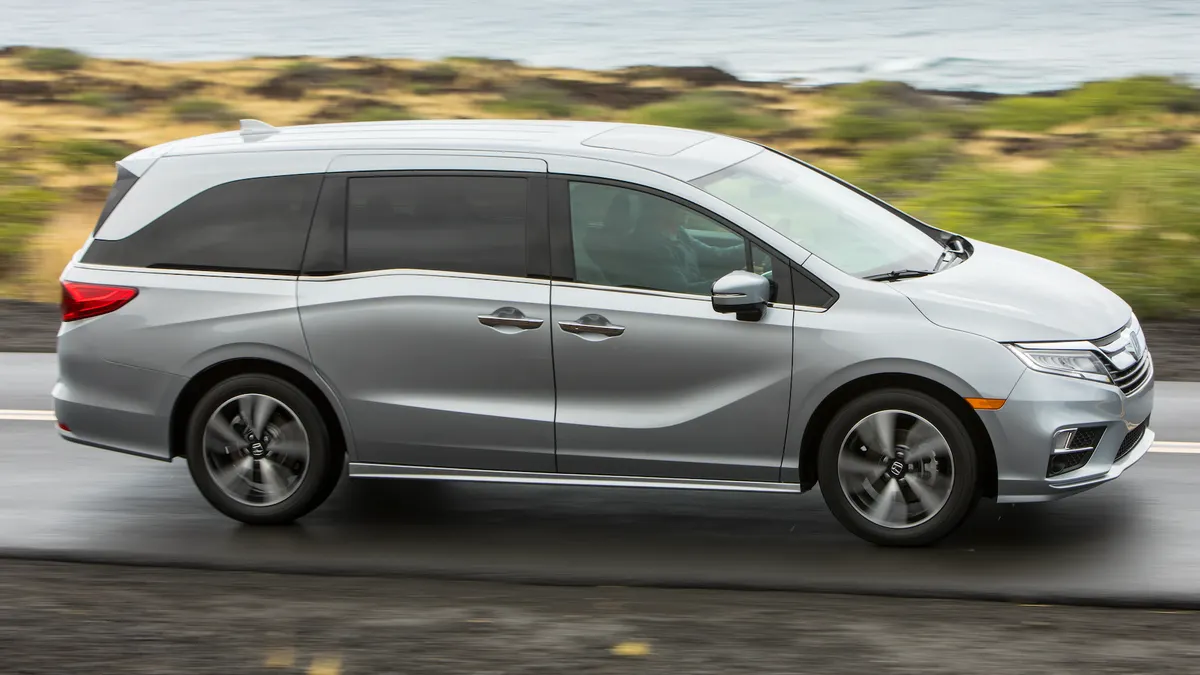
- American Honda Motor Co. has recalled nearly 326,000 Odyssey minivans because water can enter the rearview camera assembly and cause the backup camera image to fail, according to the National Highway Traffic Safety Administration.
- The recall includes certain model year 2018-2020 Odyssey models produced between January 2017 and July 2020, including some that were previously repaired for the same issue under a July 2020 recall. Just 0.8% of the recall population is estimated to be affected.
- Dealers will replace the rearview camera assembly with an improved design, free of charge. Owner notification letters are set to be mailed Aug. 24.
Dive Insight:
Water intrusion into the rearview camera assembly can cause corrosion of the printed circuit board leading to camera display failures. The absence of a rearview image when shifting into reverse limits a driver’s view of their surroundings, which can increase the risk of a crash, per the report.
In July 2020, following a nearly two-year investigation, Honda recalled more than 212,000 model year 2019 and 2020 Odyssey minivans for backup camera faults due to water intrusion, which the automaker said was caused by improper design specifications.
Honda separately addressed the backup camera issue on certain 2018 Odyssey minivans with a September 2020 product update campaign.
All suspect rearview cameras were manufactured by Michigan-based Tier 1 supplier Magna Electronics, including the improved replacement cameras.
But in June 2021, Honda received a report of water intrusion in the rearview camera of a vehicle repaired under the July 2020 recall and equipped with the new camera design. The automaker subsequently opened an investigation into the issue, working with its supplier Magna to determine the root cause.
By May 2023, Honda and Magna had not been able to recreate the problem, and Magna informed Honda that it had “concluded its participation in the investigation,” according to the recall report. Meanwhile, Honda continued to investigate the issue on its own.
Between April and December 2024, Honda investigators observed a decline in the number of reported incidents, but continued its analysis throughout subsequent months, including a review of design specifications.
Honda concluded that the defect was caused by two issues, the first being that the mounting screw hole in the rearview camera housing did not meet design specifications, and the second that the mounting screw could become misaligned during production due to variations in camera positioning.
The two issues together could create undue stress on the assembly when the mounting screw was fastened, causing the housing material to crack. Over time, thermal expansion and the freezing of trapped water could cause cracks to expand and allow water to reach the circuit board.
Based on its findings, Honda approved the recall on June 25.
As of that date, the automaker received 1,648 warranty claims since the initial recall in July 2020. But the company did not receive any reports of accidents or injuries related to the issue.
The new, improved rearview camera for the current recall is being sourced from Sony rather than Magna.
Magna-supplied rearview camera assemblies have also been involved in other recent recalls, including a 2025 Ford recall of 1.4 million vehicles and a 2025 FCA US recall of roughly 47,000 vehicles for rearview camera modules.