Dive Brief:
- American Honda Motor Co. has recalled over 880,000 pickup trucks and SUVs due to a corrosion issue that could cause rear suspension component failure, according to the National Highway Traffic Safety Administration.
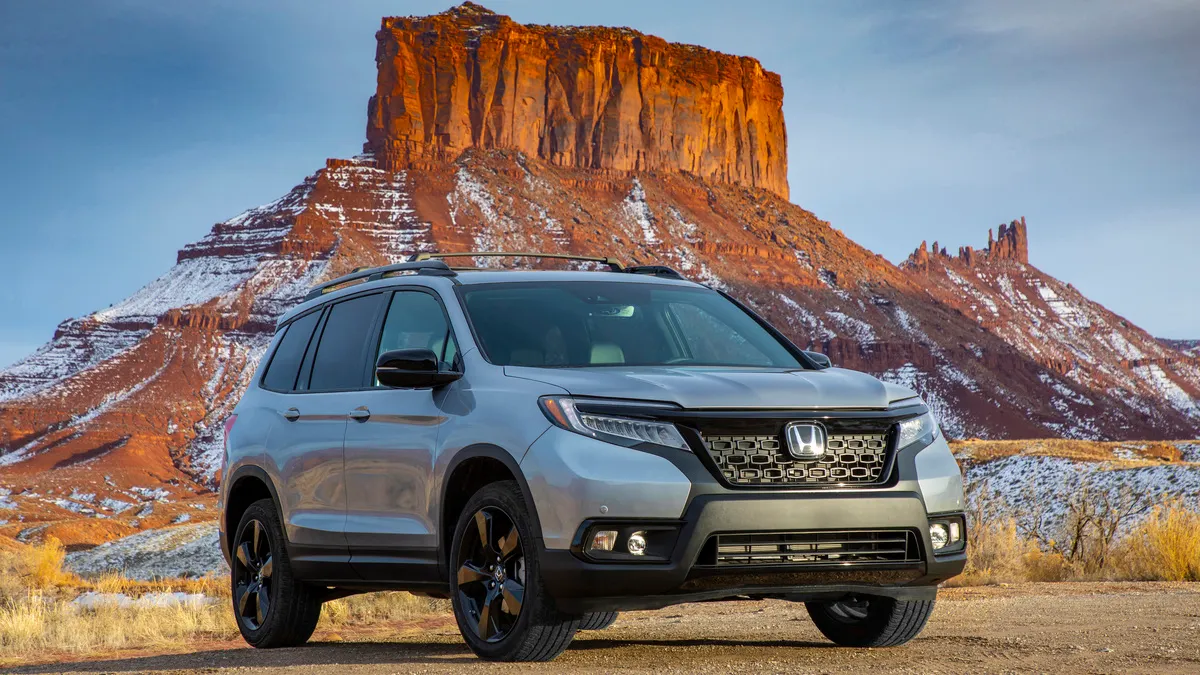
- The recall includes model year 2017-2023 Ridgeline pickups; 2019-2023 Passport and 2016-2022 Pilot SUVs, and 2014-2020 Acura MDX models sold in certain Midwestern and Northeastern regions of the U.S., where road salt is commonly used during winter. Just 1% of the recall population is estimated to have the defect.
- Dealers will install a rear subframe reinforcement kit as a preventive measure free of charge. They will also inspect rear subframe components and repair or replace them as necessary. Owner notification letters are expected to be sent July 7.
Dive Insight:
According to the recall report, the affected rear subframe assemblies were manufactured with “improper coating specifications” that can cause the paint surrounding the rear suspension mounting points to peel. If the protective coating fails and the exposed metal is repeatedly subject to road salt or other de-icing agents, the area can prematurely corrode. Over time, corrosion can weaken and fracture the mounting points, risking rear suspension arm failure.
The suspension arms help ensure alignment of the rear wheels. If the mounting points fail, the rear wheels could become misaligned, reducing stability that increases the risk of a crash, according to the report. Drivers may notice abnormal handling, unusual noises or vibrations from the rear of the vehicle.
The rear subframe assemblies were manufactured by Georgia-based Tier 1 supplier F&P Georgia.
In December 2021, Honda identified differences in paint quality by its supplier F&P Georgia and its own internal tests of the rear subframe and began to investigate the concern. F&P Georgia improved its pre-paint treatment process in August 2022 to improve consistency in production quality, and in January 2023 the supplier increased coating thickness for better durability.
Between November 2022 and February 2023, Honda monitored conditions of vehicles in the U.S. and Canada markets. The company continued monitoring and surveying vehicles between July and September 2023, observing no signs of accelerated corrosion of rear suspension components.
Honda resumed its monitoring of vehicles between February and September 2025. But in September 2025, Honda Canada received the first report of a potential corrosion issue, which prompted a broader investigation.
In April 2026, the automaker began working to identify the affected vehicle population, which is limited to vehicles sold in so-called “salt belt” states: Connecticut, Delaware, District of Columbia, Illinois, Indiana, Iowa, Kentucky, Maine, Maryland, Massachusetts, Michigan, Minnesota, Missouri, New Hampshire, New Jersey, New York, Ohio, Pennsylvania, Rhode Island, Vermont, Virginia, West Virginia and Wisconsin.
As a result of its findings, Honda approved a recall on May 28. However, the company reported no U.S. warranty claims or injury reports related to the issue, nor is it aware of corrosion issues for Honda vehicles sold in states with warmer climates.
The remedy suspension components will have improved pre-paint treatment and thicker protective coatings to improve durability.
Corrosion-related recalls are not uncommon, particularly in regions that use heavy amounts of road salt and other de-icing agents during the winter months. In February, Ford Motor Co. recalled more than 400,000 SUVs for rear suspension issues stemming from corrosion.
Honda has also previously issued corrosion-related recalls in salt belt states, most recently in 2022 and 2023.
In 2023, the automaker recalled more than 600,000 CR-V models sold or registered in salt belt states due to rear frame corrosion. In 2022, Honda also recalled nearly 133,000 Ridgeline pickups for frame corrosion that could cause the fuel tank to detach.