Dive Brief:
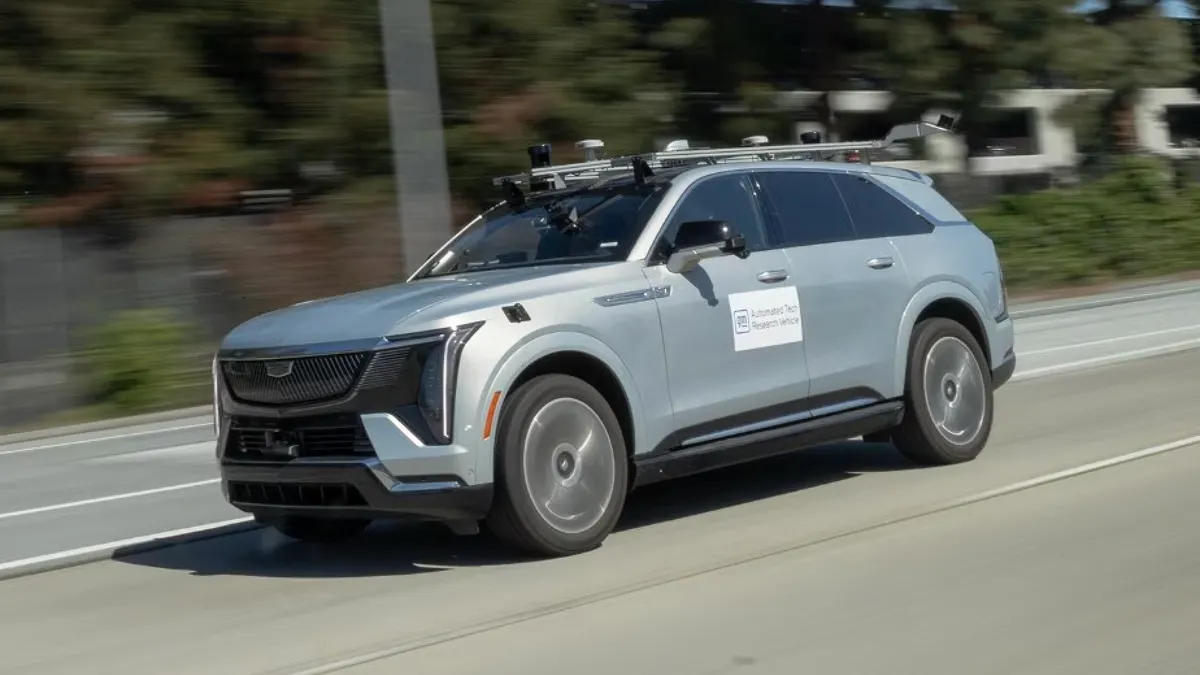
- General Motors has started testing its next-generation, “eyes-off” autonomous driving technology on public roads with development vehicles operating on limited access highways in California and Michigan, the automaker announced in a March 23 blog post.
- GM said it will soon evaluate its self-driving tech with over 200 test vehicles in real-world driving environments. Each vehicle will have a trained test driver behind the wheel who can take manual control of the vehicle at any time.
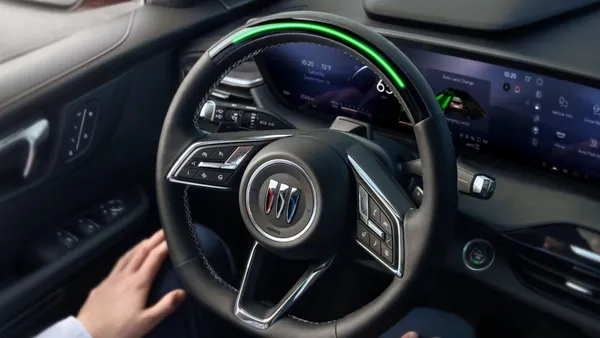
- The automaker announced its next-generation autonomous driving technology last October, which is a more advanced, Level 3 version of its Super Cruise hands-free highway driving system. The upgraded system will debut in 2028 in the Cadillac Escalade IQ electric SUV before rolling out to more GM vehicles.
Dive Insight:
GM said in its blog post that the launch of supervised on-road testing “marks a significant transition from manual data collection,” since it includes activating its eyes-off driving system in real-world driving environments to evaluate its capabilities. The automaker says that on-road testing “is essential to build a trustworthy system.”
GM will launch the self-driving system for highway driving initially, before offering “driveway-to-driveway” capabilities. Last March, GM said it was using Nvidia’s Drive AGX platform for the development of its next-generation autonomous driving technology.
In its future models, GM aims to support Level 3 automated driving, which provides hands-off, eyes-off driving but requires the driver to be ready to take over. To support this, it’s adopting a new centralized computing platform starting in 2028. The software-defined-vehicle architecture bundles all of a vehicle’s core systems, including powertrain, steering, infotainment and safety, using a single, high-speed processor. It will allow GM to more easily add eyes-off driving capabilities to other models without having to rebuild it from scratch for each respective application, the automaker said in its blog post.
The new SDV platform adds 10 times more over-the-air software update capacity to GM vehicles, as well as 35 times more AI performance to support autonomous driving and other advanced features, according to the company.
GM’s future centralized compute platform will also be continuously improved over time via over-the-air software updates from data collected from its entire fleet. This data is continuously being fed directly back into its autonomous driving development cycle to improve AI driving models and overall system robustness.
For example, construction zones or degraded lane markings flagged by its test vehicles are added as data points that feed back into the autonomy development loop for the entire fleet, continuously improving the system’s performance over time, GM said in a separate engineering blog post March 19.
To date, the automaker said it has accumulated more than 800 million customer-driven miles logged across 23 vehicles equipped with Super Cruise, 5 million of which were fully autonomous miles in what the company called “some of the most complex urban environments in the country.”
GM then combines the vehicle data it collects with testing in computer simulation, which the automaker says is equivalent to approximately 100 years of human driving experience “every single day.” The company said it's focused on accelerating the learning rate of its autonomous driving system, which also boosts safety.
In addition to launching its new eyes-off autonomous driving system, GM plans to add conversational AI to its vehicles with the integration of Google Gemini. Drivers will be able to use natural conversational language to interact with their vehicles. GM also plans to introduce a proprietary version of generative AI that will draw from vehicle-specific information, the company said last fall.
To prepare for the rollout of more advanced autonomous driving, GM reshuffled its software and services unit in November, tapping Sterling Anderson, a co-founder of autonomous trucking developer Aurora Innovation, to lead the reorganized unit. Anderson previously served as chief product officer for Tesla, where he led the team that delivered the company’s Autopilot autonomous driving system.