

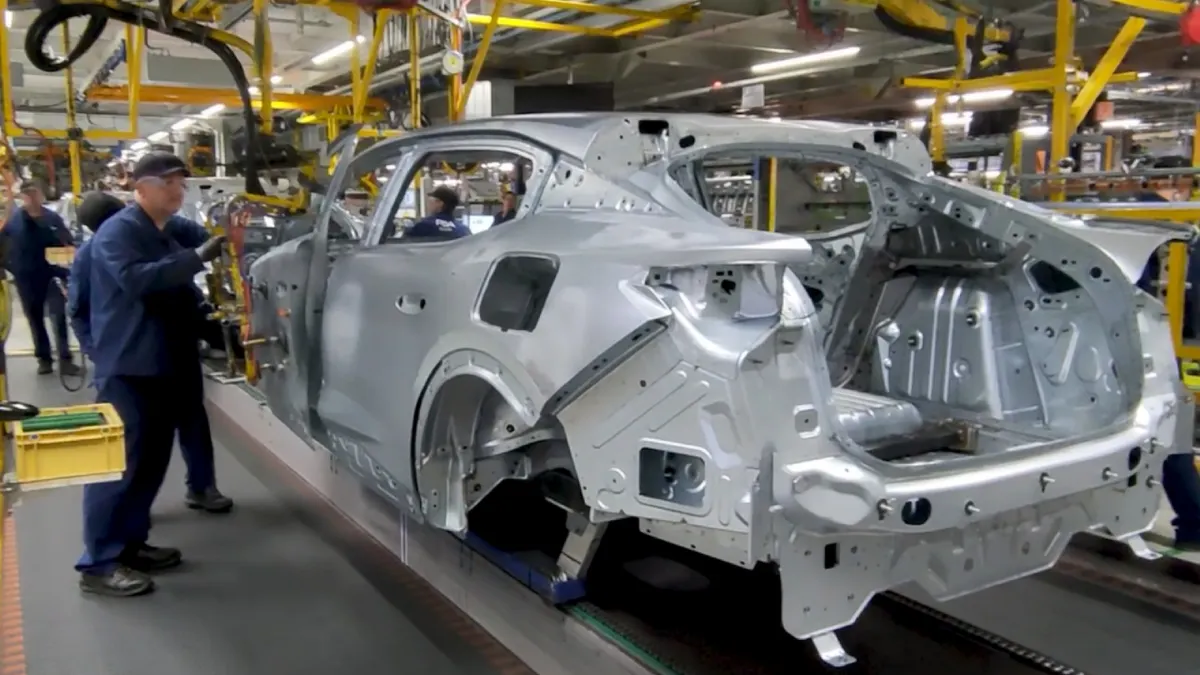
Stellantis will invest more than 1 billion euros ($1.16 billion) to build three new Peugeot-branded electric and hybrid models at its Mulhouse plant in the northeast Alsace region of France.
The automaker said all the vehicles will be using its new C-segment STLA One platform and production will begin in 2029, per a Stellantis June 2 release.
Its investment will be used to develop the new vehicle platform and expand production at the Mulhouse plant.
The move is in line with the Stellantis FaSTLAne 2030 strategic plan presented in May, where a key objective is to develop new global platforms, powertrains and technologies, the automaker said in its statement.
The new STLA One platform claims a modular, scalable architecture supporting different powertrains and vehicle sizes. It is designed to accelerate development cycles and targets a 20% cost efficiency through simplification at scale.
The Peugeot brand was highlighted in the FaSTLAne 2030 strategy as one of its four global brands with the strongest potential in terms of volume and profitability and is the first to launch the STLA One platform.
C-segment vehicles account for about 30% of total car sales in Europe and are part of Stellantis’ European strategy to strengthen its market coverage on the Continent.
Its investments will boost the use of capacity at the Mulhouse plant and will secure the future of the plant, which has 4,500 employees, the company said.
Stellantis praised the French government’s strong commitment to decarbonizing transport and supporting the European Union’s “Made-in-Europe” policy initiative. It added that these policies have created the conditions “conducive to these investments.”
“This decision attests to the professionalism and exceptional commitment of our teams,” said Stellantis CEO Antonio Filosa, speaking at the Mulhouse site. “France perfectly exemplifies Stellantis’ global strategy, presented in our FaSTLAne 2030 plan, where our global scale, our in-depth local knowledge, and our brands come together to meet and exceed our customers’ expectations,” he added.