
Editor’s note: John McElroy is the president of BlueSky Productions, which produces Autoline Daily, and a longtime opinion columnist for WardsAuto. Views expressed here are his own.
Let’s stop comforting ourselves with the old excuses. The meteoric rise of China’s auto industry isn’t just because of low wages, government subsidies, or a brutal 9 a.m. to 9 p.m. work schedule six days a week.
It’s because China has rewritten the rulebook on how to design, develop and manufacture new cars. It’s called "China Speed," and it represents an existential threat to legacy automakers.
A 2025 study by AlixPartners shows that Chinese automakers can develop new products twice as fast, with 40% to 50% less investment and with a 30% cost advantage.
How did we get here? Over the past several months, I’ve been asking industry executives and studying analyst reports on that question, and discovered a number of factors. One factor sticks out: Automakers in China have a different operational philosophy built on common commodity parts and radically simplified supplier relationships.
Consider how a legacy OEM talks to its tier-one suppliers. The automaker will hand a supplier a phone-book-sized document containing upwards of 20,000 hyper-specific technical specifications for a single component. It specifies the exact grade of steel, the precise radius of a bracket, and the exact software architecture. It takes months just to negotiate the paperwork, let alone validate it.
In China, newer OEMs will hand over a sheet with roughly 600 specs. They don’t tell the supplier how to build the part; they tell them what the part needs to do. They specify the performance, the dimensions it must fit within, and the cost target. Then they get out of the way.
Furthermore, those automakers practice aggressive, unapologetic component reuse. When they design a solid, reliable suspension layout, an efficient climate control module, or a robust power inverter, they don't reinvent it for the next vehicle program. They port it over to the next three platforms. To them, a new car doesn't require a 100% clean-sheet design; it requires a new top hat and an upgraded digital cabin with the latest tech that customers are clamoring to get. The underlying engineering is simply re-used.
Not only does that save money, it saves time. And with faster development cycles, they can get the latest technology into their cars before anyone else.
Even more radical is how this commonality extends across the auto industry in China.
That’s thanks to CATARC, the China Automotive Technology and Research Center. In the U.S., sharing parts between GM and Ford would be viewed as industrial heresy. In China, automakers willingly utilize common, industry-wide commodity components. CATARC sets the designs and validates them, then everyone uses them. They recognize that a window regulator, an electronic parking brake actuator, or a seat frame does not provide a competitive edge or define a brand's DNA. Why spend millions engineering a proprietary version of a part that the customer never sees and doesn’t care about?
The rest of the world is starting to wake up to this. The Japan Automobile Manufacturers Association, under the leadership of Toyota's former CEO, Koji Sato, recently rolled out its "New Seven Priority Challenges" — a strategic survival plan to restore the global competitiveness of Japan’s auto industry. Tellingly, one of JAMA’s core pillars focuses heavily on the standardization of components and materials across rival companies to build supply-chain resilience and slash costs. If Japan’s fiercely independent automakers are ready to pool their resources on commodity parts to ramp up to China Speed, Detroit can too.
If this story sounds familiar, it should. We’ve been here before.
In the 1980s, U.S. automakers faced a similar existential crisis when Japanese manufacturers arrived with superior quality, lower costs, and much faster development cycles. Back then, Detroit blamed low wages, currency manipulation and "Japan Inc." protectionism.
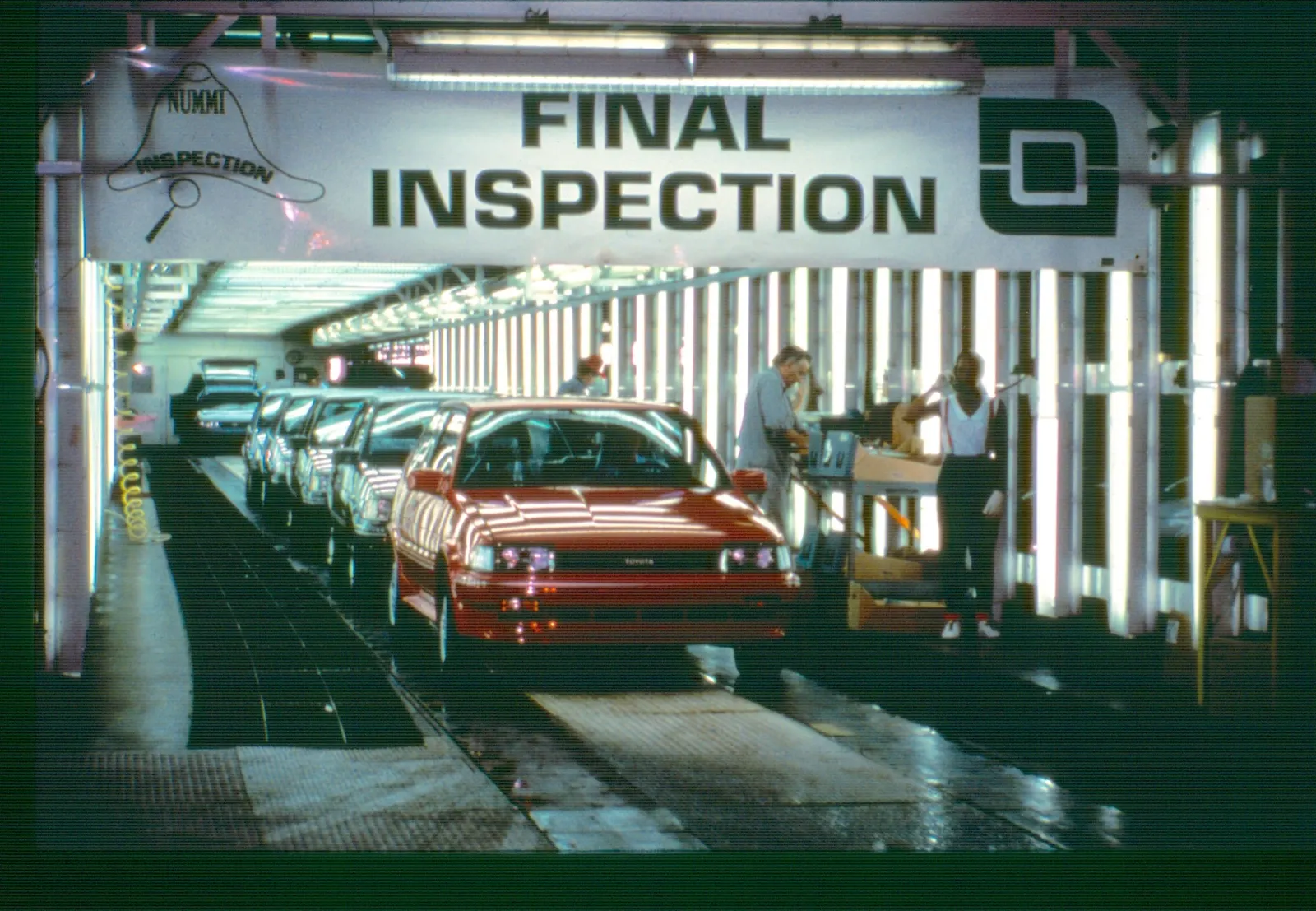
But eventually, U.S. executives stopped whining and started studying. They devoured the Harbour Report to understand true manufacturing productivity. They read The Machine That Changed the World, the seminal MIT study that decoded the Toyota Production System and taught the gospel of lean manufacturing. They learned about sequential engineering, just-in-time logistics, and empowering the line worker. It took a decade of painful restructuring, but Detroit came roaring back in the 1990s.
Now, the pendulum has swung again, and the classroom has moved to Shanghai and Shenzhen.
Legacy OEMs cannot afford to spend four years and two billion dollars validating a single vehicle architecture while rivals in China iterate through two generations of product in the same timeframe. To compete, they must swallow their pride, embrace cross-industry commodity parts, and trust suppliers to innovate.
It’s time for Detroit to go back to school, study the Chinese operating model, and learn how to run at China Speed. If we don't, we risk becoming footnotes in the history of the industry we helped create.