Dive Brief:
- BMW Group shared details about its strategy for future products and technology during its Capital Market Day 2026 event this week in Munich amid what it calls challenging market conditions that have eroded its profits this year.
- The automaker said it will rely on its strategic strengths and global presence, technology openness, the use of AI and a clear premium brand strategy in order to significantly increase speed and efficiency across its operations and boost its profits.
- “The BMW Group has always been at the forefront of the automotive industry — and that is where it belongs in the future as well,” said Milan Nedeljković, Chairman of the Board of Management of BMW AG in a statement. “Under increasingly challenging conditions, we have defined initial measures to reposition ourselves and will implement them with strong momentum.”
Dive Insight:
As part of its revamped strategy, the automaker aims to return to its long-term EBIT margin of 3%-5% in the automotive segment in 2028 and increase that to 8%-10% by 2030. Along with its initial corporate initiatives, BMW says it is evaluating a large number of additional operational areas of the company to boost its competitiveness, with additional decisions on them expected by spring 2027.
As it works to become a leaner and more agile company, BMW says it will also implement a personnel restructuring program, targeting a 20% reduction in the total number of internal divisions and related management roles by mid-2027. The company said it reached an agreement with the European Works Council in July and is firmly committed to its plans. The automaker said it will offer a voluntary severance program for some impacted employees.
An updated product portfolio in key global markets
To boost its profitability, BMW plans a product lineup more tailored around regional preferences. It's also turning its focus toward higher-margin models that can offer the greatest value for customers over the long term in each of its global markets.
BMW plans to increase local production in China with models based on its Neue Klasse vehicle platform, in hopes to turn the tide after its global vehicle deliveries fell 4.9% in the second quarter of Q2 2026 to just under 591,000 units, largely due to a 30.2% year-over-year decline in deliveries in China in Q2.
BMW is also considering expanding production of its X-Series SUV models outside of the U.S. to meet growing customer demand in other global regions. In June, BMW completed a $1.7 billion investment project in South Carolina, including a battery plant to support the production of electric vehicles in the U.S.
In Europe, where BMW is facing growing competition from automakers in China, the company plans to strengthen its presence in the high-volume entry-level segment with another fully electric Neue Klasse-based model. Via its fully electric brand Mini, BMW also aims to launch more appealing and lower-priced compact models using Neue Klasse technologies in an ongoing effort to reduce its fleetwide CO2 emissions in the EU.
BMW also said it will roll out a new AI-based retail sales model in the EU in mid-2027 that is more tailored to customers throughout the entire purchase process, from test drives to aftersales.
“Our global business model remains the foundation of our success. At the same time, we are improving our structures and cost base so we can meet the increasingly fierce competition that will define this industry in the coming years,” said Nedeljković.
BMW is adopting AI across its vehicles and operations
BMW’s Neue Klasse vehicle architecture will also serve as the foundation of the automaker’s next-generation AI-defined vehicles. The software-defined vehicle platform uses a new zonal electrical and electronics architecture across all vehicle segments and reduces manufacturing complexity.
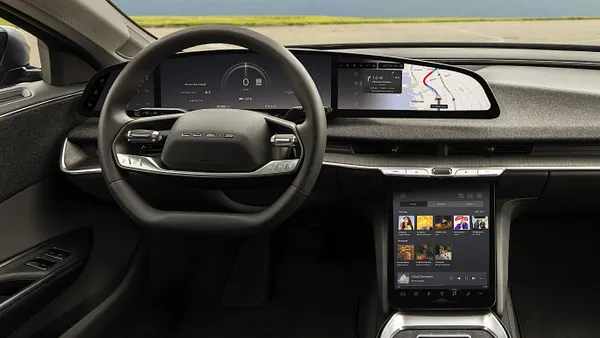
The Neue Klasse platform will also merge software and AI to deliver improved customer experiences. BMW says the focus of Neue Klasse platform vehicles will no longer be on updating individual functions, but on the intuitive interaction of the entire vehicle across all vehicle domains, such as advanced driver assistance systems, infotainment and comfort functions.
BMW also plans to further adopt AI technologies to speed up vehicle development timelines, including to boost efficiency across its manufacturing operations. BMW is implementing a standardized IT and data model, using intelligent systems at nearly every stage of production, the company said.
These AI-powered technologies include virtual factories, digital twins and AI-supported quality inspections. In the future, BMW plans to deploy digital AI agents to perform challenging tasks autonomously and deploy self-learning robots in its factories for more flexible and efficient vehicle production.
In the near future, BMW plans to use specialized digital agents and existing IT systems that the automaker has built up over decades. That will allow BMW to analyze complex information more rapidly in order to automate routine tasks to boost efficiently, per the release.
BMW is currently working with AI company Mistral on crash simulations. The testing combines BMW’s engineering datasets with Mistral AI’s training capabilities to create an AI model that enhances the quality and speed of vehicle development. BMW says it's relying on next-generation AI-powered large industry models trained on specific engineering and simulation data to make the process more scalable.
“Consistent use of agentic AI applications across all areas of the company will be a game-changer for more agile and efficient development, leaner structures and faster decision-making,” said Walter Mertl, member of the Board of Management of BMW, in a statement.
BMW is also harnessing AI to develop more advanced autonomous driving technologies. This includes a new L2++ system developed in partnership with Momenta that will be offered in China on the new BMW iX3.
In Europe, BMW is working with its partner Qualcomm to offer a navigation-guided driver assistance system in Germany that can operate autonomously on highways, secondary roads and urban streets. BMW intends to roll out this same technology in the U.S in stages. In 2027, BMW said it will launch its more advanced L2++ driver assist systems in China, the EU and the U.S.
Neue Klasse platform vehicles will be able to download new functions via over-the-air software updates, per the release. By the end of the year, BMW said that its Highway Assistant hands-free driving systems will be available on vehicles in 21 countries. However, for the new iX3 and future New Klasse platform vehicles, Highway Assistant is being upgraded to BMW’s new Symbiotic Drive Level 2 driver assist technology, offering hands-free highway driving at speeds up to 85 mph.
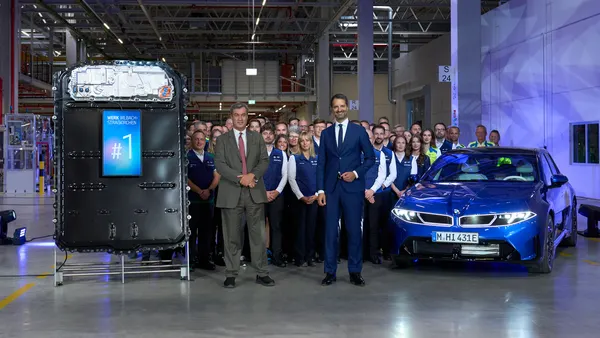
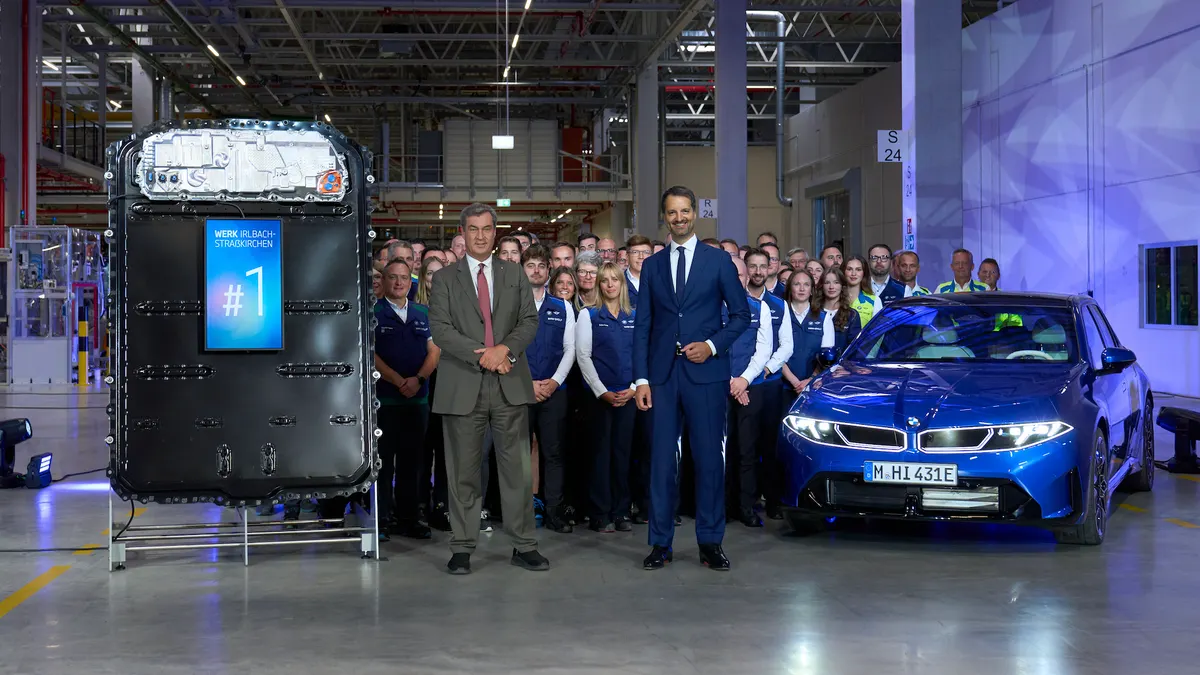
BMW also announced in a separate press release that it’s investing 2 billion euros in vehicle production and battery manufacturing to prepare its plants in Germany to produce the next-generation BMW 3-Series built on its Neue Klasse platform, which is one of its top-selling models globally. These plans included a new battery factory to produce cells for the electric versions of the 3-Series sedan. Series production of cells for the BMW i3 began this week at the new plant.
Last September, BMW said it will launch around 40 new or revised models incorporating Neue Klasse platform technologies by the end of 2027.