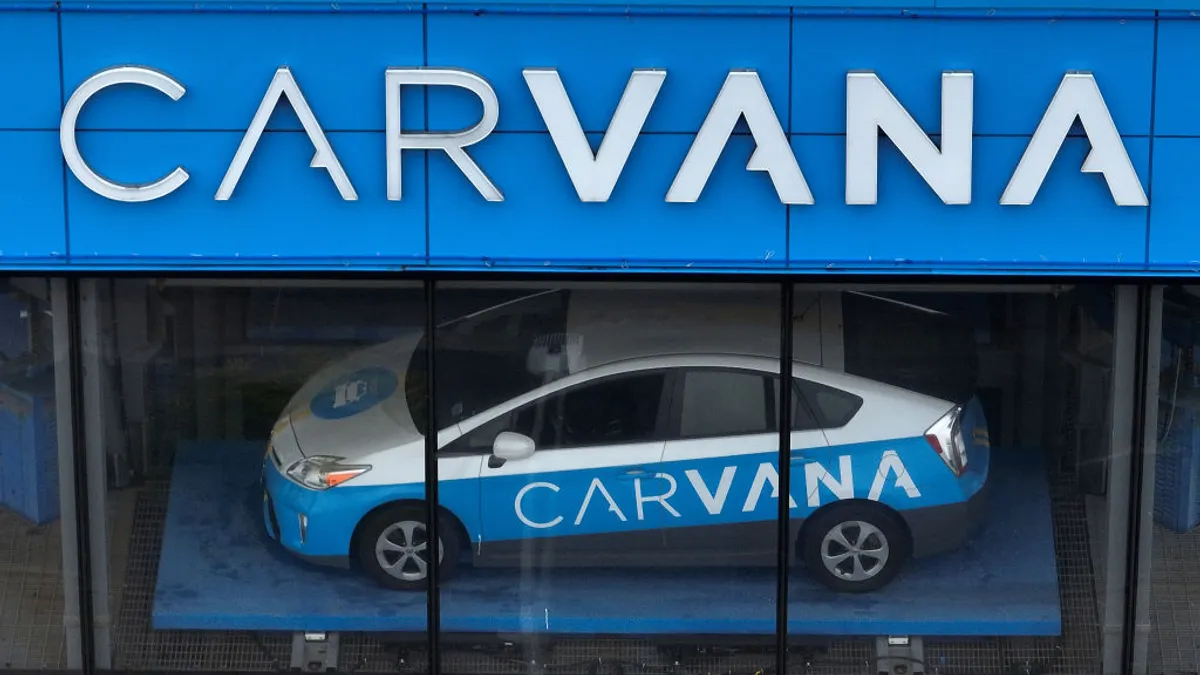
Giant used-car retailer Carvana continues to add used-car inventory — a first step in a virtuous circle, according to CEO Ernie Garcia III.
The short version goes like this: Provided Carvana delivers “great experiences” for customers, more inventory creates more sales. More sales make marketing more efficient, and therefore more affordable. More advertising and marketing create more demand. More demand necessitates more inventory. Repeat.
Behind the scenes, the plan calls for Carvana to get more efficient at shipping, logistics and reconditioning. Carvana is also integrating its operations with its ADESA wholesale used-car auctions subsidiary, which Carvana acquired in 2022, including 56 U.S. locations. Carvana is adding Carvana-style, retail-ready reconditioning capability to ADESA auction sites and adding ADESA-style auction capabilities to its existing Carvana reconditioning centers.
“I think, the way that we try to think about this is, we’re trying to build a big machine. That machine delivers great experiences, it kicks off great unit economics,” Garcia said in a July 29 conference call to announce results for the second quarter of 2026.
Carvana, based in Phoenix, set all-time records in the second quarter for revenue, net income and retail units. Total revenue was about $7.4 billion, an increase of 52% compared with the second quarter of 2025. Net income was $513 million, up 66.6%. Retail units sold were 197,325, up 38%. On the downside, gross profit per unit was $7,014, down 5.4%.
Driving the top-line improvement was used-vehicle inventory of about 77,000 units offered for sale online as of June 30, up from about 75,000 units as of Dec. 31, 2025. It was 53,000 a year earlier and 33,000 at the end of 2023. Carvana acquires used-vehicle inventory directly from customers, from used-car auctions and from wholesale used-vehicle suppliers, according to its quarterly report.
Garcia said he wished inventory was even higher. He said in a Q&A with Wall Street analysts: “Inventory has undergrown sales over the last several months, and that certainly creates a headwind to just the overall business. The team’s got a great plan, and we’re confident they’ll catch up and hopefully surpass it in the not-too-distant future. We got to make sure we do that and execute. That, I would say, is the primary objective today in that group.”
In the second quarter of 2025, Carvana announced a goal of selling 3 million used cars annually “within five to 10 years.”
Meanwhile, in a move that’s controversial among some other franchised, new-car dealers, Carvana in 2025 purchased five new-car dealerships, plus another two in the quarter just ended — all Stellantis-brand stores.
Responding to questions from analysts, Garcia said only that it’s too early to tell much about the effect of new-car sales on Carvana, including whether new-car trade-ins will have a material effect on used-car sourcing for Carvana’s used-car locations.
“I think it remains very early. We still are going to wait till we have a lot more data to share a lot more with you all,” Garcia said. He did say that net promoter scores — that is, the percentage of new-car customers who would recommend Carvana to others, minus those who wouldn’t — are “very high” for Carvana’s new-car dealerships.