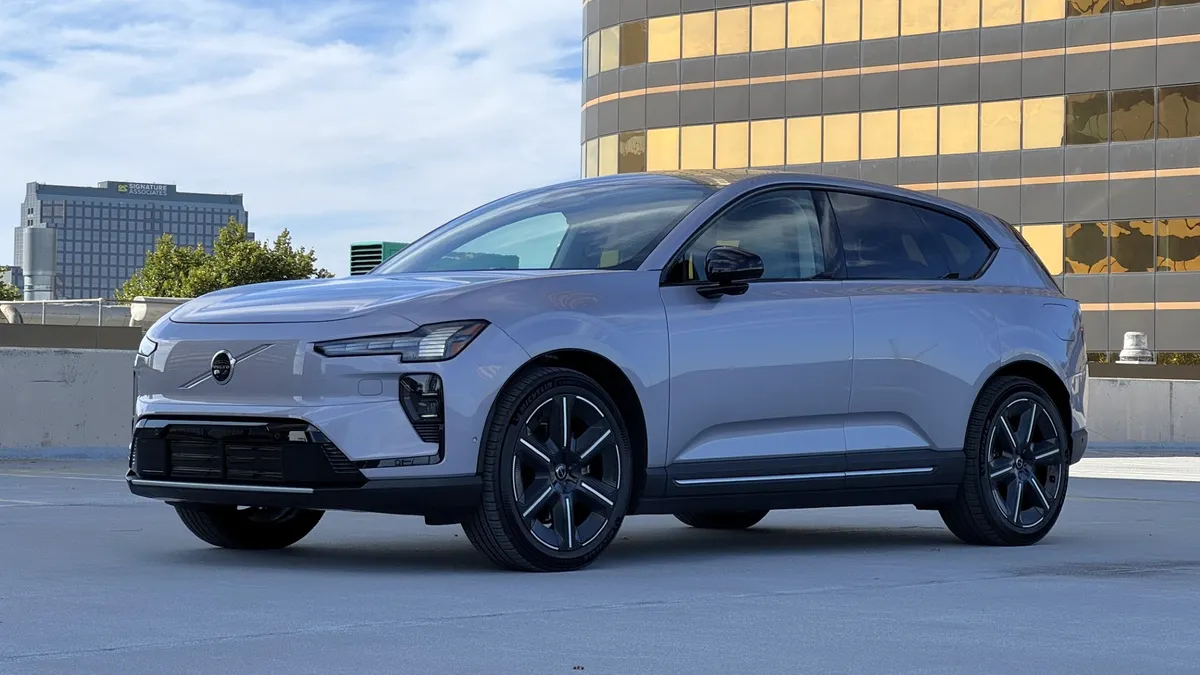


Mitsubishi’s new EV wears badges once fit for some of the edgiest tuner cars. But in up-close time last month around Seattle, WardsAuto found the Eclipse Sportback EV to be everything but that: quiet, refined, confident and comfortable.
That’s a good thing. In that lens, the Sportback EV impressed as the kind of daily driver that might better serve urban commuters than gasoline or even hybrid crossovers — if the household has access to daily charging, that is.
The relatively low-volume Sportback EV is essentially a soft launch for a refreshed, much-expanded set of Mitsubishi products for the U.S. Heralded by its Momentum 2030 plan, the EV is set to be followed by a more rugged Outlander variant early next year, a pickup and potentially another SUV.
Nissan has delivered hundreds of thousands of Leafs across continents, and a third-generation Leaf just arrived last year. Very few of the new Leaf’s fundamental traits have changed for the Sportback, and that’s a good thing.
With prices revealed this week in a press release, the Sportback EV has a U.S. price tag that neither calls it out as a bargain nor prices it up versus the Leaf. It costs $39,740, including the $1,995 destination fee. Add the Sportback EV’s only option, the $2,600 Technology Package — bringing an electrochromic sunroof, Bose 10-speaker audio, a power liftgate and roof rails — and you end up at $42,340, positioning it above the entire Leaf lineup.
That’s comparing 2027 Sportback EV to the 2026 Leaf. The base 2026 Nissan Leaf starts at $31,565, including its $1,575 destination fee — $8,175 less than the Mitsubishi EV’s entry price — and it runs up to $40,565 for the top Leaf Platinum+ version, which tops out at $41,565 with two-tone paint.
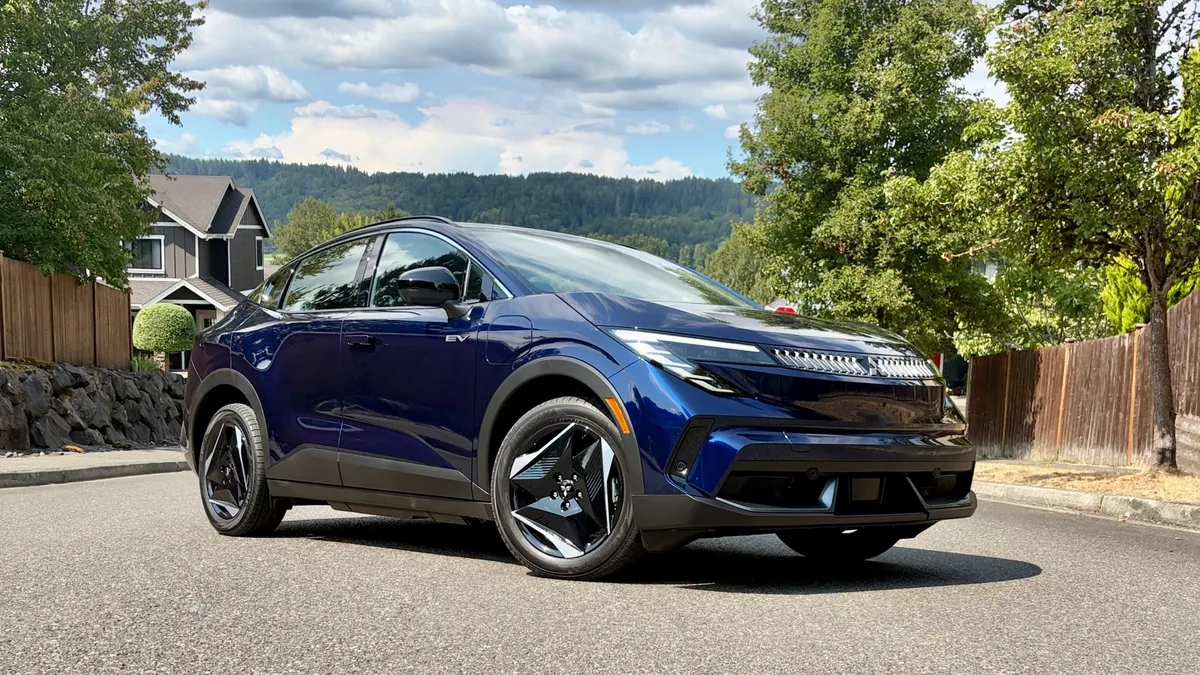
While the Sportback EV has exactly the same roofline, doors and fundamental proportions, and it’s made in Japan all the same, Mitsubishi has tweaked its front-end styling extensively to arrive at a sharper, more rakish look versus the Leaf. Meanwhile, from the rear, the Sportback looks more like a hatchback coupe than the Leaf. There are also different wheels versus the Leaf, and various pattern and color changes inside the cabin — although the shape of the dash, the sculpting of the seats and more are all the same.
Follows Leaf strengths for range, charging flexibility
The Sportback EV also picks up on Leaf strengths and doesn’t miss a beat when it comes to charging. From a 75-kWh liquid-cooled battery pack, it gets a driving range of up to 282 miles and a DC fast-charging time from 10%-80% in as little as 35 minutes at up to 150 kW — so it’s ready for weekend road-trip duty, too.
Especially of note is that the Sportback EV, again like the Leaf, offers a dual-port approach to charging. It has a Tesla-based NACS connector, only to be used for DC fast-charging, on the front passenger side, while there’s a J1772 connector for Level 2 charging on the front driver’s side.
Like the Leaf, the Sportback EV comes in front-wheel-drive, single-motor form only, delivering 214 hp and 261 lb.-ft. of torque. Acceleration from 0 to 60 mph takes about 7 seconds, which isn’t particularly quick for a modern EV but will beat any of the original non-turbo Eclipse sports cars in a stoplight race.
It’s certainly more exciting to drive than the automaker’s last EV, the i-MiEV, a space-efficient yet no-frills hatchback that was discontinued after 2017 and then offered just 59 miles of U.S. EPA range.
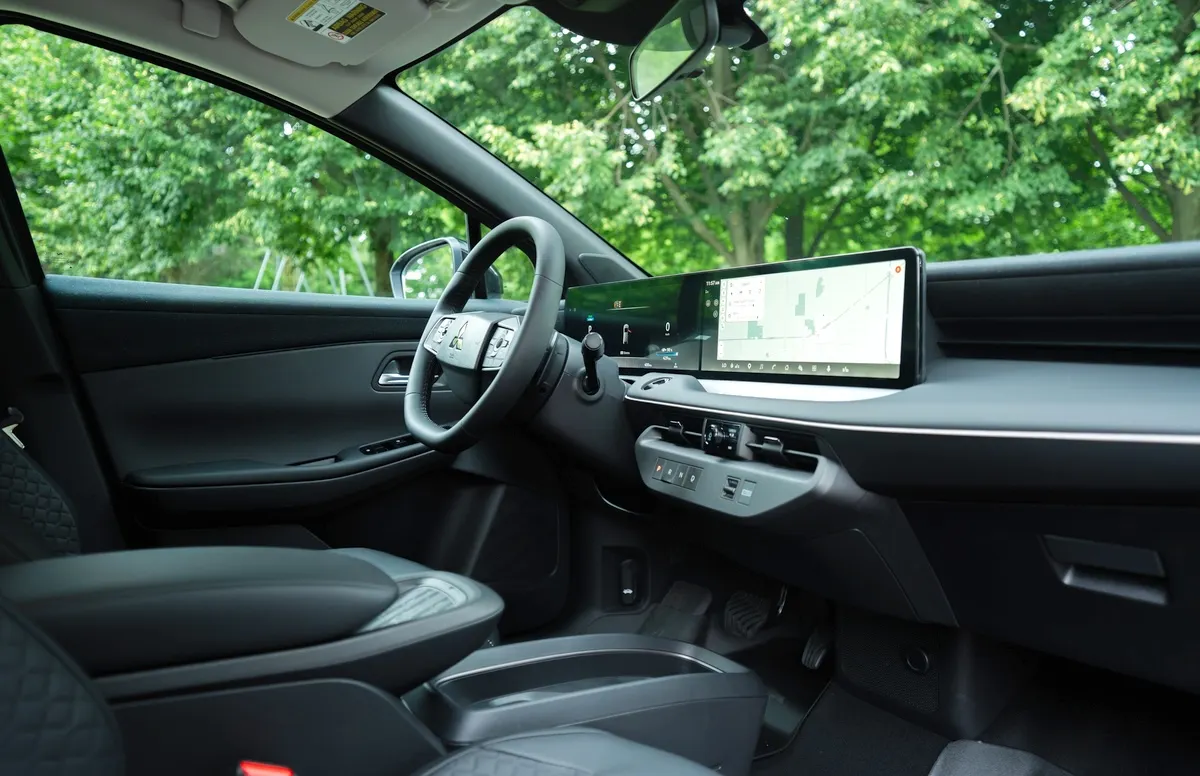
A gem of a daily driver
Just like the latest Leaf, the Sportback EV impresses as a gem to live with, offering impressive cabin materials versus other affordable vehicles plus a smooth, super-refined, luxury-like driving experience. It straddles the line between comfortable and quiet yet nimble in a way that’s perfect for the mission.
Within my first mile or two of driving the Sportback EV, I’d gone through two roundabouts and got a sense of how easy it is to drive and maneuver. The way it accelerates smoothly and regenerates predictably when you lift the accelerator reflects Nissan’s years of getting the interface right in the Leaf.
You can fine-tune it, too; a click of the left paddle orders up more regen braking — signaled by a down-arrow on the instrument panel. Four of those signals the deepest level of regen, or press e-Step, which brings you quickly down to a stop without the brake pedal for all but the strongest stopping needs. The only off-putting detail, to some EV drivers, will be how it creeps forward like an automatic-transmission model if your foot is off the brake pedal.
On backroads in the outer suburbs of Seattle and surrounding Cascade foothills, it provided the hushed experience of a luxury vehicle, without any detectable wind noise around the mirrors or gear whine with the motors, as you tend to notice more in an electric vehicle. It’s this ease of the steering-handling-braking interface that I love about the Sportback EV — and Leaf. My least favorite control detail, on the other hand, is the shift-button layout, which feels oddly placed and might be easily confused in the back-and-forth of getting into a tight parking spot.
The Sportback EV is just 173 inches long, and it rides on a 106-inch wheelbase — making it a compact vehicle by American standards. Rear seats fold flat and allow a good amount of space behind the front seats. That might be the best use of them much of the time unless kids are sitting in back; while there’s plenty of space in front, back-seat space is tight on kneeroom unless those in front can slide forward; this isn’t the sort of car that comfortably fits six-footers behind six-footers —although those in back do get climate-system vents.
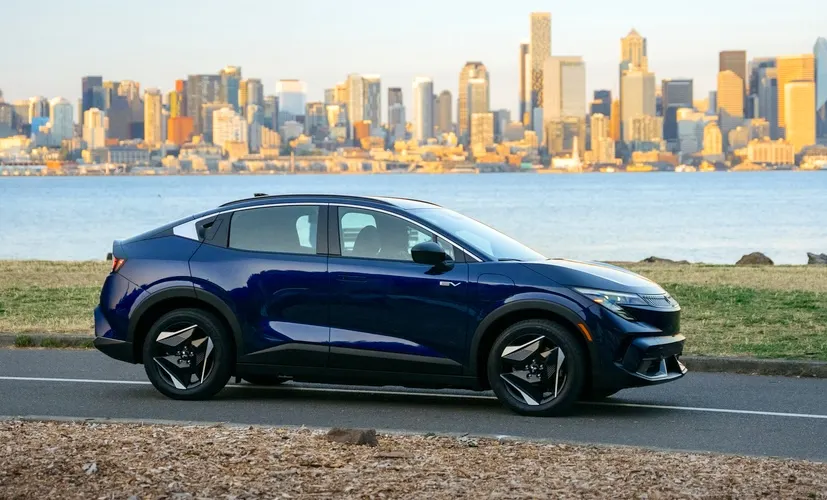
Lots of pragmatic points, a bargain still taking form?
But there are a couple of substantial differences that savvy shoppers are likely to lock onto. One of them is warranty: The Sportback EV has a 5-year or 60,000-mile vehicle warranty, while the Nissan Leaf’s warranty is for three years or 36,000 miles. And its battery and EV system are warrantied for 10 years or 100,000 miles, versus 8 years or 100,000 miles for the Leaf.
All Sportback EVs also include a heat pump, which will help keep the cabin warm in winter weather without cutting into efficiency and driving range. The Sportback EV’s battery pre-conditioning system is linked with this and with navigation routing, with the battery temperature optimized for the quickest charging possible.
That’s a little confusing, as while the Leaf is offered in three different trim levels, Mitsubishi plans to offer the Sportback EV in just one — which means that it wraps in a lot of the most desirable features as standard, including a power driver seat, heated steering wheel, a heated front seat and heated outboard rear seats. The 14.3-inch infotainment system includes navigation and an around-view monitor, plus Apple CarPlay and Android Auto compatibility, and there’s a wireless phone charger. There’s also Google Built-in, bringing that whole ecosystem of apps — although if you use the latter, or some of the Sportback EV’s remote features like climate-control preconditioning, you’ll need to tap into the vehicle’s connectivity.
The Sportback EV is compatible with a Vehicle-to-Load accessory that will allow owners to use the charge port as a power outlet for accessories, tools and more while the vehicle is closed. Mitsubishi is also including a CCS to NACS converter and a charging cable good for 120V or 240V. Without any options or adapters, it includes one 120-volt outlet in the cargo area and another one in the second row.
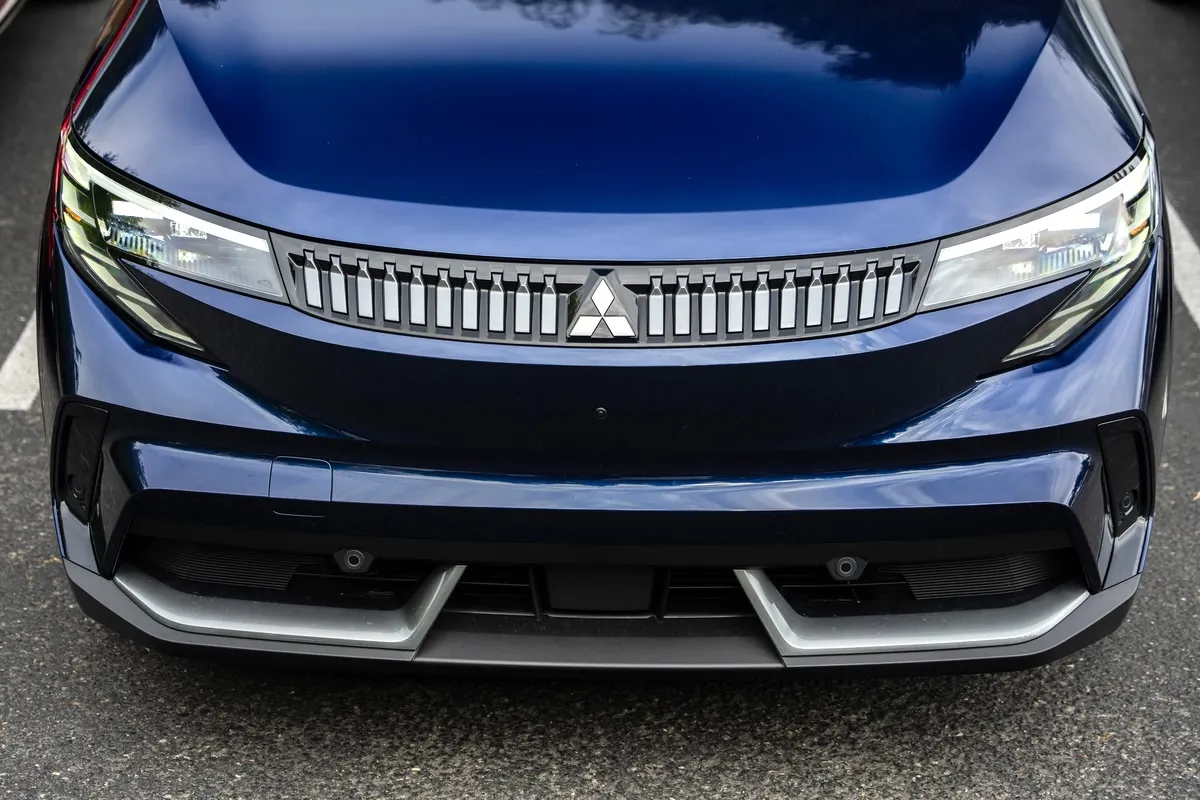
Mitsubishi lets you choose from five rather mature-looking colors; no splashy bright hues here, although I liked the way the appropriately named Midnight Blue of my test car looked as the sun hid behind clouds.
Mitsubishi does actually think a substantial chunk of those interested in its Sportback will also have checked out the Nissan Leaf. So it truly does come down to which styling details you like — or which dealership.
The Sportback EV is set to arrive at U.S. dealerships in October. And as this leaf falls for Mitsubishi, it’s the start of a new season.