Dive Brief:
- Electric vehicle maker Rivian reported consolidated revenue of $1.6 billion in its second quarter earnings released on July 30, which is a 27% increase compared to the same period last year.
- The revenue included $1.1 billion from its core automotive business and $515 million from software and services, $308 million of which was attributable to Rivian’s joint venture with Volkswagen Group, CFO Claire McDonough said during the company’s earnings call.
- Despite higher revenue, Rivian reported a loss of $36 million in Q2 compared to a much larger loss of $335 million in Q2, 2025. The improvements in Q2 were mainly due to an increase in delivery and production volumes, revenues of $108 million related to regulatory credits and an IEEPA tariff refund receivable, which helped to partially offset the costs associated with the launch of its new R2 SUV.
Dive Insight:
Although Rivian continues to narrow its losses, which were $62 million in Q1, the company has never turned a profit and executives expect headwinds to continue as Rivian navigates an uncertain EV market. The company delivered 12,194 EVs to customers in Q2.
During Rivian’s earnings call, McDonough cited external cost pressure, including macro and geopolitical factors, which she said are creating “added complexity, cost and uncertainty.” She also flagged increasing commodity and memory costs associated with Rivian’s autonomy platform.
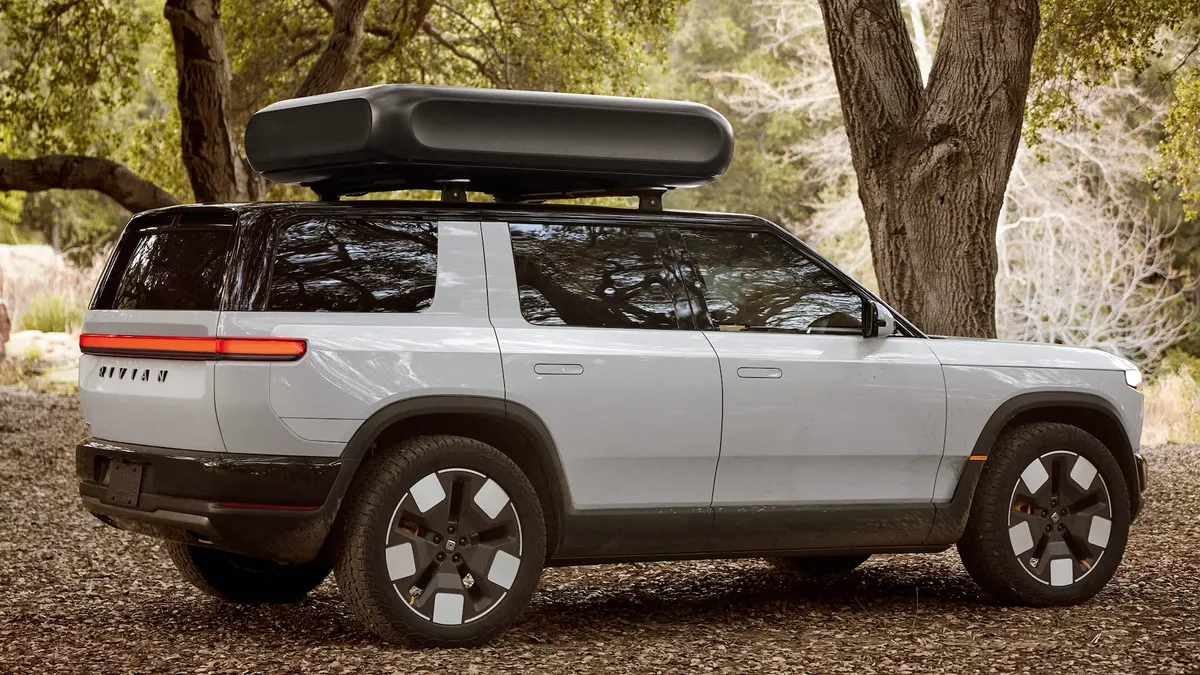
McDonough also referred to 2026 as a “transition year” for Rivian as it continues to scale production of the R2, which she warned may impact the company’s financial performance in Q3 before the company sees improvement. McDonough said Rivian recognized approximately $100 million in incremental costs in Q2 due to the ramp-up of R2 production.
“We expect the complexity of a new vehicle launch will negatively impact our automotive gross profit in the third quarter, before becoming a benefit for our overall operations in the fourth quarter as we ramp production and deliveries,” McDonough said.
McDonough said Rivian’s management emphasizes exit rate improvement for its full-year profitability progress. “We continue to expect that R2 will achieve a positive gross profit as part of our exit rate for 2026,” she said.
Boosted by the R2 launch and an increase in deliveries, Rivian also raised its full-year guidance. The company is targeting deliveries of 65,000 to 70,000 EVs this year, up from the previous target of 62,000 to 67,000.
“We expect R2 to be a game changer for our customers and a driver of Rivian's long-term growth and profitability,” founder and CEO RJ Scaringe said during the company’s earnings call. “Importantly, in the U.S. automotive marketplace starved for a high-quality EV choice, I strongly believe R2 is an attractively priced option for everyday adventures that will resonate with a broad set of consumers.”
Scaringe said Rivian expects to add a second shift to R2 production at the end of the third quarter. A more affordable RWD version of the R2 starting at $44,900 is also due to arrive in 2027, according to Rivian’s website.
In April, Rivian announced plans to increase initial capacity at its future electric vehicle factory near Social Circle, Georgia by 50%, from 200,000 EVs a year to 300,000. The company said boosting production capacity at the plant will lead to lower cost per unit and provide significant room for future expansion in phases. The project is being funded by a $4.5 billion loan commitment from the Department of Energy.
Rivian said it has approximately $5.3 billion in cash on hand, plus a July follow-on offering in which the company sold over 86 million Class A shares to raise approximately $1.3 billion. The company also expects to receive $1 billion in nonrecourse debt from its software joint venture with Volkswagen, as well as an additional $250 million equity investment from Uber.
In March, Uber said it will invest up to $1.25 billion in Rivian through 2031 in a deal to add up to 50,000 of the company’s new R2 SUVs to use as robotaxis on its ride-hailing network.