Editor’s note: This is a reported column, in which Steve Finlay periodically explores the relationship between automakers and dealers for WardsAuto.
Many auto dealers bridled when various automakers last decade began pressing them to upgrade and even rebuild their facilities to create a common look.
The idea was to achieve a shared architecture to highlight the brand.
Asked to pony up a chunk of the costs, skeptical dealers questioned the reasoning behind the projects.
It prompted the National Automobile Dealers Association to commission a study that recommended automakers do a better job explaining the business case.
Automakers argued that a shared look for quick recognition was essential for brand identification, like the commonality of McDonald’s restaurants.
Some dealers questioned that.
“Do automakers think people on a road trip are going to say, ‘Oh look, a Chevy dealership. Let’s go in and buy a car,’” said Bill Underriner, a NADA chairman when the dealership-improvement movement had shifted into high gear.
Yet today, many auto-retailing people agree that those facility upgrades have spurred car sales.
Tim Jackson, while president of the Colorado Auto Dealers Assn., worked to slow down the facility-upgrade movement. Now, he believes they’re beneficial.
“A lot of dealers don’t think improving the showroom will sell one more car,” Jackson told WardsAuto. “We’ve all heard that before.”
But sales results debunk the skepticism.
Jackson cited a luxury brand dealer who built a new store (at a better location just off a freeway) from the automaker’s blueprints.
“His sales went up 60%,” Jackson said. “I see that a lot. Almost every time, an upgraded facility increases sales.”
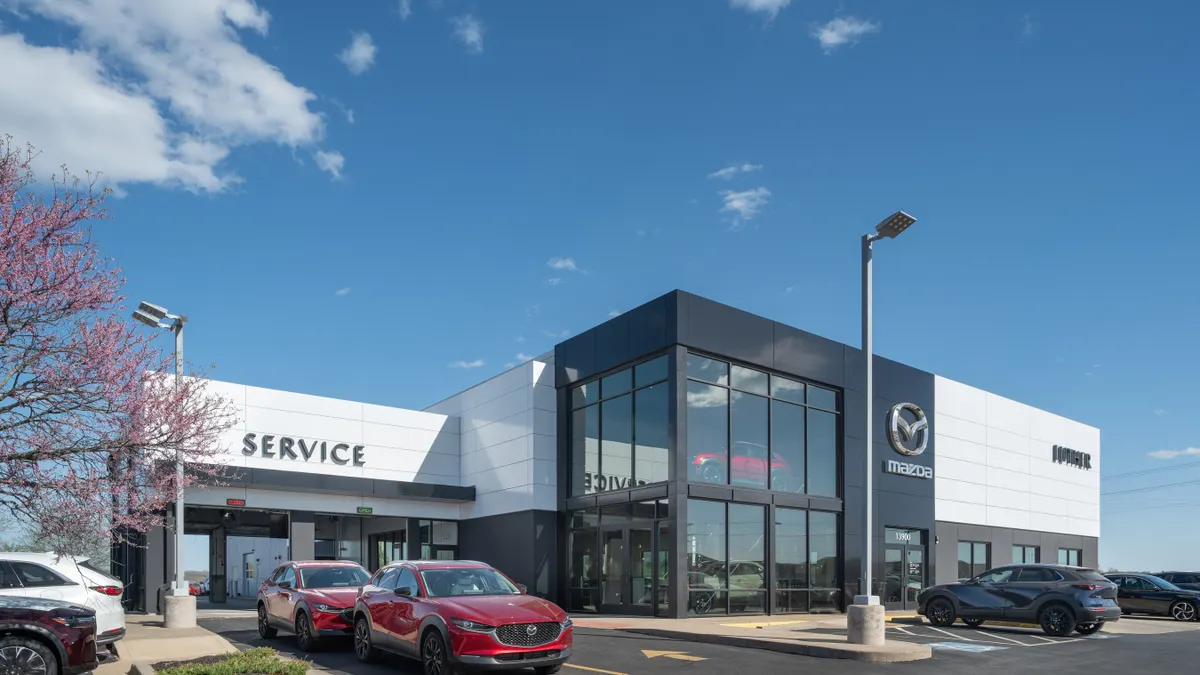
Tim Manning, as senior vice president for retail operations at Mazda North American Operations, helped spearhead a movement to, among other things, improve the look of its dealerships with a unified visual brand image.
“Ten years ago, more than a few of our stores looked like this,” he said, showing a photo of an old Mazda dealership that architecturally resembled a small tool-and-die shop.
“It was not a representation that fit our brand,” Manning told WardsAuto.
Today, 350 of Mazda’s 545 dealerships sport the automaker’s recommended redo that collectively cost $2.5 billion. Those stores account for nearly 90% of Mazda’s U.S. sales.
Another 40 Mazda facility-improvement projects are in the works. Mazda’s U.S. sales of 424,000 units in 2024 were 40% more than they were 10 years earlier, when the automaker’s Retail Evolution project began.
“The new ones have a more sophisticated, warm, transparent and open feel. It’s a better balance of what we want our brand to be,” Manning said. “Dealers have taken to it well.”
They’ve also bankrolled about 80% of the land-acquisition and building costs.
Pine Belt Enterprises, a four-brand dealership group in Lakewood, N.J., bought a Mazda store four years ago. It immediately went to work replacing the old building with a new one.
“It was a no-brainer for us to rebuild the dealership under the new program,” Pine Belt Dealer Principal Rob Sickel told WardsAuto. He’s also chairman of the Mazda National Dealer Advisory Council.
“It’s an absolutely beautiful facility. It allows us to take care of our customers the way they should be taken care of in a well-thought-out place where everything works together to enhance the customer experience,” he added.
The new stores could help as Mazda strives to move more upmarket.
“It opens us up to premium customers,” Manning said. “This is the environment you want for selling a $50,000 or $60,000 vehicle.”
Was it a hard sell to get dealers on board with the initiative?
“Last decade, it would have been harder,” Manning said. “It’s much easier today.”
Pied Piper, a consultancy, just did an inaugural Dealership Facility Consistency Study to see how well individual brands have achieved a common, appealing look of their sales points.
The company used Google’s satellite and street imagery, matched with artificial intelligence, to visually analyze all 18,862 dealerships in the U.S. for its “look-alike index,” Pied Piper CEO Fran O’Hagan told WardsAuto.
However, he said that sometimes it’s fine for same-brand dealerships not to look the same.
“The index is not a judgment,” he explained. “Being less consistent might even be intentional for some brands that may want local flair.”
Conversely, other brands, such as Porsche, dictated precisely how their dealerships look, right down to interior wall colors, he said.
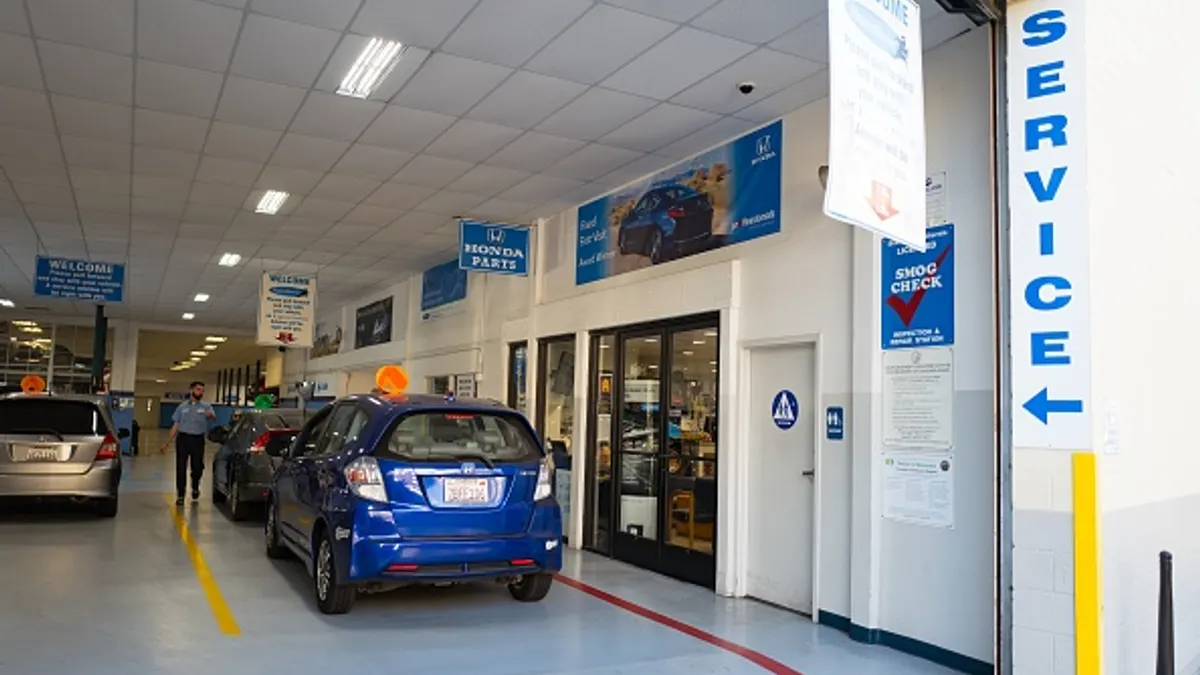
The study’s top look-alike brands were Chevrolet, Honda and Toyota. At the bottom of the list were Polestar, Lucid, Tesla, Alfa Romeo and Fiat.
Some automakers can overreach when it comes to how closely dealership appearances are tied to sales, said O’Hagan, who as a former Jaguar vice president oversaw facility appearances.
Short of not appearing like a dump, does it matter how nice a dealership looks?
“It’s super important, but not necessarily for what a lot of people think,” O’Hagan said. “It showcases product as well as attracts more shoppers, service customers and — just as important — it attracts talented staff.”
So what about the “but” part?
“I’d say a well-trained staff working out of a circus tent will sell a lot of cars, too,” O’Hagan said.