Dive Brief:
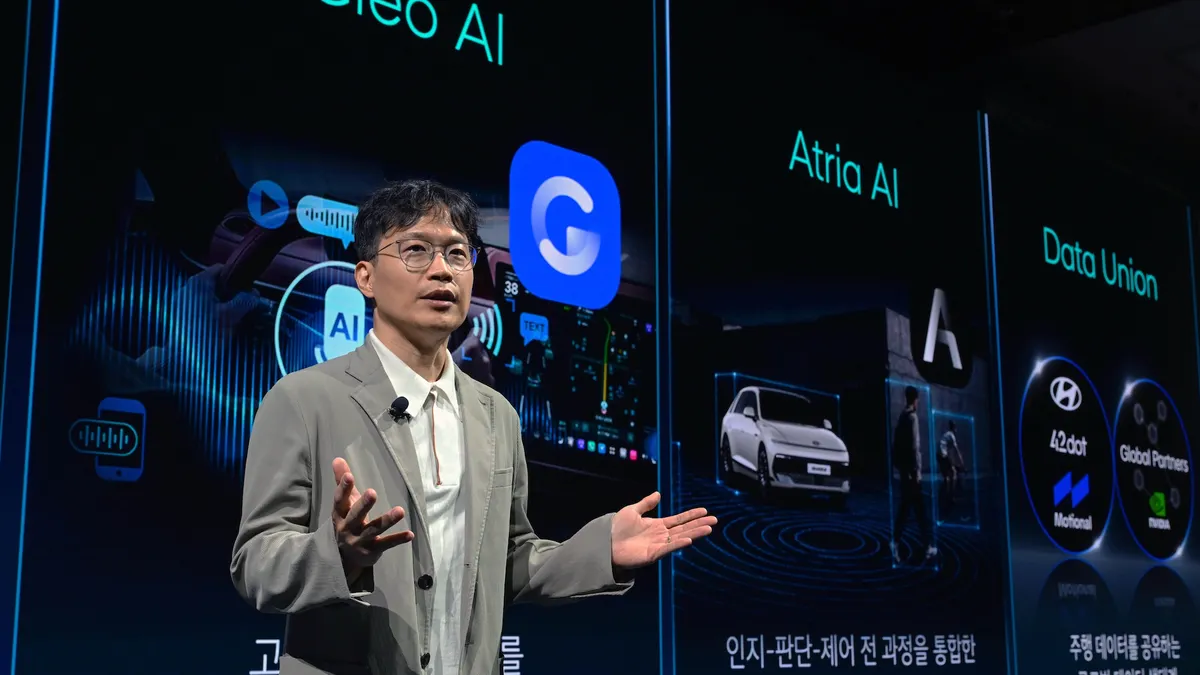
- Hyundai Motor Group is building a “data flywheel” to enhance its software-defined vehicle capabilities, in which it will continuously collect and analyze data from its global fleet to deliver over-the-air updates, including improved autonomous driving capabilities and infotainment experiences, the automaker announced at its 2026 CEO Investor Day presentation on Aug. 26.
- The automaker will then apply its data flywheel to improve its vehicles’ autonomous driving capabilities. Data collection will begin with Hyundai's flagship Grandeur sedan in the South Korea market equipped with the automaker’s Pleos Connect infotainment system and Gleo AI, its new generative AI in-vehicle assistant.
- Hyundai says it will standardize its vehicle sensor architecture around the Nvidia ecosystem so that vehicle data acquired by Hyundai, its affiliate brand Kia, software subsidiary 42dot and its autonomous driving unit Motional can be used consistently by each organization to deliver continuous improvements to the automaker’s future SDVs.
Dive Insight:
In the fields of AI and machine learning, a data flywheel is a virtuous feedback loop, where data is continuously collected and analyzed to make system improvements. Over time, the accumulated data is used to train machine learning models, while the data gets richer and the process, at least in theory, gets more efficient.
The automaker said the data from Hyundai and Kia vehicles will first be analyzed to enhance its Gleo AI and develop new, in-vehicle infotainment features. Gleo AI will be centered on vehicle controls and convenience features, but will be linked with other application services in the future, the automaker said in May.
Hyundai plans to roll out more advanced autonomous driving technology to its vehicles in stages. As part of the automaker’s ongoing collaboration with Nvidia, it will add Level 2+ autonomous driving tech to its first mass-produced SDV in 2028. Accumulated data from these vehicles will be used to advance and update the capabilities of Atria AI, the automaker’s in-house end-to-end autonomous driving system developed by 42dot.
By the end of the year, Atria AI will be deployed on vehicles in South Korea to collect data on unexpected and unusual road situations to train its AI models, which are known as edge cases. Atria AI will eventually be deployed in millions of additional Hyundai Group vehicles to support Level 2+ and Level 4 autonomous driving capabilities. The data collected from the fleet is expected to accelerate AI learning and improve performance rapidly, per Hyundai.
Over the long term, Hyundai aims to add a standardized sensor system and AI computing platform to most of its mass-produced vehicles.
Beginning in 2029, Hyundai said it expects that the amount of autonomous driving data collected from its connected fleet will grow rapidly, so the automaker is building its own large-scale data center to process it.
Hyundai is bringing online its Saemangeum AI Data Center in South Korea, a 100-megawatt facility that can house over 50,000 GPUs, per the company. The data center will also connect data from Hyundai’s global production system and its integrated in-house AI, which it says will help it better compete in SDVs and advance its vehicles’ autonomous driving capabilities.