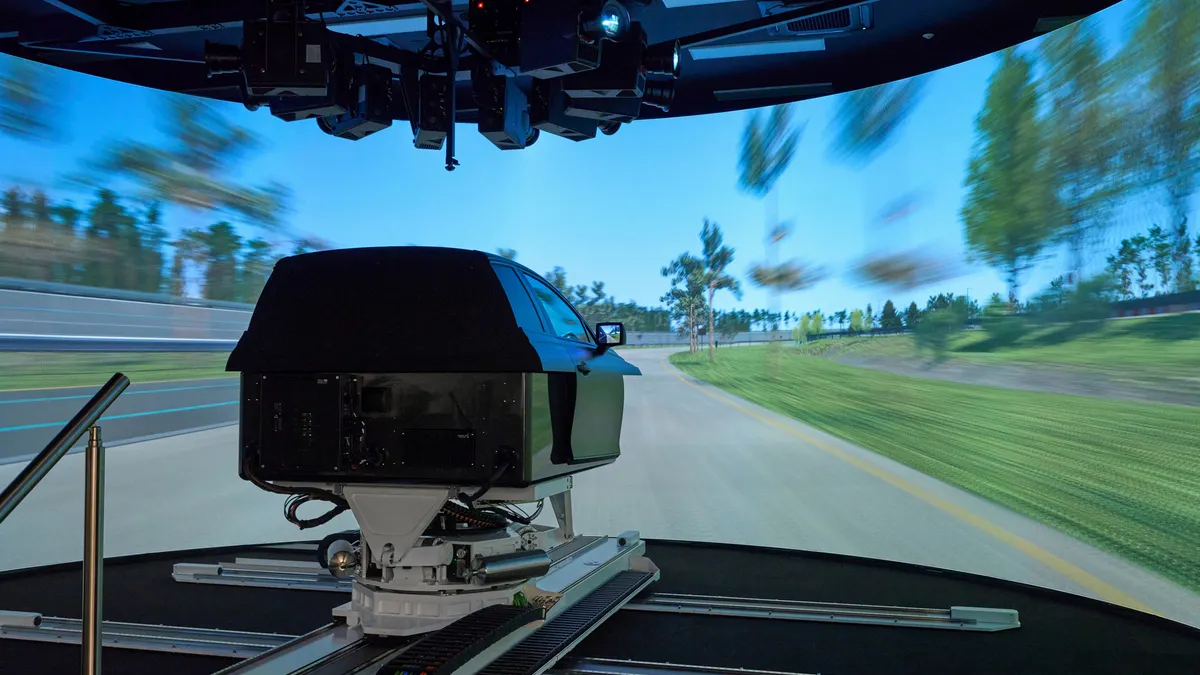
Hyundai Motor Group recently shared a behind-the-scenes look around the newly completed Advanced Driving Simulator at its Namyang Research and Development Center in South Korea. The Driving Simulator can reduce months of rigorous vehicle track testing into just hours using a highly accurate computer-simulated environment, according to Hyundai, in a July 13 press release.
Hyundai said it began working on its proprietary virtual validation platform in 2014, but the value of such a platform was not fully realized until the COVID-19 pandemic, when travel restrictions hampered the automaker’s physical vehicle testing both locally and overseas. Hyundai also said it faced challenges as the complex validation process required to test advanced vehicles had outpaced the limits of physical, on-road testing alone.
Given the widespread adoption of electrification technologies and autonomous driving, plus customer expectations for improved driving dynamics and connectivity, its test engineers faced a paradox. The launch of more advanced vehicle technology requires more physical testing, but the sheer amount of physical prototyping required to conduct these tests can extend vehicle development timelines and budgets.
Hyundai’s solution was to build a Driving Simulator to validate the performance of its vehicles.
The Driving Simulator was developed using the automaker’s own data, software and engineering expertise and took approximately 10 months to complete, from initial construction in April 2025 through to final completion earlier this year, per the release. The simulator also supports co-development through collaborative data-sharing among other global engineering teams for Hyundai Motor and Kia.
Hyundai’s Driving Simulator features a 270-degree curved display and nine 4K projectors. That submerges the engineer in a photorealistic driving environment as if they were behind the wheel of an actual Hyundai or Kia vehicle. It even has a carbon fiber cockpit and production-equivalent steering wheel, seats and pedals for an authentic driving feel, per the release.
The curved displays stream high-resolution road data in real-time without latency to simulate driving on dozens of kilometers of roads. According to Hyundai, it delivers an accuracy level that test engineers cannot distinguish from actual highway driving.
However, managing the enormous volume of data presented a challenge to Hyundai engineers. Traditional approaches would require loading tens of kilometers of road data into the simulator simultaneously, which would exceed its compute capability, according to Hyundai.
To solve this, Hyundai developed a Terrain Server that streams only the immediate surrounding road data needed for the vehicle’s current position. The proprietary technology reduces latency and delivers ultra-high-resolution rendering by only loading data required for the vehicle’s immediate position. The system can update the terrain information in under a second, enabling seamless operation, according to Hyundai.
“The biggest challenge was building the software environment,” said Pilyoung Jeong, Senior Research Engineer for Hyundai’s Dynamics Functional Concept Development Team, in a statement. “We had to reconfigure the vehicle dynamics analysis tools used at Namyang R&D Center for the simulator environment while ensuring real-time operation of the motion platform without latency. It was a highly complex integration process, but the simulator’s exceptional fidelity in replicating real vehicle behavior made the effort worthwhile.”
The simulator also features linear motion to replicate the driving dynamics of a physical vehicle, including forward, back, left, right, up, down and rotational motion, such as roll, pitch and yaw. Turning the steering wheel causes the entire cockpit to tilt and sway — replicating g-forces, longitudinal acceleration and micro-vibrations that drivers would experience in the real-world. Hyundai engineers also added advanced motion feedback that reproduces micro-vibrations that are imperceptible to humans but are critical for validating vehicle suspension systems and tire performance, per the release.
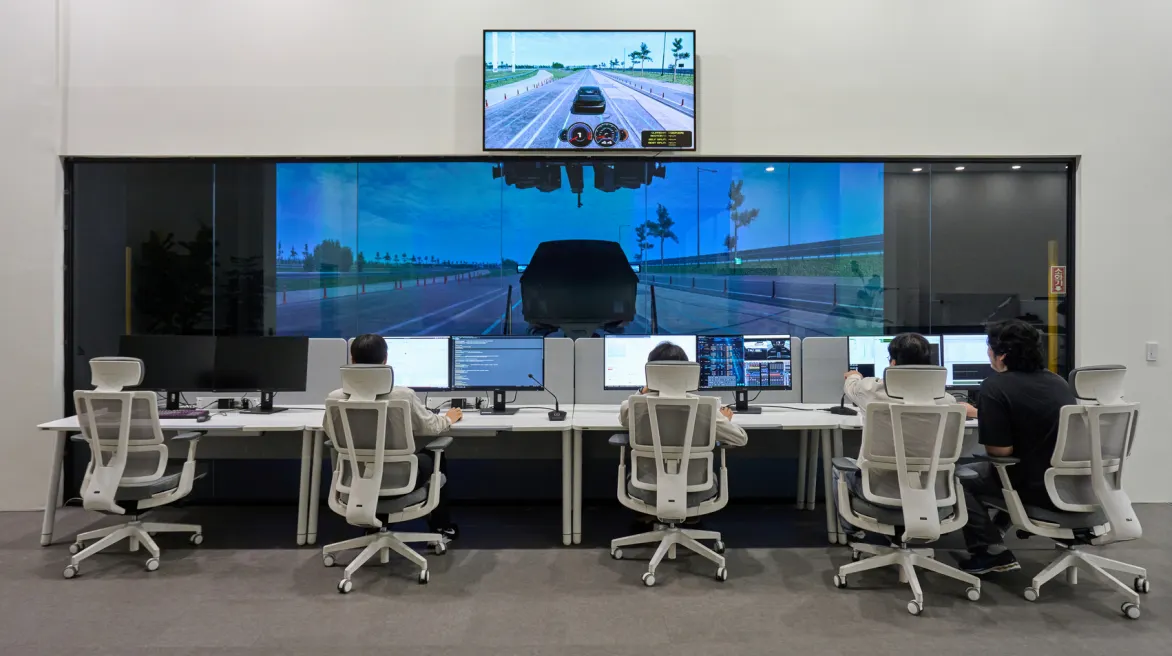
Hyundai said that recreating this level of sensory realism required a complex mapping effort. The automaker’s engineers precisely scanned its Namyang testing grounds in 1-millimeter increments, capturing every minute road surface detail, including asphalt texture, bumps, slope variations and drainage features. This data was then used to create a highly accurate 1:1 replica map of the physical test track for its Driving Simulator.
What used to take Hyundai engineers days to complete on test tracks can now be validated much faster in simulation, including testing dozens of different vehicle configurations without building a single prototype, per the release. Among the models Hyundai is testing are its N Performance electric vehicles, which include the Ioniq 5 N.
“The most important part is helping with faster decision-making,” said Jeong in a statement. “The simulator lets us verify performance improvements before and after changes easily and quickly, which speeds up decision-making and lets us put more effort into making better cars.”