

With ever-increasing dependence on artificial intelligence for automated driving functions, it’s a mistake to think “mapless” systems are the way forward.
That’s the view of Here Technologies’ head of automotive solutions, Remco Timmer, who reverses this view by asking, “Can AI-powered autonomous technology be trusted without a continuously updated understanding of the road ahead?”
Speaking with WardsAuto in an online interview, Timmer believes the future of automated driving is not mapless but “map-smart.”
“There's no point-to-point autonomous driving if you wouldn't know your next destination and if you wouldn't have a route,” Timmer said.
The minimum necessary for automated driving is a navigable route, he explained, with awareness of the road’s rules and regulations, speed limits on those routes and a lot of those things that are not signposted have to come from maps, because they are invisible to the vehicle’s sensors.
“Autonomy is going to play an important role in urbanized worlds where, for a big percentage of the time, the field of view of the of the sensors, whether it's cameras, radar or lidar, is obstructed by the other road users,” said Timmer.
“So, it's actually super helpful to be able to plan ahead, do path planning to position yourself on the road and which lanes are going to go in which direction across intersections and at exits,” he added.
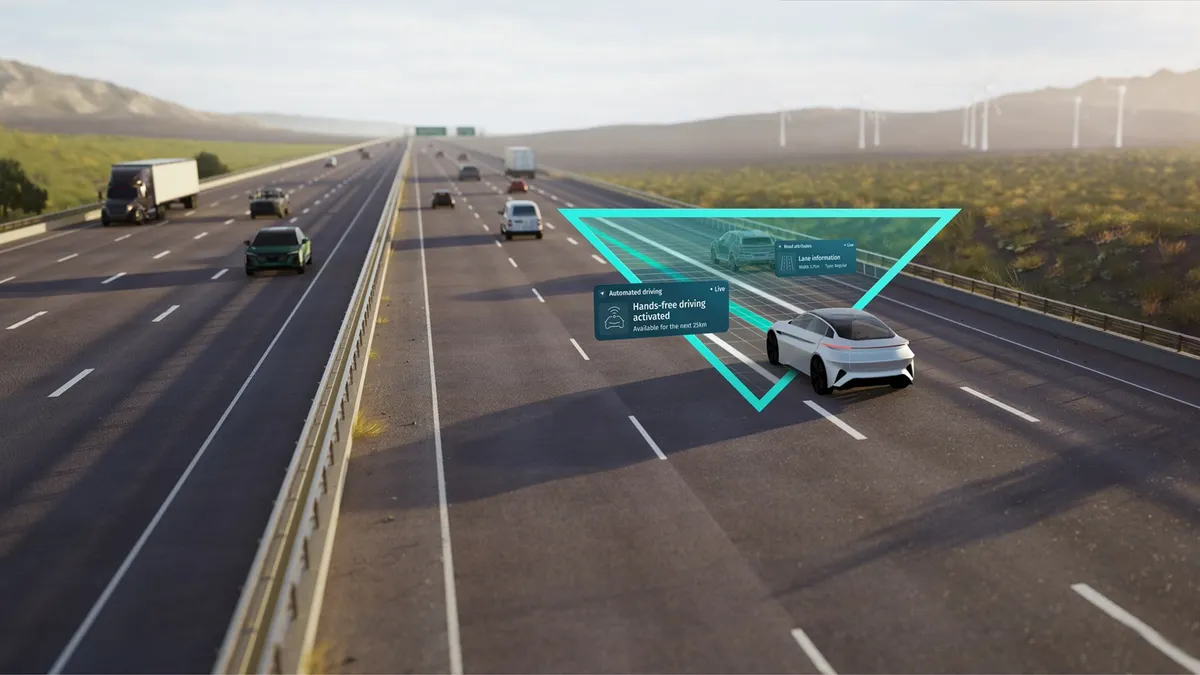
This is referred to as a “continuous lane model,” according to Timmer, which allows an understanding of how many lanes are available and how they transition to off-ramps or on ramps.
However, even so-called mapless autonomous driving systems, that claim to no longer require the high-definition part of the map, does not mean they are truly mapless.
“I think all systems, including all advanced driver assistance systems and the AD systems aiming for point-to-point navigation rely on maps,” said Timmer.
Map-smart
AI will help AD systems to become map-smart enabled where end-to-end AI will play a major role in making these systems more scalable and human-like. But high-definition maps will still provide the foresight, context, redundancy and operating boundaries needed for safe deployment at scale, Timmer said.
This is currently where mapless approaches can fall short, especially around foresight, validation, regulation and edge cases.
“Providing map data as part of the things to consider in sensor fusion is absolutely vital,” said Timmer.
However, lots of different strategies are being explored at the moment by AD systems depending on the sensor stacks and compute power being used.
“So, it isn't being super hard defined yet in the industry. What's the best mix of sensors, compute, logic and map, but the map always plays part in this future,” he added.
Mapless shortfall
In Europe for example, many of the national speed limits are not signposted beyond a speed derestricted sign, which naturally will change from country to country, explained Timmer. “This one area where mapless systems could struggle,” he said.
Again, in dense urban traffic, the field of view of all the perception systems is very often very much obstructed, especially when trying to traverse a complex intersection. “Then, I would say, that even in the development phase, having training environments and scenes that actually originate from the map is super useful,” Timmer said.
“So, for further refinement and training and tuning for your next job, having map-grounded simulation environments is absolutely vital,” he added.
Other real-world scenarios can include simple issues with sun-glare that can compromise the visibility of certain sensor arrays.
“I don't think that anybody aims to build a system that could just run on the map, I think that would also be a risk,” said Timmer. “But I think the other way around is an equally high risk,” he added.
End-to-end AI
Where end-to-end AI can help is in improving scalability, adaptability and more natural driving behavior, according to Timmer.
However, “I think a lot of people admit that it’s more like [a] hybrid, so combinations of multiple models that are trained and then connected through rule sets,” he said.
Timmer explained that many AD engineers are aiming for end-to-end AI, with one large black box that takes all of the fusion data as input and the drive as output, so that AI plays an ever more important role in the brain of the vehicle.
Yet, AI also plays a large role in the way that mapping companies generate and keep their maps fresh and up-to-date.
Humans are still vital in helping to train, tune and curate the output of AI, but most of the updates of the map are fully automated, said Timmer. “We can also start to leverage crowdsourcing effectively the vehicle sensor data that we then process into the map updates,” he added.
Sensor fusion
Timmer says the modern maps used by automated driving systems as part of sensor fusion can help build in resilience and redundancy, because no single sensor can be 100% correct.
“In certain cases you can rely more on the map, in other cases you can rely less on the map,” said Timmer. “In certain cases you can rely more on the camera, in other cases you can rely less on the camera, so that's basically the art of sensor fusion that then feeds into the AD function,” he concluded.