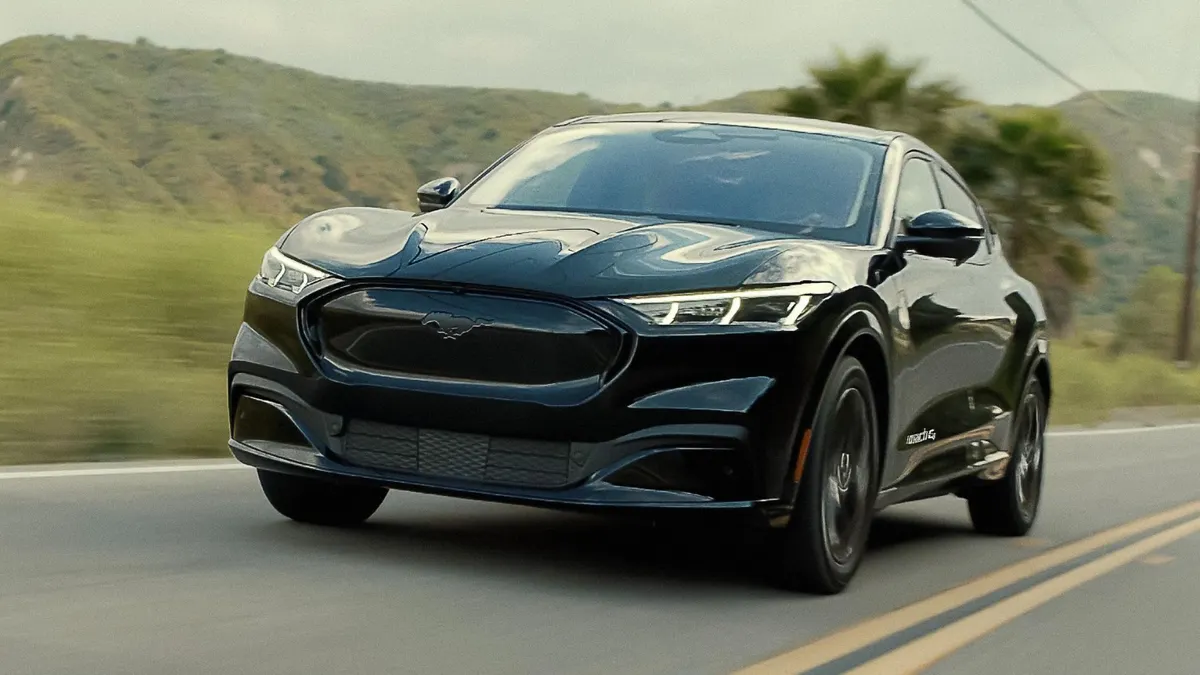
Although demand for new electric vehicles has slowed, used EVs are shaping up to be the segment for dealers to watch in the second half of 2026 and beyond.
That potential of the used EV market to take off was underscored in findings from the latest Manheim Used Vehicle Value Index report, released by Cox Automotive July 8.
“The driver is supply,” said Jonathan Gregory, senior director, Economic and Industry Insights for Cox Automotive, in a webinar the same day, to announce the Manheim Index for June and for the first half of 2026.
That is, the supply of 3-year-old used EVs coming off-lease is about to skyrocket, according to Cox Automotive estimates.
Bigger piece of a bigger pie
Lease maturities in general, not just for EVs, are set to rise, reflecting a comeback in leasing which began in 2023. Most leases are for 36 months.
What’s true for off-lease volume in general goes double for used electric vehicles. Used EVs represent a growing share of all lease maturities, at least through 2028.
Not only that, more off-lease vehicles — and particularly more off-lease electric vehicles — are expected to reach wholesale, dealer-only markets in the next few years, instead of being purchased by the first owner, or by the originating dealer.
Cox Automotive estimates there will be around 3 million lease maturities of all kinds in 2026, up 26.6% from 2.4 million in 2025. Growth is even bigger in 2027, to an estimated 4.3 million lease maturities, up 42.2% vs. 2026.
Within those totals, used EVs represented an estimated 4.4% of all lease maturities in 2025. That share doubles to an estimated 9.9% in 2026, 13.6% in 2027, and 18.4% in 2028, according to Cox Automotive.
Subsidized leases then, higher gas prices now
Besides the all-around comeback in leasing starting three years ago, EV leasing especially took off after the U.S. Congress passed the Inflation Reduction Act in 2022. The so-called “leasing loophole” made many luxury-priced or foreign-made EVs eligible for a $7,500 tax credit that otherwise would not have qualified — but only if they were leased.
Fast-forward three years, and Cox Automotive estimates that EV lease maturities will almost double in the second half of 2026, to 195,446, vs. 105,653 in the first half of 2026. The numbers increase even more in 2027 and 2028.
Which scenario will result from the increase in off-lease EV volume? Will it be a drop in used-EV values because of greater supply, an increase in demand with better availability, or a just-right “Goldilocks” situation?
As for whether dealers should stock up on off-lease EVs, or avoid them, gas prices are likely to have a big influence, according to Cox Automotive.
Jeremy Robb, chief economist for Cox Automotive, expressed cautious optimism in a June 24 briefing that maybe the Strait of Hormuz had been re-opened, and maybe fuel prices would subside.
Stability looked less likely by the July 8 Manheim Index briefing. “Apparently it’s not over yet,” Robb said in the webinar. “As of this morning, it looks like the deal is off and oil prices are rising in response,” he said.
If fuel prices remain elevated, that could support greater demand for used EVs, Robb said.
“Obviously, with these higher gas prices that we saw through Q1 and at least the most of Q2 also, this has definitely driven some more demand in the used EV market,” said Robb, in the July 8 briefing. “We’ve seen that. We measure it several different ways. The 3-year-old used retail EV prices have been moving higher overall as well, even though supply has been going higher.”
Return to sender
Another factor that affects off-lease EVs in particular is that a higher proportion of EV lease returns are expected to go to auction, instead of being purchased at lease end by the first owner or by the originating dealer.
Before the pandemic, it was the usual practice for OEMs and their captive finance companies to employ artificially inflated residual values as a form of lease incentive. A lease customer only has to finance the up-front cost of the vehicle, minus the residual value specified in the lease contract. Therefore, a higher residual value produces a lower monthly payment.
The OEMs did this knowingly, aware that the residual value at lease end — the price of the buy-out for the customer — would be higher than the street value of the off-lease vehicle. That was usually OK for the OEM, which had set aside reserves to cover the difference.
As a result, in the past it was almost always the best deal for the customer to turn in the car at lease end to the originating dealer, and hopefully lease another new car at the same dealership. The dealer would pass the off-lease unit back to the captive finance company, and the captive would send it to a wholesale auction.
But resale values went through the roof during the new-car shortage. It didn’t take customers and dealers long to figure out that they were better off purchasing the unit for the residual value which now was way too low.
That situation is starting to go back to normal, and return rates for off-lease vehicles are on the rise. That’s especially true for off-lease EVs, because their street value fell proportionately, when the $7,500 new-EV tax credit expired.
Here’s a real-life example of return rates, from separately reported results from Ford Credit.
In the first quarter of 2026, the captive said that for all lease units, including all powertrains, its lease return rate was 48%. That was compared with a recent low of 39% in Q2 of 2025. At the same time frame, its lease share of retail volume grew to 24%, up from 21%.
However, in pre-pandemic days, such as Q1 of 2019, the Ford Credit lease-return rate was 80% — more than double the lease-return rate in Q2, 2025.
All in all, Cox Automotive said, conditions point to a huge increase in off-lease EVs reaching wholesale auctions. Robb said, “these units are highly underwater relative to the market overall.”