

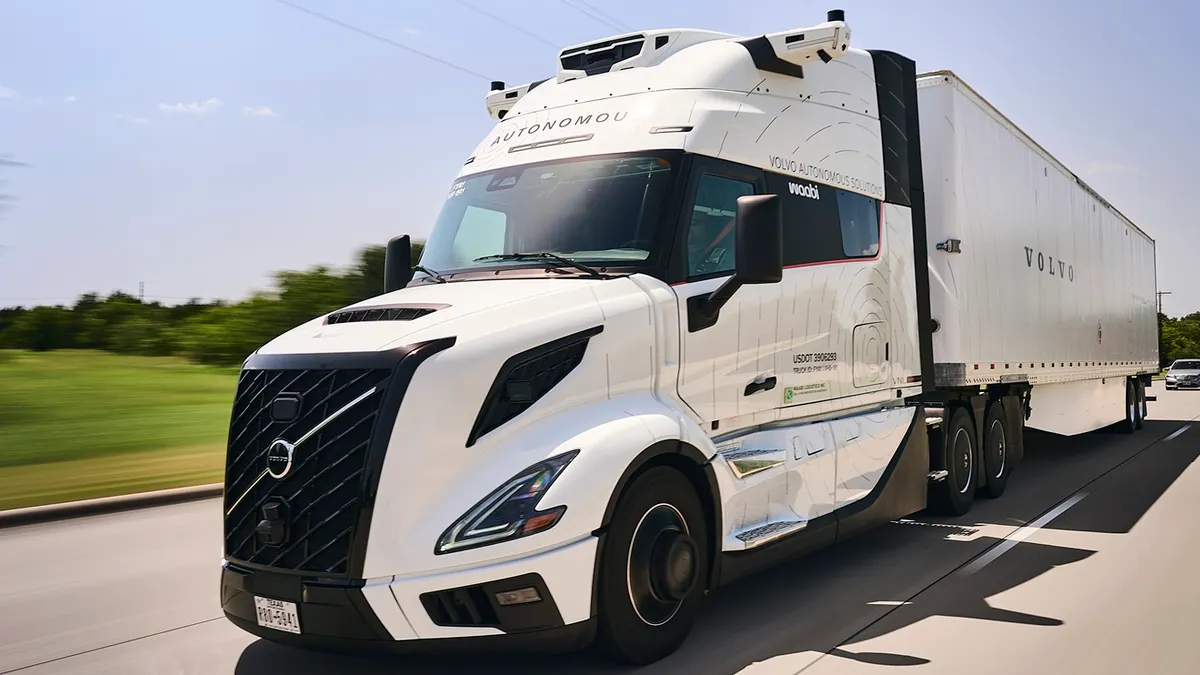
Lessons in self-driving truck technology acquired in the U.S. gives Volvo Group’s autonomous team confidence their systems can be rolled out into Europe in the near future.
Ingor Stürmer, head of Volvo Autonomous Solutions, told WardsAuto that the biggest challenge for Europe is the multi-nation make up of the region with a myriad of different transport regulations
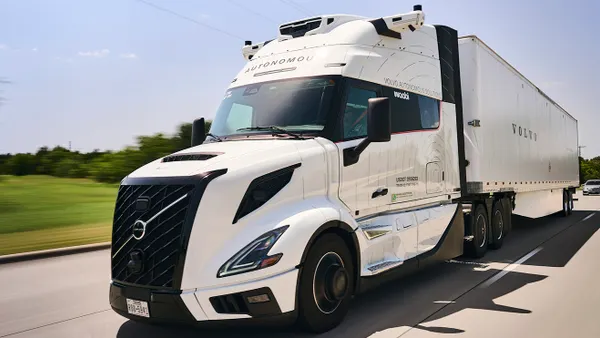
Volvo Autonomous Solutions has been working closely with autonomy partners to equip trucks in the U.S. and Canada with self-driving technology, such as the Aurora Driver or Waabi Driver. Many tests currently include a safety driver, but earlier this year, the company announced it aims to remove the safety driver and enable fully autonomous commercial runs by the first quarter of 2027.
“We have a purpose-built vehicle for autonomy, our VNL Autonomous truck, which is fully redundant for public road applications, meaning redundant steering, braking, power supply, and compute,” he said in an online interview. “Everything you need for full redundancy for safety critical applications,” Stürmer added.
However, he admits the situation is different in Europe where Volvo has to operate in confined areas and non-public roads.
“When you're on a public road, the vehicle itself needs to solve, technically, everything by itself, because you don't have an influence on the infrastructure or how people behave around you,” explained Stürmer.
Yet, he believes the cost-saving use-cases that can be proven in the U.S. will bring about a change in approach by European regulators.
The transport of fresh goods from San Franscico and Los Angeles to New York, for example said Stürmer, can take up to five days and illustrate the advantages of driverless trucking versus manually driven trips that require regular breaks for human drivers.
“When you do everything fully autonomously, you can halve that time down to two days,” he said. “That, of course, is a game changer in terms of logistic flows and transport for onward transport,” added Stürmer.
However, the number of different nations in Europe causes real challenges for driverless technology where a journey may involve two or three different countries all without harmonized transport standards, he pointed out.
This answers why the U.S. offers a lot more speed in scaling up autonomous driving projects from testing to commercial services in a shorter time scale.
“It's actually a very practical, straightforward approach that one starts with small areas, corridors where you transport, and then scale it up from there,” explained Stürmer. “In Europe, we have so many legislations in place that hinders this first-growth push that you actually need,” he added.
While current regulations in Europe’s fractured transport network put the region behind the U.S. and China in terms of driverless technology, lessons Volvo can learn from its test programs in these nations should be able to be brought to the Continent.
As and when Europe can harmonize its transport regulations “then, for all autonomous trucking providers, it would be a huge step forward and, of course, for Europe itself,” said Stürmer. “Europe, I still believe, is a technical powerhouse but we need to make sure that we actually can economically scale,” he added.
While this might seem a long-term ambition, it is the commercial advantages of autonomous technology that can, ultimately, tip the balance for its adoption on the continent.
Stürmer explained that logistics fleet owners are primarily interested in the total cost of ownership as a measure of how they can work effectively.
That’s because while an autonomous truck will be offered at a higher sticker price than a manually driven one, it can bring returns in requiring less maintenance over the lifecycle of the unit.
He pointed to Volvo’s experiences of running autonomous trucks in the challenging environments of mining often with working environments in rough terrain.
“We just see we become better off in terms of the need for replacement of parts and service because we're driving more conservatively with these vehicles,” said Stürmer.
Other running costs, such as fuel consumption, are also lower. “So, we see there are commercial benefits on many levels,” he said. “It will be, in the end, the total cost of ownership of these vehicles from a fleet provider perspective or logistics company perspective,” added Stürmer.